
AITKIN, Minnesota
Here in the town of Aitkin, up in Minnesota’s Wild North, folks don’t mess around when it comes to cancer. “We decided we would promote awareness,” explains Elaine Hill, co-chair for the county’s Relay for Life Committee. And they’re doing it. In the week leading up to the town’s big event, Aitkin is draped in purple (the designated color of the American Cancer Society), decorating their shops to celebrate survivorship, drinking purple smoothies, and raising money on a business and personal basis.
 Relay for Life is in association with the American Cancer Society and is billed as their signature [nationwide] fundraising event to be held locally this coming Friday. The money collected “goes to research and to different services that are available,” explained Elaine, “including free wigs, a feel better program” for women and men, and in many cases, when needed, “a free hospital bed”.
But the story of fighting cancer in Aitkin runs deeper than affiliation with Relay for Life. In a town of 1,984, when somebody gets cancer, it’s personal, because everybody knows everybody. In a single day in town I found myself surrounded by stories of survival meets images of hope.
I spoke with multiple cancer survivors, many of whom had benefited by town fundraising events in which the good people of Aitkin stepped forward to help each other out. Silent auctions, live auctions, family and friends not waiting to be asked for help. But more than monetary support, this town truly lends moral support, as one young man explained, “even if it’s just in one person’s life – it’s still a difference in their life and it’s very important to them.”
 At the age of 36, one town cancer survivor, Kathie Smith, a mom of two young children, explained that it was Austin Price, a young boy who was diagnosed with cancer at age 4 1/2, who “paved the way for my kids to handle me being diagnosed with cancer.” “I graduated from high school together with [Austin’s mom] and Austin was in day care with my children. He taught my kids that just because you have cancer [it] doesn’t mean it’s fatal.” Somewhat of a living legend here in Aitkin, Austin, now age 6, has survived a year following eight months of hospitalization and treatment down at Children’s Hospital in Minneapolis. “He’s made it,” beamed Kathie, fighting back tears.
 When asked for advice for others who might be fighting for their very lives around the world, Austin, moving between examining the camera and sitting on his mother’s lap, rubbed his head before answering: “Be strong” – to be followed by the simple, hard fought admonition – “be brave.”
 “It was a surprise to get the award from the Minnesota Small Business Administration but also a bigger surprise to be invited to Washington D.C.,” explained Mr. Wells. Upon arrival to the White House with small business award winners from different states, Andy was seated in front as a ‘special guest’ – a guest whom President Obama would address in his speech on the “courage and determination and daring” of great leaders, stating: “It’s what led Andy Wells, a member of the Red Lake Ojibwa Tribe to invest $1300 back in 1989 to found Wels Technology, manufacturing industrial tools and fasteners, and creating jobs near reservations in Minnesota, where he lives.”
 Upon arrival at Wells Technology, which doubles as Wells Academy, it struck me as an interesting concept to put a classroom front and center in the headquarters of a main business office. “Every day is an open house,” explained Mr. Wells. “Every day we’ve got a busload of reservation kids or church groups or even car enthusiast clubs coming around. When the busses pull up you can see who the tough kids are – the ones who smoke a cigarette outside before coming in and hang their head in the classroom. But when we start to show them how our products help shoot flares out of military helicopters and other interesting things, they perk up – they start to ask questions – they start to understand why it is important to learn about math and science.”
 “There is book learning and there is other wisdom,” explained Mr. Wells, referring to the system of ‘elders’ within the Native American community. “The [positive] influences began in my life early – it was neighbors, my parents, my grandparents … A neighbor friend, named Charlie Barrett, who really had no formal education but was a very humble neighbor noticed me running ahead of the adult groups quite often and he said to me, ‘Why don’t you open the door for people when you’re up there.’ At the time I thought he meant the physical door but now when I look back, maybe he meant more. Maybe he was a wise fellow like many of the wise people I’ve met, and he could see that perhaps one day I would be able to open doors of opportunity for people – and now that’s one of my main missions in life – to continue doing things that help other people because so many have helped me.”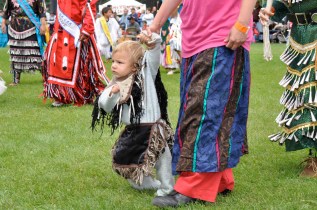
 Veterans, the youth, women, and elders are all honored at this traditional pow wow, now celebrating its 47th year, in multiple ways. Many of which are sacred and cannot be recorded by camera or sound. For example there are the songs of the drums. Each drum possesses within it a song which is special – a song within that only that drum can play.
 What makes this particular pow wow special is that it features approximately 300 dancers and concentrates on the old and the young. My take for a story was to attempt to document how the knowledge of the dance is passed down from the old to the young, from generation to generation.
 And funny enough, when I spoke with Andrew Wakonabo, a winning boy crowned “Mii-Gwitch Mahnomen Brave” from last year, he said the same thing, explaining, “I pretty much learned myself – watching other people dance.” The winning dancers are crowned “brave” and “princess” and their title is more complicated than simply wearing a crown and a banner. Leech Lake Band of Ojibwe Councilman Joe Gotchie explained that once they win, for the entire year they must “demonstrate responsibilities [so] that other youth look up to them.”
 There’s a bond between the old and the young within the Native American community that other cultures can learn from. The Ojibwe historically used complex pictures on sacred birch bark scrolls to communicate their knowledge.

 22 Rivers