
ANGOLA, LOUISIANA
I had no idea there was no perimeter wall at Angola as I canoed along the natural barrier that surrounds three sides of Louisiana State Penitentiary – the Mississippi River. The sun had broken thru the morning mist as I made my way upstream from my camp the previous night on Shreves Bar Island, about one and a half miles downstream. The short upstream trip was work but at long last I reached the prison’s ferry landing. I had read online that this was a ferry for prison guards only, and as such, I had hoped to catch a ride into the prison. The ferry was not operating and I was later told that due to high water, they were using a “crew boat” for foot passengers only, but that this only took place during a shift change.
I was preparing to make the trek up to Angola on foot when I met my first convict “trusty”, Charles Martin. Mr. Martin had driven up in a truck while I was pulling my canoe out of the water and had busied himself working on the ferry structure moored into the banks of the river. When asked how far it was to the gate of the prison, Mr. Martin turned towards the road from where he had just come and replied, “What gate?”
 Angola has transformed itself from what Collier’s Magazine once called “the most dangerous prison in America” into what observers are now calling the safest. According to Warden Burl Cain, this about face has taken place with two words: “morality” and “communication”.
The communication in the prison, afforded by Warden Burl Cain, gives the men a sense of freedom, a sense of hope. It is a psychological barrier that has been taken down – and the men are truly appreciative. From my interview with the warden, I was led to a meeting with the radio station, newspaper, and television station, before being brought to the prison’s hospice, into a room where Richard Vinet was  on vigil, awaiting his death. Mr. Vinet, age 54, whose liver is failing, has been at Angola since 1984 and is officially now “on vigil” which means he was not expected to last the next 24 hours. As I spoke with Mr. Vinet about his love for the radio station and the chance he had had to request his favorite songs, a USA Today photographer snapped photos. When asked what it was that he wanted most to say, Mr. Vinet pointed towards his nurse, as well as one of Angola’s vice-wardens, Cathy Fontenot, stating, “I want to thank these two women here.” According to Ms. Fontenot, “No inmate here dies alone, a stroke of compassion which tends to lead the prisoners here in hospice to the realization of the gravity of their past actions.” When asked for specifics, Ms. Fontenot quoted a late prisoner who had spent time here in hospice as saying, “I realized the last person I was with when they died was my victim,” going on to say, “I’m truly sorry.”
 Warden Burl Cain takes a similar approach when it comes to the men on death row, a people he refers to as “his children”, taking the trouble to hold their hand as they are executed by lethal injection. In so doing, Mr. Cain, who will have worked with these inmates on getting as right as possible with their maker, is able to “communicate” in a wholly different fashion. There is nothing fake or pretentious about Warden Cain. The man commands respect thru his presence alone – when he enters a building. Among multiple people I spoke with, both outside and inside Angola, the idea of Burl Cain as a good and honest guy was unanimous.
Approximately 86% of the 5,000 inmates at Angola are never going home – a sentence of “life” that in the State of Louisiana actually means it. The strategy of Mr. Cain is simply to let these men he has custody over have the chance to better their lives, to communicate, to be men.
 As the sun began to set, I asked to be taken out to the prison’s old cemetery, a place where 1/3 of all those who die here will be buried, having no family or friends to take their remains away. I found a bronze marker set up for the “Unknown Buried Here” with the dedication: “Remember not my name nor my sins nor guilt nor shame; only that I was a man.”
In the end it was two inmates who pushed me and my canoe back out into the Mighty Mississippi. The sun had gone down, and the Mississippi was shiny black, reflecting the lights of the crew boat. I was not afraid. I knew exactly where my island lay, having approached the night before under similar circumstances. There comes a time on this river when you become one with your craft, where the danger of a seriously dangerous river is outweighed by a sense of calm, of a cocoon that envelopes you and lets you know you’re going to be alright. It could very well be due to the fact that I was only a visitor, but I felt this same safety – this same calm feeling the entire day at Angola – my very first day in a maximum security prison. My canoe with my gear in it had been loaded on a truck, and together we heaved it out and into the water. It was a strange feeling to step in and glide away. The convicts whose names I had forgotten to ask waved and wished me Godspeed. The sliver of a moon had broken thru the clouds for a moment and as the current took me, I waved back, feeling a certain camaraderie with the prisoners and their warden, but thankful to be free.

Thanks for making this story possible:
Vice-warden Cathy Fontenot.
My guide for the day was Major Joli Darbonne.
Interviewed for this story on video at the “Ranch House” – Warden Burl Cain.
KLSP (Louisiana State Penitentiary) — a 100-watt radio station that operates at 91.7 on the FM dial from inside the prison to approximately 6,000 potential listeners including inmates and penitentiary staff. The station is operated by inmates and carries some satellite programming. Inside the walls of Angola, KLSP is called the “Incarceration Station” and “The Station that Kicks Behind the Bricks.” Interviewed for this story is KLSP disk jockey Keith Alexander. Mr. Alexander is 44 years old and has been incarcerated at Angola for 21 1/2 years.
LSP TV Station 21 is a one-room television station that serves Angola State Penitentiary. Interviewed for this story: Matthew Morgan, sports editor; and Shawn Vaughn, editor.
The Angolites interviewed for this story are: Lane Nelson, managing editor, age 55, incarcerated at Angola for 28 1/2 years of a life sentence for murder; Kerry Myers, editor, age 53, incarcerated at Angola for 19 years of a life sentence for murder; and Klye Hebert, age 44, incarcerated at Angola for 9 years of a life sentence for attempted murder.
In the hallway of Maximum Security Cell Block D are: Marlo Green and Devon Morris.
Interviewed at Angola’s Hospice: Richard Vinet, age 54, incarcerated at Angola for 25 years.
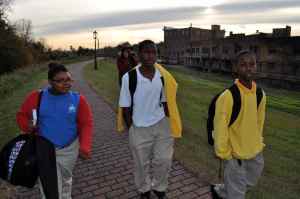 Garon, Fredrick, Brooklyn, and Veronica, four KIPP Charter School Middle School kids from downtown Helena, Arkansas smile as they walk the levee from their school to Mr. Ruskey’s Helena-based workshop. This is their second class at Quapaw Canoes, and even though their friends are catching the bus for home, these kids walk with a stride in their step.
 Mr. Ruskey does not speak in sound bytes. He speaks from his soul and he speaks with conviction. When asked how art, education, and the Mississippi River come together, Mr. Ruskey explained, “They come together with each paddle stroke you take. If you watch the way a paddle cuts thru the water – it creates a double spiral on either side of it – and if you look at the shape of a classic canoe, it’s almost the same shape you see created in the water as you’re stroking the paddle. And that’s the wonderful thing about the Mississippi River and any moving water – but on the Mississippi you see it more than any other body of water I’ve ever experienced. You see expressions of patterns, of life patterns – the very basic patterns that govern our life – you see them expressed, constantly being expressed and then re-created over and over again. And so it’s actually there on the face of the water that you see all those things come together. One of our mottos here is
  that the River brings us together, and in that sense it literally does bring together education and canoes and art – they all come together as you’re paddling the canoe.”
 When Jay and Beth VanWinkle saw that their favorite actor, fellow Mississippian Morgan Freeman, was coming out with a new movie titled “The Bucket List”, Beth turned to Jay and said, “I’ve got to see that.” One year previous, Beth VanWinkle had been diagnosed with Alzheimer’s Disease, and has been, as she puts it, “grasping for everything I could get [out of life – before it’s too late].”
 The film inspired Beth and Jay to write down a short list of ideas they wanted to accomplish before Beth permanently goes into, what she describes as her “cave” – a place where she will be in her very own world.
 In this report, we witness Beth leading the first annual Oxford Memory Walk as well as the story of Beth’s realization of her third and final wish – to ride a horse – a story which she will now be able to replay again and again, as her memory continues to fade.
 22 Rivers