On a recent two-week canoe expedition down a portion of the Ohio River, I had the pleasure to visit and bed down at Harlan and Anna Hubbard’s beloved Payne Hollow near Milton, Kentucky. The Hubbards lived here from 1951 to 1986, subsisting off the land with no electricity and only cistern water. Harlan was a painter and writer and Anna was a librarian and musician. Together, they lived in harmony with the landscape for 35 years. Harlan designed and built Payne Hollow out of wood and stone, along with a detached studio.
“This is the day we begin a new venture, facing now the true direction.” – Haran Hubbard
It wasn’t my first visit to the property. Back in 2021, while paddling up the length of the Ohio River on my cross-continent sojourn, I’d often slog it out from first light until sundown – and beyond. On June 16, 2021, I was pushing for the boat docks at Madison, Indiana just up and around the bend, but came up short. The curtain of night fell, there was a frenzy of tow and barge traffic in the river up ahead, and as I looked to my side, the perfect stealth camp spot materialized.
A spit of land jutted out into the river just so along the Kentucky shoreline. It was flat and inviting, and I happily paddled to the riverside. Pulling my canoe and gear out of the water, I set up my tent, and took a seat along the riverscape, taking in the majesty of the stars and the firmament. It was a special place in my mind – I could feel it – so I marked the spot on my Google maps with a heart. I didn’t then know I was camping on the shore of Payne Hollow.
Payne Hollow by Harlan Hubbard, 1986, Oil on board. On display at the Behringer-Crawford Museum via the Caddell Collection. Photo by Neal Moore.
I’d soon become intimate with the art, life, and story of Harlan and Anna, along with a need to save their seven-turned-sixty-acre oasis connected to the river. By 2022, the property had fallen into a state of neglect. The owner had health issues and was not able to visit as regularly as was needed. There were reports that racoons had invaded the home and that it could soon be destroyed. I’d befriended a group of Louisville, Kentucky academics and artists, along with a separate group of Madison, Indiana concerned citizens who wanted to see Payne Hollow saved. I helped to bring the two groups together, to organize a meeting at the home of Bob Canada of Madison, Indiana, a retired dentist who had befriended Harlan and hosted him until the end of his life. My hope was that the two groups could put their collective experience, expertise, and influence together to purchase and save it. Which is exactly what happened.
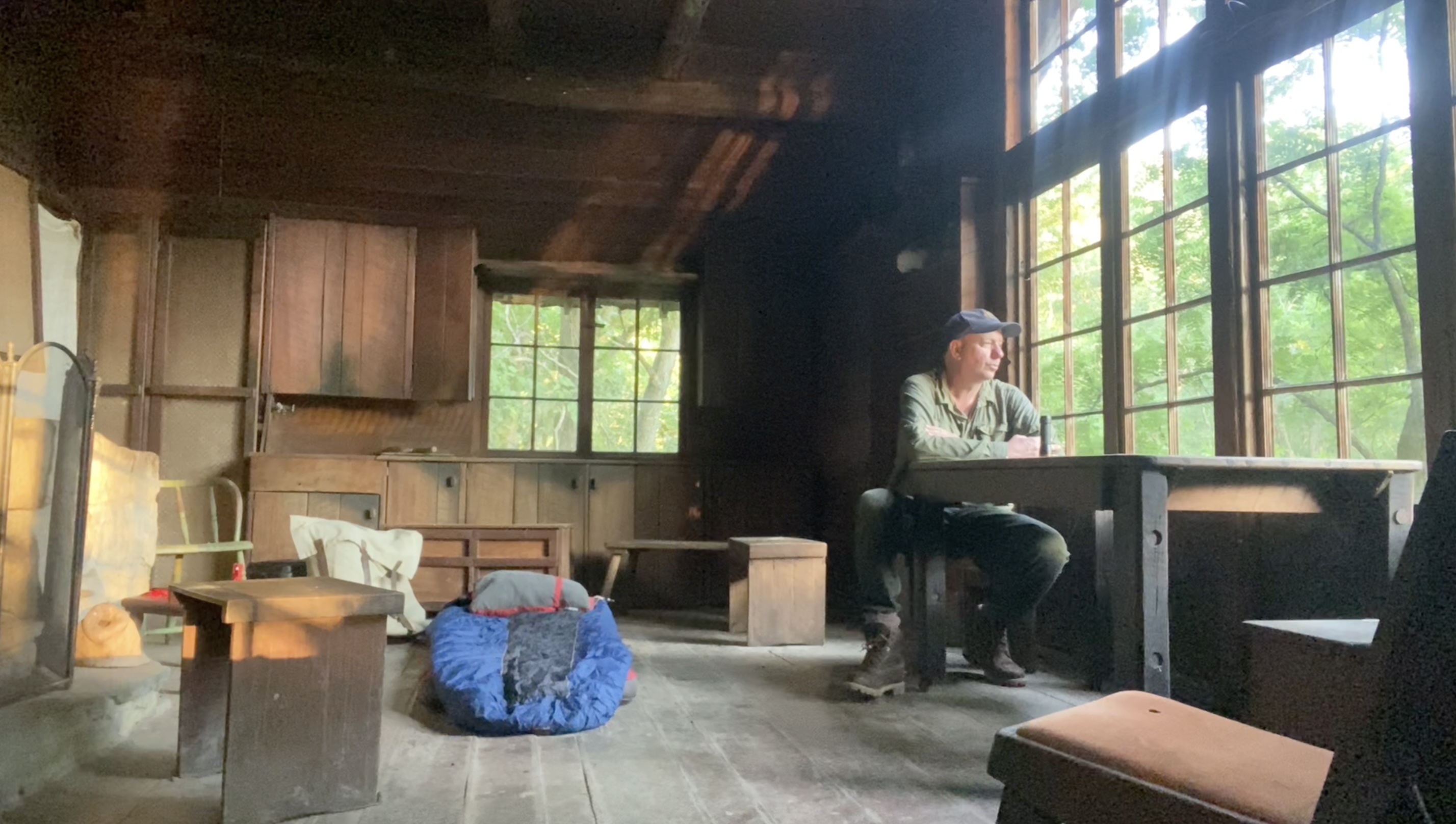
Neal Moore getting ready to bed down for the night inside Payne Hollow on the evening of July 22, 2025.
From my perch of a porch outside the side door of Payne Hollow, the steady flow of the Ohio could be viewed through the trees. As I sat and admired the wildness all about me on this recent exploration down the river, there was a moment, in concert with the sun’s final rays, when I could hear voices. When the trees rustled in a lack of a breeze and I felt the hair on the back of my neck stand up. It was the height of summer and sweltering hot but then it turned cool. I thought of the Wendell Barry-inspired pastoral ghost story opera “Payne Hollow” and the line of Harlan talking about the music that’s just out of hearing. I was sure it was a haunting. And with it the realization the Hubbards are very much still here. And then it passed, and I was at peace once again.
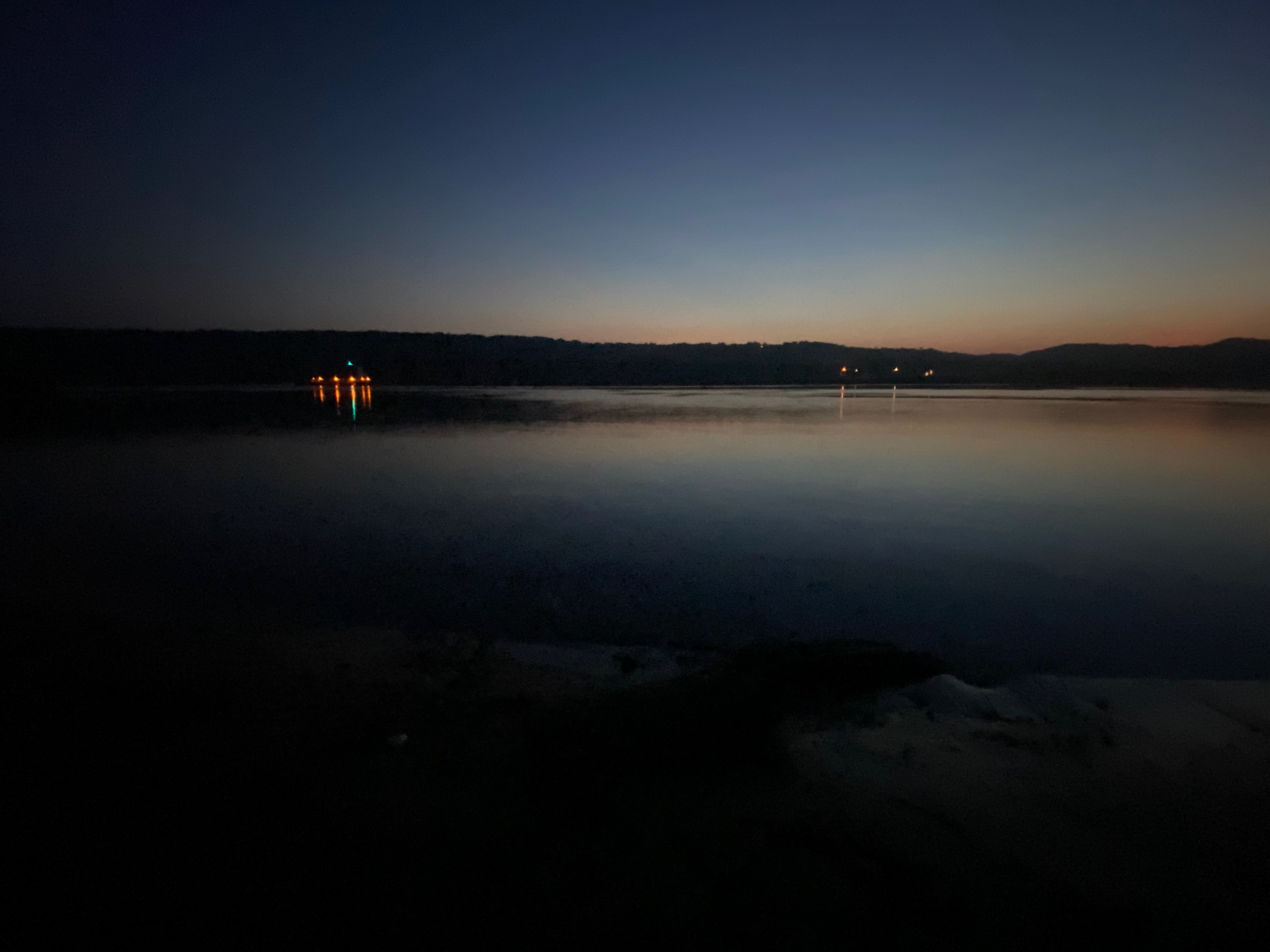
The sun had set proper and there was that golden strip of an afterglow. Just at near-dark there was the hum of an approaching tow pushing up the Ohio. The river acted as a muse for many of Harlan’s works, along with the home itself and surrounding landscape. I thought of Harlan in such a circumstance – with such an oncoming tow – that he might grab for his paint brushes and a found strip of wood or tin or available canvas and head down to chronicle the waterborne paddle-wheel tow of yesteryear. I rose from my seat and bounded down to the river to capture the passing modern-day vessel with my camera. With a smile and an understanding that he’d seen and chronicled countless such images.
A solitary tow pushes upriver past the shoreline of Payne Hollow on July 22, 2025. Photo by Neal Moore.
Back up on the hill, I rolled out my sleeping bag onto the floorboards of Payne Hollow, took a swig from a bottle of Kentucky bourbon for good luck, and closed my eyes. Morning dawned through the windows bright and cool and clear without further incident. I woke from a peaceful sleep, rubbed my eyes, and rolled up my sleeping bag. Packing up my river bags and heading out the door, I paused before locking up to poke my head back into the home and say, “Thanks for the stay, Harlan and Anna. It was delightful.”
***
“Anna and I were attracted by the very conditions which caused it to be abandoned. We are unique among its inhabitants, not farmers, nor fishermen nor shanty boaters in the accepted sense; yet closer to the earth than any of them, with true respect of the river and the soil, and for Payne Hollow. May it long remain as it is, not merely for our selfish enjoyment, but for the satisfaction it must give many people to know there is such a place. Few wild pockets are left along the river these days.” – Harlan Hubbard from Payne Hollow: Life on the Fringe of Society
Many thanks to Payne Hollow on the Ohio for the invite, a Kentucky non-profit with a goal to sustainably preserve, protect, and promote the legacy of Harlan and Anna Hubbard.
Neal Moore, seeing America low and slow on his cross-continent canoe trip for the 22 Rivers project. | Feature photo: John Noltner
Neal Moore spent most of the last two years on a canoe trip across America, the country where he was born and raised, and which he left at 18. In the three decades since he lived and adventured all over the world. He spent little time in the U.S., aside from his 2009 source-to-sea paddle on the Mississippi River, and also the months he spent in 2018 fighting high water on the Columbia River and its tributaries, all the way up and over the Continental Divide, only to call it quits in North Dakota.
Neal Moore is descending New York State’s Mohawk River by canoe, approaching the end of a journey that began 22 months and more than 7,000 miles ago. His paddle has plied 21 bodies of water so far on his way across the continent. Downstream always means easier paddling, yet dangers abound – wedge up against a log or rock, and the current will flip him and sink his earthly goods. All those upstream slogs were worse, of course. His eyes would scan the river for the calm seams of flat water, the points of land that subdued the stream and made the way less difficult. Lest he surrender hard-earned progress, he would dig and dig long past the burning of his shoulders in midmorning and on into the long and stifling – or freezing and windblown afternoon.
“Twenty-two rivers, 22 states, 22 months of journeying” has been his declared objective. “Stringing together rivers” and the people along them to see what still connects us as Americans in divided times.
At evening, sunset often beams upon a chosen spit of sand – the river showing him where to camp. He likes islands for their safety from animals but also from people. An hour before nightfall he unloads his gear, pitches his tent, fixes some supper, maybe cracks a beer. And then he dines in perfect solitude seated upon an overturned plastic bucket, watching the timeless mystery of day becoming night. Music of coyotes, crickets, frogs. The silent coming of fireflies from out across the water, piling into the willows above his head. He turns in early, marveling at the strength in his 49-year-old limbs, which increases by the day. He’ll will himself awake one hour before dawn, and in concert with the first hopeful rays of morning he will push off into the stream, leaving nothing behind but the notch in the coarse sand where his canoe has passed the sacred night.
Moore kept a journal detailing everywhere he went and everyone he met. Photo courtesy Birney Imes.
WHEN MOORE WAS a 13-year-old growing up in Los Angeles, his older brother, Tom, whom he adored, crashed his Mustang and died from his injuries. Devastated, Moore passed his teenage years in a spiraling funk – drugs, attempted suicide – made worse when his beloved mother was diagnosed with breast cancer and began a slow decline. His father was a fifth-generation Mormon whose pioneering ancestor had led a company of handcart-toting emigrants across the prairie to Utah. Now, with her health dwindling and her son hopelessly adrift, his mother stated her dying wish: for Moore to serve a two-year mission to spread the gospel, as is traditional for devout Mormons between high school and college.
Moore was anything but devout. But his mother wanted him to do something transformative. To do something pure. If she died while he was away, he was not to come home for the funeral. Surprising even himself, he went. His assignment was South Africa, 1991 to 1993. During his first month in the field, he got the phone call he’d been dreading – his mother had passed. Honoring her request, he stayed on.
The mission changed his life. In South Africa he learned to live outside his dark thoughts. To serve wholeheartedly. To walk freely among strangers and learn their stories. To shake hands African-style, thumb upward. To smile and mean it.
“When you push yourself out of your comfort zone,” he concluded, “this is when extraordinary things can happen. This is when you learn and grow.”
Over the next decades he lived as an expatriate, teaching English in Taiwan, selling antiques in South Africa, adventuring in Egypt, then heading into Ethiopia’s broiling heat. And back for a visit to his homeland in 2009 for a paddle down the length of the Mississippi River to see how the middle of America was faring during the Great Recession – this despite having never previously spent more than an afternoon in a canoe.
Cancer had taken his mother, and in 2012 it tried to take him too. He needed surgery, which left him unable to walk. Over the course of months, he crawled and then stood and then took a few shuffling paces and then got to where he could once again trek for miles.
Photo courtesy Norman Miller.
From overseas, after the 2016 election, he watched division and rancor infect his beloved country. He needed to rediscover America, to see what still held it together. His 50th birthday was approaching. Cancer would be back for him, he knew it. He’d love to plan an absolute banger of an excursion. Without a wife or children who’d miss him, he had the luxury of time. And he knew exactly how to use it – he’d traverse the continent by canoe.
The open canoe would not only honor the continent’s first inhabitants, it would put as little as possible between himself and the world. Rather than following the path of Lewis and Clark, he would reverse it and keep going, Pacific to Atlantic. The trip would need some kind of flourish at the end, and he knew just the thing — a victory lap around the Statue of Liberty, symbol of the American people, who were what this trip was about.
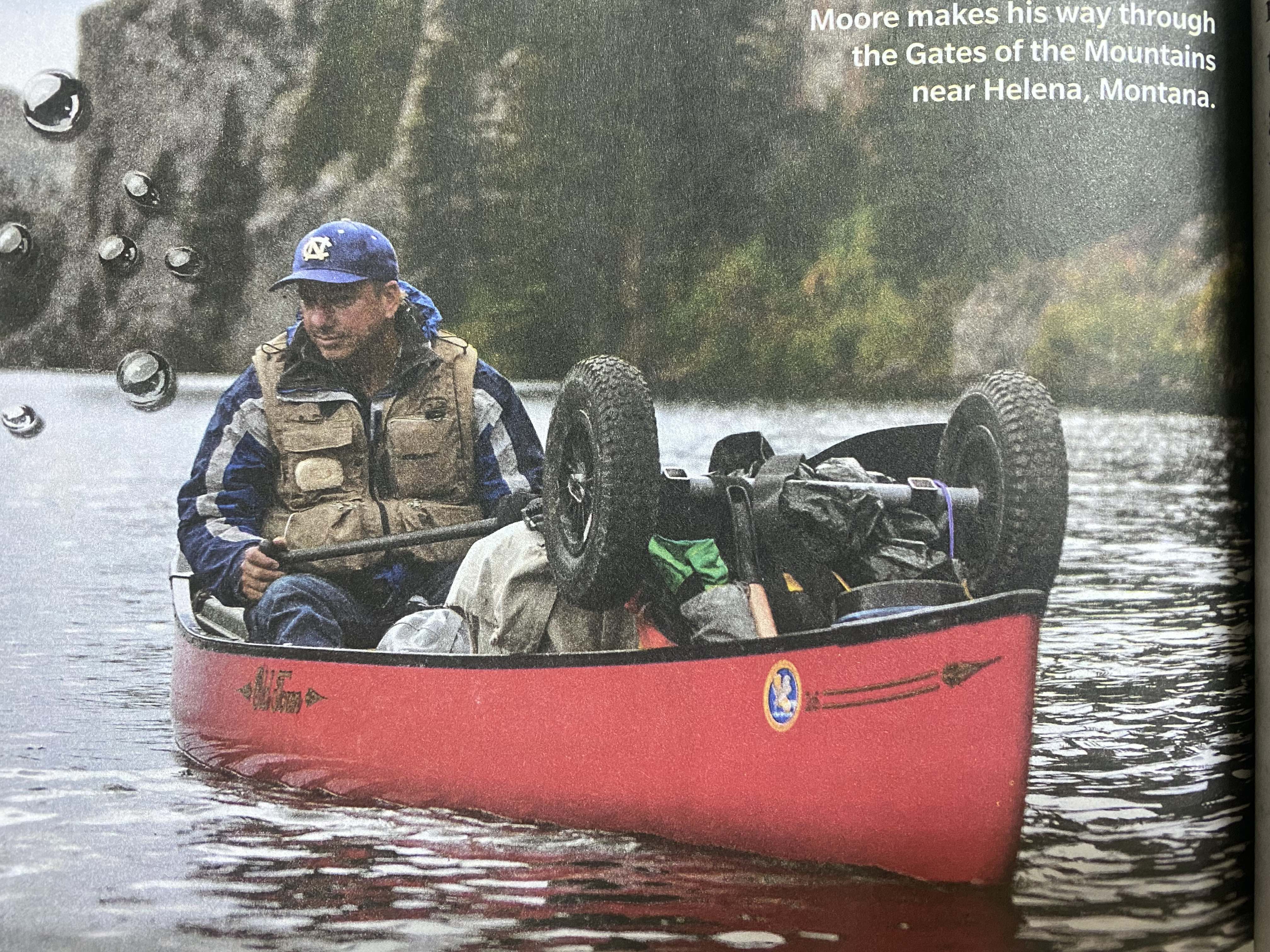
ON FEBRUARY 9, 2020, Moore sets out from Astoria, Oregon, at the mouth of the Columbia River. He packs a tent, a sleeping bag, jugs of water, and a bucket of freeze-dried meals, then points his bright red 16-foot Old Town canoe upstream.
He starts pulling — 1,078 uphill miles to the Continental Divide in Montana (rivers: Columbia, Snake, St. Joe, Clark Fork). Portage over the divide. Then the eight-month, 3,600-mile downhill run to New Orleans (rivers: Missouri, Mississippi). Final leg, 2,890 miles and almost a year, east along the waters of the Gulf, then up through Alabama, Tennessee, and Kentucky, up to Lake Erie, across New York to Albany, then down to the Big Apple (rivers and waterways: Gulf of Mexico, Mobile, Tombigbee, Tenn-Tom, Tennessee, Ohio, Kentucky, Kanawha, Allegheny, Chadakoin, Lake Erie, Erie Canal, Seneca, Oneida, Mohawk, Hudson).
Dodging barges and container ships. Startling grizzlies. Bumped hard by a bull shark. Escorted by dolphins. Curious alligators. Twice capsized. Days and days too windy to paddle. Sleet. Downpours. Floods. Spectacular, breathtaking scenery. And every day, that involuntary laugh of the free man reveling in his element.
The pandemic hits, things shut down, plans change, but Moore pushes on. He dines with the homeless and with mayors and with multimillionaires. Strangers shelter him for the night, buy him meals, show him the town, explain their histories. An Umatilla Indian in Oregon acknowledges with approval that he’s “going the wrong way,” west to east, reversing manifest destiny. In the Columbia River Gorge, a Klickitat chief shares his enduring love of the Columbia River and its salmon. Recreational fishermen insist on giving him all their food and beer. At dinner after a treacherous lake crossing in Montana, a rawboned cattle auctioneer tells him that he and his family were watching, ready to boat to the rescue. He attends concerts, pokes around museums, visits old friends, makes new ones. He goes out of his way to meet America.
In Bismarck, North Dakota, a farmer-turned-entrepreneur convinces him to get a tattoo. He chooses a memorial tattoo in honor of his brother, Tom, and listens to the life story of the artist, 42-year-old Lance Steven Paulk II, who has spent more of his life inside penitentiaries than out, who has been a prison gladiator, who has done solitary next to Charles Manson. That night when Moore opens his journal, he sees that it is July 13 – Tom’s birthday.
Taking it easy near Syracuse, New York. Photo courtesy Neal Moore
The beauty of a river is that it bears you along through seeming wilderness until it opens suddenly upon a town. This balance between nature and civilization appeals to the artist in Moore, who is at least as interested in people as he is in the land. At river towns as old as the country itself, he hauls his craft ashore. He’s often swarmed by curious locals: where did he say he’d come from? And he’s going all the way to where?
In St. Joseph, Missouri, he is hailed by an extended family partying along the river. He cautiously comes ashore and within minutes has become part of the group — they thrust a glass of moonshine into one of his hands and a grilled brat into another. Half an hour later, moonshine still in hand, he finds himself careening over the edge of the Missouri’s banks in a dune buggy, a giant grin on his face.
Photo courtesy Richard Sayer
In Oil City, Pennsylvania, an 82-year-old former pastor named Gale Boocks greets him on the banks of the Allegheny. Boocks had known Verlen Kruger, considered by many to be the greatest canoeist in history, and owns a paddle that had belonged to the legend. Boocks has read about Moore in the paper, and has come out looking for him so he could bequeath the paddle. Stunned, Moore accepts the gift on the understanding that he will merely be its temporary custodian until someday passing it on to another enthusiast.
It isn’t all rosy. At a bar in Montana, Moore slips up and reveals his politics, something he’d promised himself he wouldn’t do. The crowd turns on him and calls him — him, Neal Moore, descendant of pioneers, pilgrim on a voyage of love of his country – an enemy of the United States. The next morning the family that has been hosting him shows him the door.
But that is the only real stain on the trip. Any other time he expects danger or hatred, he finds their opposites. He tries to avoid places that attract meth addicts, so at a campsite up on the Snake that looks a little sketchy, he is apprehensive when approached by a fellow camper. But despite missing an eye and being what society deems “homeless,” the man, Brian Bensen, turns out to be anything but a threat. Over the years he has equipped himself with a pretty sweet outfit for surviving on the margins of society — a 7-by-12-foot trailer with solar-powered air conditioning and TV — and is eager to share whatever he can with anyone who needs it.
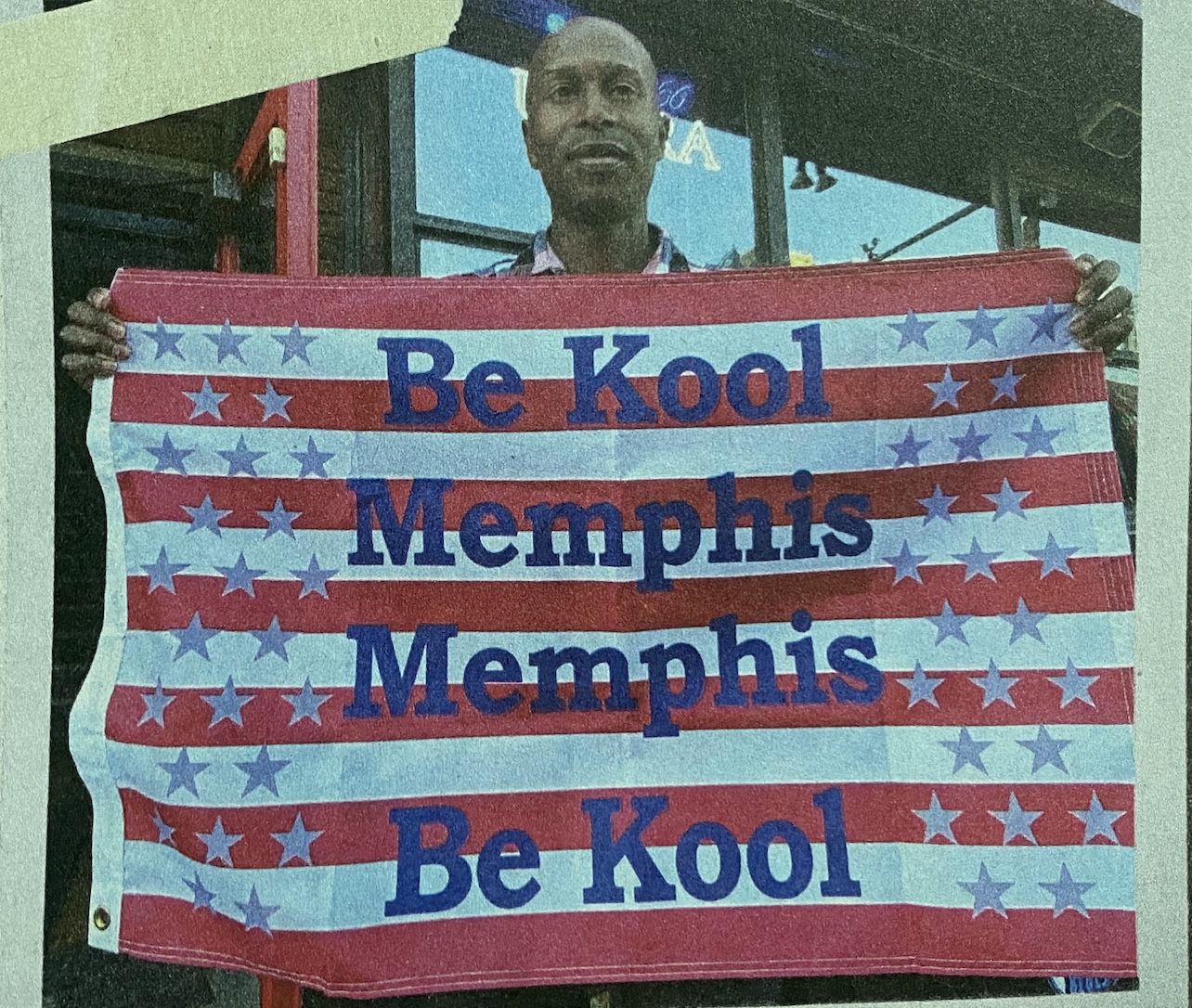
A new friend, Downtown Tat, in Memphis on election night 2020. Photo courtesy Neal Moore
“Push comes to shove, I can feed myself,” he tells Moore. “Feed as many weary travelers as I can.”
Another night in Idaho, camped behind a church, Moore hears two men outside his tent raving in a drug-addled fury. They menacingly approach his flimsy shelter, commanding him to reveal himself. Shaking, he laces up his running shoes and readies his bear spray and Buck knife. Eventually they leave him alone. Then, strangely, in the morning one of the men returns — and invites him to coffee. Moore sits and hears the man’s story of hardship and addiction, and they part friends.
In Memphis, on the day of the 2020 election, the political tension is palpable. Private security details patrol the streets. Moore takes a seat at BB King’s Blues Club on Beale Street to see how things will go. He hears a commotion — not trouble, but laughter. Outside, a man is running with a flag in his hand, on which is printed “BE KOOL MEMPHIS.” He is posing for pictures with tourists, lightening the mood. Moore gets up from his lunch to introduce himself to the man, who calls himself Downtown Tat.
“What’s the flag about?” Moore asks.
“It’s not just Memphis,” Tat says. “It’s the whole country. We just have to be cool. Be cool, baby!”
Americans, Moore decides, still don’t know how to reconcile their politics, but they’re quite capable of ignoring them. And when they do, the vast majority are happy to help. To share, to swap stories, and to form intense — however brief — connections. Whatever you might see on the news, Moore learns that out in America the people are still generous and curious, brave and resilient, still connected by the neighborly values he recalls from his youth.
Because of the pandemic, the authorities closed down navigation of part of the Erie Canal, so Moore paddles its first half (Buffalo to Syracuse), then walks the remaining 170 miles to Waterford and the Hudson River. (If you think a long-haul canoeist on a river is a curiosity, try one wheeling his loaded boat along the road.) The second December of his expedition is coming on, and he wants to make it to Manhattan before the lower Hudson’s notorious winter winds and choppy waves. He is right on schedule.
Photo courtesy James R. Peipert
On December 14, 2021, shortly after his 50th birthday, Moore makes his final approach to New York City. The press comes out to observe the eccentric in his moment of triumph, and a contingent of kayakers and canoeists put in to join his victory lap around Lady Liberty. But near the George Washington Bridge, the winds come up so strong that he ends up with his bow pointed north, and he can’t safely turn it south again. Hell, he thinks, this whole trip has been about going the wrong way anyway. So he paddles stern-first the rest of the way.
Hard to believe it is coming to an end. Tears well up, and not from the wind. Immense above his puny craft looms Liberty Enlightening the World, and crowding the harbor are bobbing boats filled with friends and journalists and gawkers marveling at the magnitude of his accomplishment: 7,500 miles. Twenty-two rivers, 22 states, 22 months, just as he’d said he would do.
His mother would be proud — he had done something transformative, something “pure.” But it’s over now, and he wishes he could just keep paddling.
Derek’s feature expedition interview is in the October 2022 print edition of Reader’s Digest, available everywhere magazines are sold.








 22 Rivers