
Author and adventurer Neal Moore set off to cross his country in the most austere, intimate and traditional way imaginable—by canoe. Over the course of 675 days he paddled 22 rivers and waterways from Astoria, Oregon to the Statue of Liberty. Along the way he survived encounters with sharks, alligators, tornadoes and drug addicts. He had fought his way across the country in an effort to better appreciate America, but after 7,500 miles, he realized he had been a fool—that the light from Lady Liberty’s torch had been reflected in the smiles, friendships, and hospitality he had experienced from the very start of his journey.

A solo canoe journey across the entire United States sounds amazing, but it’s also exceptionally ambitious. What made you think you were up to the task? Did you have significant small-boat paddling and voyaging experience already?
Neal: My previous experience in the canoe was an afternoon as a Boy Scout about age 12 and then that I paddled solo down the Mississippi River from the source at Lake Itasca to New Orleans. It was 2009, the height of the Great Recession, and early on that trip I met the great paddler of Riverman fame, Dick Conant. We became friends. We paddled on and off together on the Upper Mississippi and he taught me many things. One of which is the rivers of this land connect.
The Mississippi itself, it comes at you in stages. From the source, it’s 500 river miles to your first lock and dam at Minneapolis Saint Paul. 26 locks and dams later, just past Alton, Ill., right above the confluence of the Missouri and Saint Louis, it becomes a river wild and something almighty to behold. When you approach her in stages then she’s absolutely doable. You graduate. You graduate along the way and the graduation from New Orleans for me was to take up the advice, the mantra of Dick Conant—that these rivers string together. If I was going to go from point A to point B, where would that be? What would that look like? To look and to feel and to absorb the possibility of making my way, of stringing these rivers all the way from coast to coast. For me it turned into West Coast to East Coast by way of the Continental Divide, the Gulf of Mexico and the Great Lakes in an attempt to remain continuous for 22 months by following the seasons.
The author William Least Heat-Moon famously set out to explore America—first by road in his epic Blue Highways, and then by water in his book River Horse. Did his books inspire your own journey at all? What was your inspiration?
I had taken a year to work out my own unique map, what I thought was unique. And then after I was absolutely positive about the route I was going to take, I stumbled upon River Horse. I took one look at that book at a secondhand bookstore in Taipei, I took one look at his route, and I gasped because it was so similar—except in reverse. And except that I dipped down to the Gulf of Mexico and then came back up to the Ohio. I didn’t want to read his book because I didn’t want to copy his style or his journey, if that makes sense. I really respect him. I met multiple people along my cross-continent journey in the canoe that had met him or hosted him. And I have all the respect in the world for him. I’m looking forward to reading River Horse and Blue Highways after I finish my own telling of the 22 rivers expedition.
My inspiration started out with another Missouri-based writer, Eddie L. Harris, and Mississippi Solo. I picked up that copy in Cape Town many years ago. I picked it up and I was reading that book when I realized, oh my gosh, I can’t say this out loud to any of my friends just yet, but I am going to do the Mississippi. I started with that and then came to Dick Conant at the Brainerd, Minnesota portage who was stringing rivers together, who inspired me to unfurl the stars and stripes of my imagination. Then also along that river there was the Mark Twain Museum staff who invited me to bed down for the night in the boyhood bedroom of Samuel Clemens in Hannibal, Mo. There was just so much inspiration.
Do you think a traveler gets a better sense of America traveling by roads or by river? In what ways did river travel offer a unique perspective?
I’ve always been fascinated by small craft. I’ve always been fascinated by rivers. And the idea that the rivers were the first thoroughfares. That the first roads built in America were built along the rivers. You’ll note there are a number of River Roads. The first settlements, the first cities, all along the rivers. Also, it’s important to point out that for me, with a journey along 22 rivers and waterways, coming across the continent, I saw traveling by river—specifically in an open canoe—as a nod to the First People of this land. I was able to befriend and interview Wilbur Slockish Jr., the chief of the Klickitat People in the Columbia River Gorge, early along my journey. And what I was told was, “Neal, there is a First People on every single river that you will ply.” So, there are a number of firsts. To travel by river versus road, that’s unique. That’s an interesting way to feel your way across the landscape.
I’m not listening to a podcast or to music. There are no earbuds in my ears. I am listening to nature. Nature herself is my orchestra.
We imagine the slow speed of your travel kept you more in-the-moment than most other forms of transport. Was the chance for extended contemplation part of your reason for going?
Absolutely. For example, the Ohio River is 981 miles. I paddled the entire way up. That was one of the 22 rivers and waterways. I averaged about two miles an hour on up the Ohio. About half the rivers I was coming up, and half the rivers I could happily make my way down. Regarding the vast majority of the rivers I battled my way up against, I could walk faster than I was paddling.
Paddling a canoe 100% puts you in the moment. My mantra was obstacles. It’s the obstacles that can trip you up. The boulders from below, the gnarly branches of the trees from side to side. I’m in the craft, and I’m not listening to a podcast or to music. There are no earbuds in my ears. I am listening to nature. Nature herself is my orchestra. And what I’m looking out for beyond the ooohs and the aaahs of nature to behold—quite literally all the way around you in a canoe so low down to the water—are the life-threatening obstacles.

The idea that life is like a river is a popular metaphor—the ever-changing nature, the ideas of going with the flow or fighting the current, etc. After 7500 miles and 22 rivers, what do you think of the metaphor?
Life is like a river. I didn’t really think too much about that metaphor. I think you can say that about a lot of things. My thinking of the journey that I undertook was when you put yourself out on the water, you’re really living. You’re living to the full extent. There are no guarantees. And that’s really part of the fun. It’s a challenge. It’s something unique and it’s something that’s quite beautiful. And if you’re not careful, it’s something that on a good day or bad can absolutely snuff out your light. So you have to respect that.
What regions of the country or sections of paddling did you find most and least scenic or pleasant?
Two of my favorite stretches were 1) in South Dakota along the Missouri River coming through the landscape where they actually filmed Dances with Wolves and the punch line is that virgin prairie, a lot of that virgin prairie is still there. It’s really quite something. It’s windswept. It’s hot as sin in the middle of summer which is when I came through. But come last light the sun spots you up and when you look to the side of the river at that craggy, windswept landscape you’re shadow-paddling. There you are and there is your canoe and in tandem you are shadow paddling right alongside the banks and then before too long you have to pull out. That one night that I shot video of the shadow paddling, a coyote darted out from the rocks exactly where I wanted to make camp and it was just 100% magnificent. 2) The second location, scenic wise that surprised me was the Gulf Islands National Seashore. I had to connect the Mississippi River to the Mobile River. I actually decided to go out on to the barrier islands in the Gulf of Mexico. So off of the Mississippi and Alabama Gulf Coast. Those islands were absolutely breathtaking. It was the middle of winter, and my canoe was bumped hard by a bull shark in tandem with last light. I was escorted the following morning by a pod of dolphins. To be out there some 12 to 14 nautical miles off the coast in an open canoe in the dark—with just the right conditions—zero wind on the coast and a bright sky above—and then making your way across from island to island was a challenge. Shooting out at first light from Horn to Petite Bois to Dauphine to have the chance of less wind was something really exciting as well. Those waves in the Gulf of Mexico come at you like a shooting gallery. They’re rolling up on you every which way and you very much feel like you’re on top of a mechanical bull in a Texas honky-tonk. Your legs outstretched in your craft, trying to steady your canoe, and with a big smile on your face making your way through and to the next destination.
Any place surprise you?
I was thrown off my game with COVID. And found myself in-between Oregon and Washington when both governors locked those states down. I had planned to come all the way up the Columbia to BC to catch the Pend Oreille River to be on water all the way up to Lake Pend Oreille and then up the Clark Fork River to the Continental Divide. But when Washington closed down, when the Canadian border closed down, when everything closed down around me, I took one look at the Snake River and realized it was a Federal Waterway. I received permission from the executive director of the Nez Perce People to cross their tribal lands once I reached Idaho and the Corps of Engineers to paddle up the Snake. I received permission to continue forward into free and clear Idaho.
What surprised me was the wildness, the absolute wildness of the Snake River. I had the provisions and the right craft and the know-how. But I didn’t see a single person, not one person for my first five days paddling up that river. It was 9 days total to get up and across the border to Lewiston, Idaho. There was not one boat, there was not one fisherman. Everything was closed down and it was just me and sleet and snow and waves and wind and a wet suit and a PFD and the hope that I just might not tip in. It’s so rugged. It’s so beautiful. And it’s so dangerous. You add that all together and you have adventure.
Least Heat-Moon wrote, “When you’re travelling, you are what you are right there and then. People don’t have your past to hold against you. No yesterdays on the road.” And the adventure writer Tim Cahill wrote: “A journey is best measured in friends rather than miles.” How were your interactions with strangers generally?
My previous MO on the Mississippi River was to “pull off stories of international consequence.” I was juxtapositioning my canoe between the wildness of the river and the towns. It was during the height of the Great Recession, and the practical advice that people who live along rivers might offer was priceless. People who inhabit river towns have a certain grit. They’re hard luck. They’ve seen boom times; they’ve absolutely seen bust. And they had practical advice on how to survive for the whole world. I pulled off 50 stories in four months and 22 days in 2009; which stories appeared across multiple CNN platforms. The human face of the Great Recession.
The interesting thing about this new coast to coast journey was I had to change up. I was initially looking at pulling off stories from 100 river towns from coast to coast. I was looking at the history of each town and possibly trying to spin a story for each. But with COVID and not walking into a Native American reservation for example and not trying to “pull off a story” it just turned into the chance encounters. The storytelling was thus enriched. I made friends with multimillionaires. I was hosted by mayors. I dined with the homeless. Homeless camps took me in and brewed me coffee and it was really something. It turned into multiple ethnicities, all walks of life. And by the time I reached the Statue of Liberty, I’d been fighting. I’d been fighting and fighting across the whole country for that view. To be in a position to have a better idea how to appreciate that view. 7,500 miles to see it properly—from the American side. When I saw that torch, I immediately realized I was a fool. I was celebrating and then I started to sob—well I wanted to sob but there were press cameras in my face. So I was sobbing inside. Basically, what I realized was I had been an idiot. For that torch, that light was reflected in all of the smiles, in all the well wishes and waves. I didn’t have to paddle to New York to understand or appreciate that. Those friendships, those instant friendships we experience as small-craft practitioners had been with me right from the very beginning of my journey.
Did you have any personal safety issues or anything stolen?
I took safety seriously. I take a lesson from the White American Pelicans. They travel in large groups coming south along the Mississippi River, and what they do is they’ll circle an island at last light. They’ll touchdown. They’ll power down their wings and they will roost. And that’s exactly what I did. The perfect scenario for me—and it turned into most nights—was islands. I was shooting for islands to land at last light, to not light a fire, to not advertise my presence. And then shoot back out onto the water in concert with first light. Just like the pelicans. In so doing, nobody knew where I was. And I was all the safer for it.
There’s probably no way to make such an ambitious journey without a few close calls on the water. Tell us about your scariest moments:
I had fully expected to be robbed. I had prepared myself that I might very well be killed along my feel good, happy go lucky journey from coast to coast. And that it’d be worth it if it happened. When I finally got on to the Hudson River—my 22nd river and waterway—I realized, wait a second, I might actually make it. I might make it in one piece. I was never attacked of course. I wasn’t killed and only one item was stolen from me on the Missouri River. There was a mother with a young daughter at a public camp spot. I’d taken shelter there the night before from an oncoming derecho. As I was going back and forth from my tent to pack up the canoe, she helped herself to my hammer. To my one-dollar antique hammer that I used to batten down the hatches of the guy lines of the storm shelter for my “bombproof” vintage Moss tent.
What did you view as the primary dangers on the expedition?
Lots of close calls on the water.
On a crossing between Deer Island off Mississippi Springs and Horn Island 14 miles out into the Gulf, mid-stride I was hit hard three times under my craft at last light. I knew exactly what it was. I knew that it was a bull shark. But I couldn’t let my mind go there. I had to just keep paddling after instinctively holding the paddle like a baseball bat for a spell in case the shark came up for a look. You cannot see Horn Island from the Mississippi Gulf Coast. At night it’s tough to see it at all. But in time with that bright moon, you could see the treetops. I willed and I paddled for all I was worth. And once the tip of my canoe pushed up onto that crystalline white sand, I knew I was safe and only then could I come to grips with what had actually happened. And how lucky I was to be standing on that island, to be kneeling down on that island so thankful to have terra firma under my feet and my body.
We all know the most dangerous animal is human. Along my journey, especially out west where there are these “Private Property” signs every which direction—where I was portaging, where I was paddling—private property was an issue. Where people are within their rights to shoot you. What I did was to carry charts with me. Corp of Engineer charts. To carry county maps to be able to know where I was making camp. To make sure that it was not private property. That I wasn’t infringing on people’s private property because that can be a really dangerous combination.
I did have an encounter with a grizzly bear on top of the Continental Divide. A mountain man on meth screamed at my tent “Reveal Yourself!” throughout the night in rural Idaho. A giant gator made its way into my camp at Lacombe Bayou off of Lake Pontchartrain. There were some dangerous, scary moments.
But for the vast majority of the time, I was just in absolute wonder with the big smile and like many people who find themselves in a small craft, I found myself laughing. Laughing every single day. Just laughing at how beautiful and how ridiculous a journey like this—the realization of a journey like this—can be.
Tell us about the boat itself. What were its specs and strengths and weaknesses?
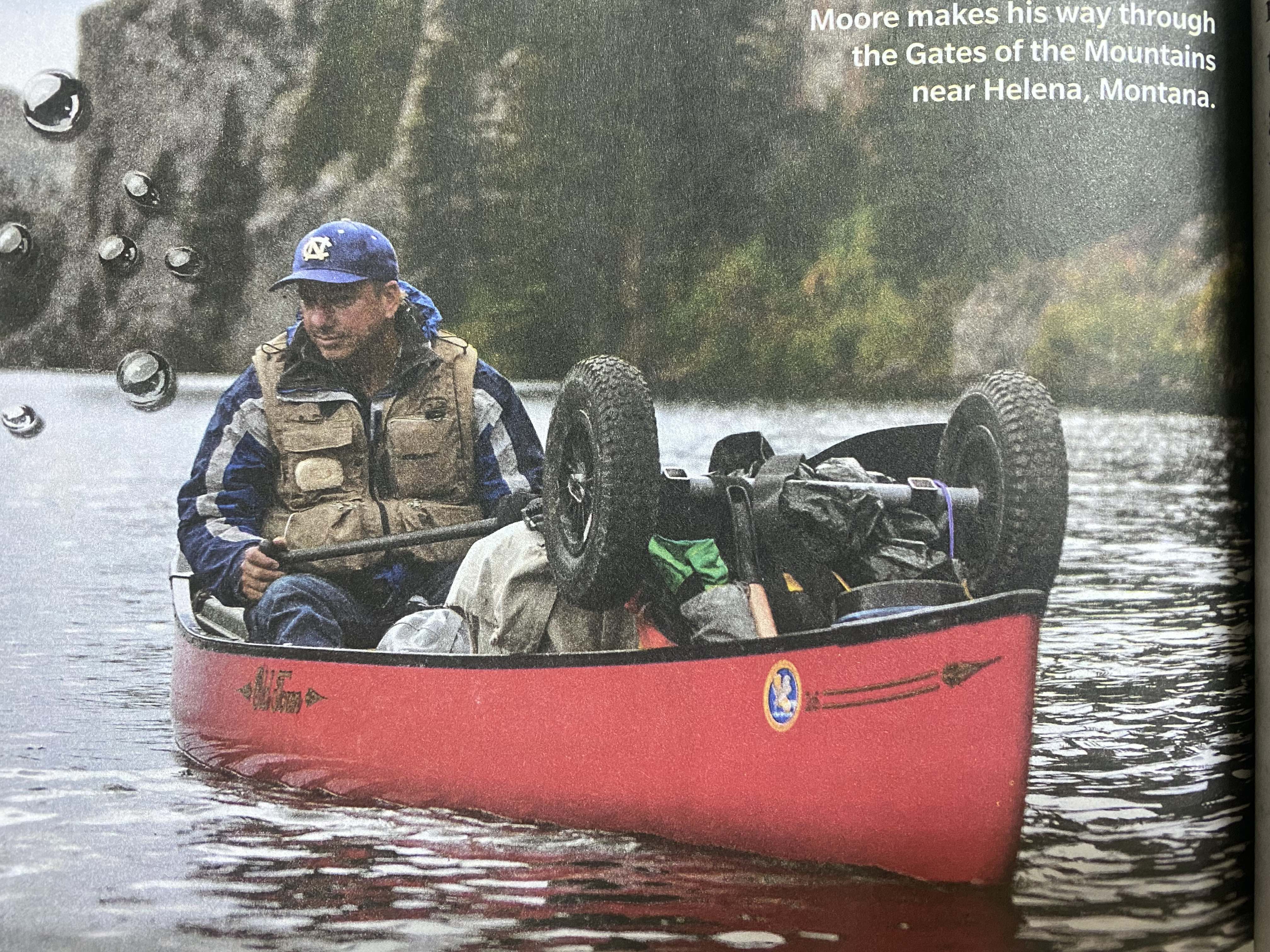
I paddled in a 16-foot Old Town Penobscot Royalex canoe. It’s 16 feet long, 35 inches wide, and weighs in at 60 pounds. The Penobscot is one of the Native American Old Town designs. It slices through the water quite well, through waves. It also tracks really well. The strength of the of the Royalex material—which is a material no longer made—is it weighs 20 pounds less than fiberglass. So that same Old Town model in fiberglass is 80 pounds. Both examples can carry 1,440 pounds, I believe. For me, my canoe was tough. It was tough as nails, and it had to be. It had to be to make its way across the landscape like that. I always said that canoe is a whole lot tougher than me. And I was just really happy to be along for the ride.
How about your primary gear?
You’ve got the canoe. In cold weather (I saw three winters) you have a wet suit against your skin. I’ve got snow ski pants a size too big so I can kick out of them really easy. I’ve got Muck Boots for cold weather and for warm weather. I’ve got a gore-tex jacket that keeps me warm. I have different paddling clothes versus camp clothes so when I push up onto an island, I’m transferring into my camp clothes. Which are wool. So I’ve got a Navy wool beanie. I’ve got a wool sweater. I’ve got Wrangler jeans. I’ve got smart wool socks and I’ve got full leather (waterproof) Timberland boots. The camp clothes, the wool – even if it gets drenched inside your dry bags with torrential downpours, that sort of thing, they will still keep you warm. That combined with the freeze-dried food—where you can boil some water, where you can get a hot meal into your belly and maybe a swig or two of Southern Comfort to wash it down —you’re guaranteed to be warm. When you’re in your craft your body is in motion—as you’re paddling – and you’re warm. The second you stop and step out onto that island you have to make a plan. Get the shelter up. Change your clothes and get that warm meal into your body.
On the flip side of that is the summer and the extreme temperatures. Along the Dakotas on the Missouri River and then the second summer for me was coming up the Ohio River. So the flip side to the cold is wearing swim trunks and Tiva sandals. And of course at all times your PFD. I could feel my body getting too hot. I’d pull off to an island. I’d pull to the side river to a sandbar and I would get out and jump out of the canoe right into the water. And I could feel my body temperature just coming right down—and I knew that I was going to be okay.
There’s lots of other gear. I was on the water for 7,000 miles of paddling and on the land for 500 miles of portaging. So you have your paddles. For me, the first 6,000 miles I utilized traditional wooden paddles from Canada. I changed up when I could feel it in my elbows—that something was going to go bust. I was on the Ohio, part way up the Ohio and I changed up to a carbon fiber paddle. To a really high end ZRE from upstate New York. To a carbon fiber bent shaft paddle which made a world of difference.
What piece of gear did you find especially useful or surprisingly invaluable?
The sponge. When you’re paddling a single blade paddle, you’re bringing that paddle across the canoe. I paddle in my own unique way— I don’t subscribe to or believe in the J stroke. I do my own thing. So I’ll take 3 or 4 paddle strokes and then crossover and three or four paddle strokes and cross back over. So these droplets of water are coming down. With a sponge on the ready you can catch all that water when it starts to rain. Then there’s the mud as well when you push off from a mucky or a muddy bank. You can clean everything off with that sponge by dipping it into the water and by taking care of business. My favorite piece of gear was the sponge.
What was your diet and your typical cooking plan?
I don’t know how to cook. My mom didn’t cook. My grandmother didn’t cook. I was raised in Jewish delicatessens in downtown Los Angeles near my grandmother’s apartment as a small boy. I can barely boil water. My go to plan is greasy spoons. It’s all about the greasy spoons. What I will do is set myself up along the river, so I’ll make camp wild, a stealth camp, just before a town or a village. You talk to the fisherman leading up to that town. I’ll see a Sheriff deputy or old-timers along the way and ask them if they might recommend a greasy spoon. And they’ll tell you. These places generally open up in concert with first light. So that’s my first stop. I’ll rough it and eat freeze dried food and whatnot at night. And lots and lots of snacks from beef jerky to chips to all sorts of snacks. The real experience, the real food is in these diners. To see how the recipes change from West Coast to East Coast is interesting. For example, where you have hash browns up until a certain point and now there are no more hash browns coming east. Now you have home fries. And eventually of course down South you get the grits as well. To see how that menu changes up—and how the wait staff dish out not only food but a heavy dosing of sass to their regulars. The interactions between people in a diner are fascinating – especially when you’ve been solo, when you’ve been wild for days or for weeks leading in. How wait staff and local customers as well always make me smile.
How about paddling or shore-camping techniques? Any seamanship or skill lessons you learned and can share with readers?
As everyone knows, the rivers and the waterways are continuously changing. They’re changing by the day, they’re changing by the hour, they’re changing by the moment. With freak storms. I saw two derechos on the Missouri River and multiple tornadoes in the Dakotas and again in Alabama. Hurricane Ida hit me in Pittsburgh on its way to Philly and New York City. Although I was well away from the gulf (by design) that hurricane still hit me with a torrential downpour.
While paddling, you have to read, to learn how to read the conditions and adapt. You’re continuously adapting. It’s safer to make your way up a river because you’re going much slower in a canoe than to come down. Because the obstructions are coming at you slower, the potential obstructions. One trick when paddling up a river is you of course have the raging river coming down against you but then on the side you have that seam. And then you have the updraft, the up-current along the side of the river lots of times. That can actually propel you up the river until you get to the point. Once you get to that point then you have to look and see—can you get out? Can you get around it? Do you have to shoot across the river through that current to potentially make it through on the other side? Or do you have to come back and make your way across the land, asking permission to cross private property to get to the road? To be able to haul the canoe like a mule.
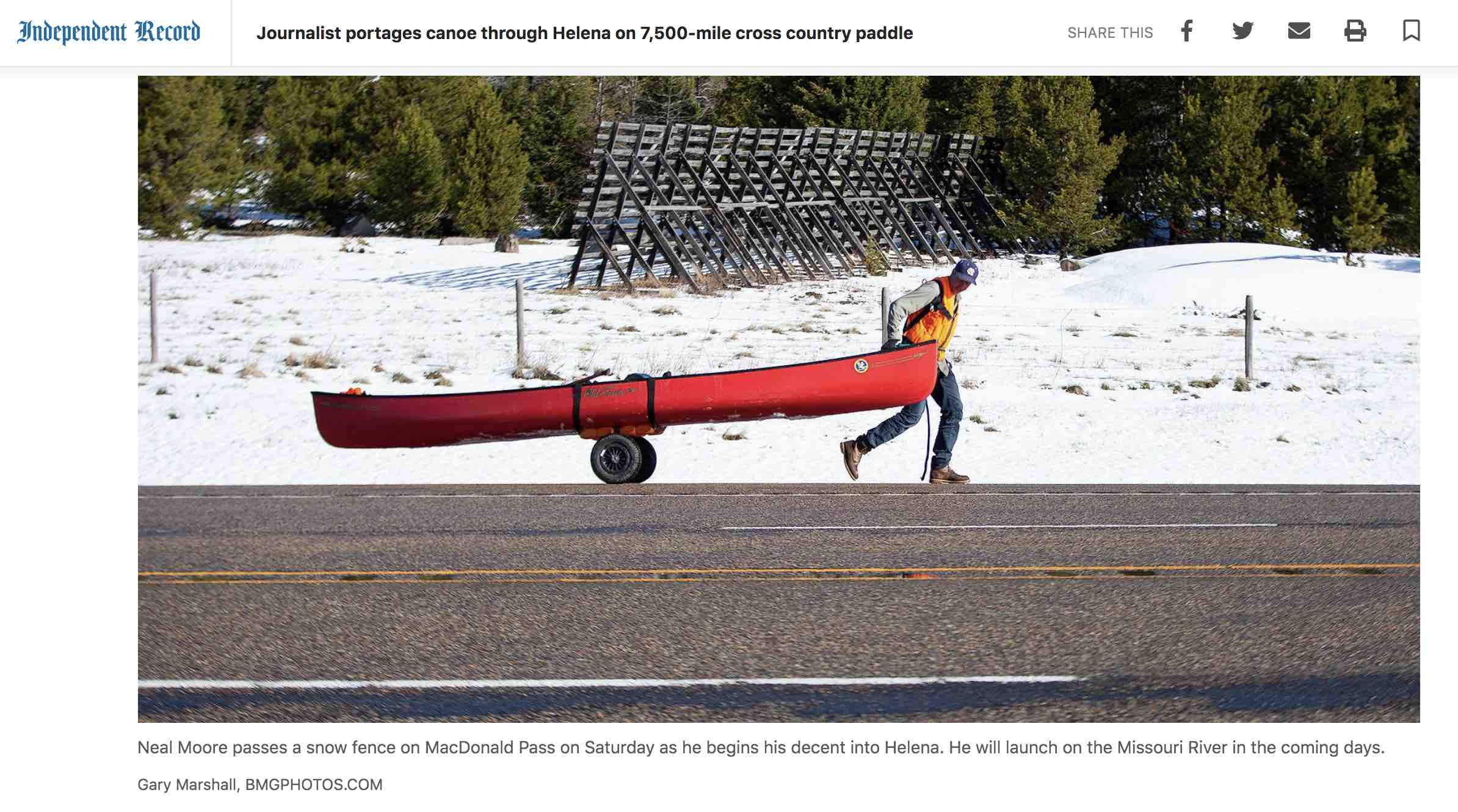
I went through four sets of wheels before I found the right set of hardcore expedition wheels from Canada. You strap the canoe on top of the wheels, place all your worldly belongings inside, step into a fall harness, and tie a 7/8” shipping rope between your fall harness and the canoe. Then you’re able to pull on the side of the road. One trick is where you’re pulling on the side of the road you have to make sure you have the shoulder so that you’re not interfering with traffic. If there’s a logging truck coming one way and there’s a minivan coming the other way with a family and there’s an idiot with a canoe on the side of the road with a fall harness – that would make for a really dangerous and not fair surprise.
There’s paddling, there’s portaging, and then there’s the seamanship as well. For me it was how to control the craft. You figure out what works for you – the strokes of the paddle, how to position the canoe, when to make the call in the mind that it’s too much. When to make that call to get off of the water. All of that, all of that changes up by the moment again. You learn from your mistakes and you’re absolutely able to control your craft. The moment you can’t control your craft – that’s a really good time to get off the water.
Were you mostly happy during your expedition? How do you view the link between minimalism and psychological well-being?
I really like the idea that you can place all of your worldly belongings into a small craft like a canoe—like a 16-foot by 35-inch canoe —with all of your lifelong belongings. You pitch them into the canoe about an hour before first light. It takes an hour to break down the camp and then to push off from an island in concert with first light. With all your worldly belongings inside, for me, that is the definition of bliss.
Are you plotting any new adventures?
There are always new adventures to be had. I find myself right now in the oldest hotel in Rome, Italy. I was just in Paris and in Cape Town before this. It’s my first time in Italy. My French friend Natt explained when you go to Rome, you make no plans. You just find a café, you have your coffee in the morning, and then when you’re ready you stand up and you just walk. You just walk.
So I’ve been going nonstop since the time I was a boy—spinning the globe and placing my best foot forward. I am looking forward. There are certain places in the world that I’m still dreaming to not go and visit—but to mail my books to, to hang up my hat for a season or two. There’s Timbuktu. There’s old Delhi. There are certain places in the world that I’m looking forward to setting foot. And there are certain riverways and waterways that keep me up at night—that I’m so looking forward to plying as well. This coming summer I’m hoping to be in the water for at least a couple of months.
Where can our readers find your books or follow along?
You can find my books—Down the Mississippi and Homelands: A Memoir – on 22rivers.com. From that blog you’ll be able to see the cross-continent “22 rivers” route, check out the books, and you can find the gear that I used. Along with any updates on the upcoming book and on future adventures as well. You can also follow my Substack here.
Thank you so very much. •SCA•






 22 Rivers