TRIBUTARIA – Poetry, Prose, & Art Inspired by Tributaries of the Ohio River Watershed

Dear Friends,

I’m thrilled to be included in the creative new anthology TRIBUTARIA – Poetry, Prose, & Art Inspired by Tributaries of the Ohio River Watershed
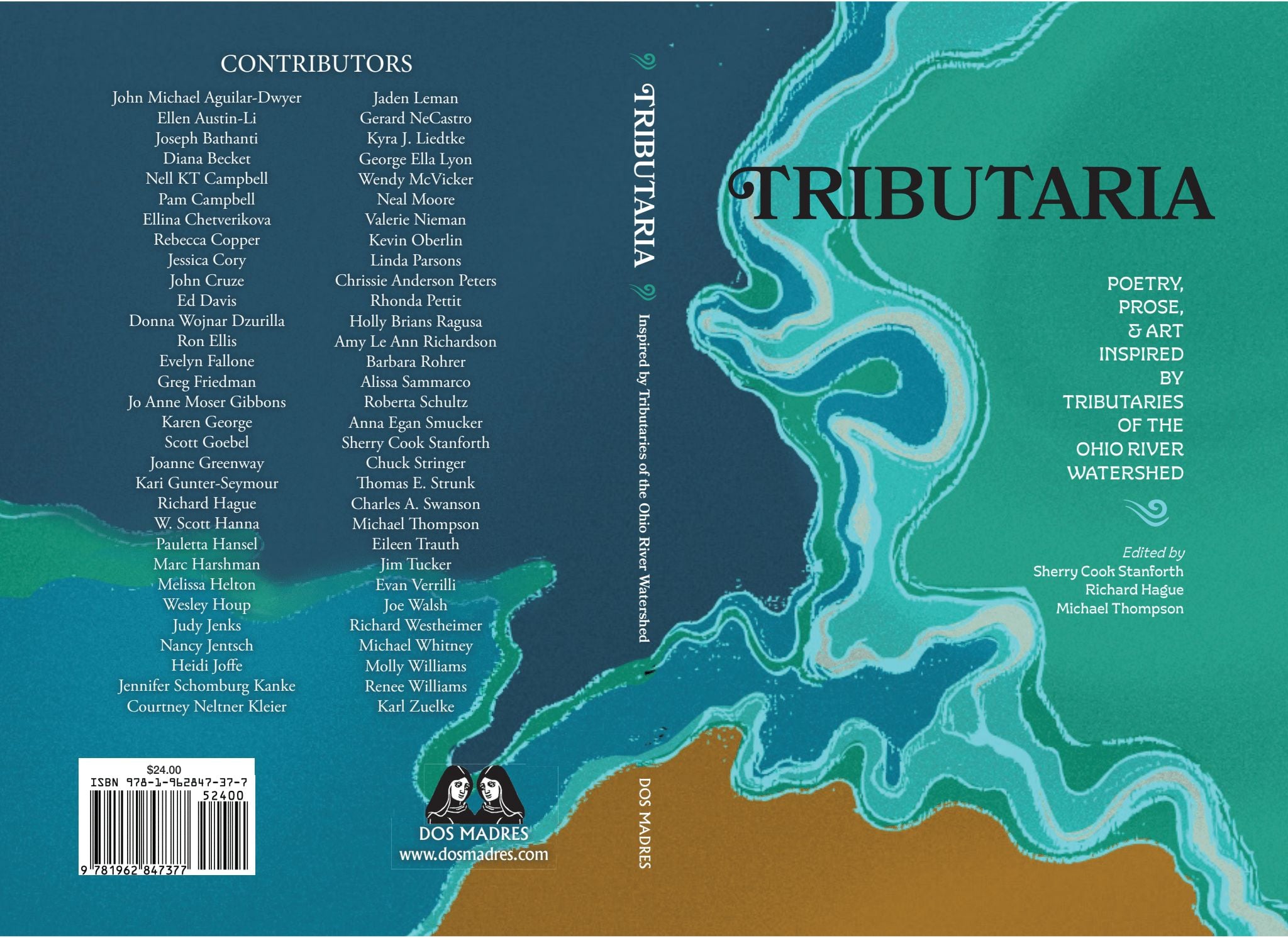
Overview by Managing Editor: Sherry Cook Stanforth & Literary Editor: Richard Hague

The contributions of poetry, prose, visual art, and photography in this collection form a creative tribute (using one meaning of the word) to one of the largest river systems in North America. The Ohio River Basin’s scenic and historic tributaries—rivers, streams, creeks, and rills—are flowing through nearly 204,000 square miles of territory, impacting more than 25 million people living in areas of Pennsylvania, Ohio, Kentucky, West Virginia, Indiana, Illinois, Tennessee, New York, Virginia, Maryland, Georgia, Mississippi, Alabama, and North Carolina. Nearly five million people drink water from the Ohio River itself, and millions more depend on the commerce, recreation, and transportation provided by its connected watersheds. The lovely living gift of the ohi:yó sustains us, body and soul.

And yet this precious lifeline, this vast and beautiful ecosystem, is being sickened by pollution, rewritten in the specialized, expressive language of dioxins, furans, PCBs, mercury, VOCs, phthalates, POPs, phenols, polycyclic aromatic hydrocarbons, HAB dead zones, E. coli contamination, on and on and on. In 2023, the American Rivers conservation group listed the Ohio River as the second most endangered waterway in the country. This diagnosis came well ahead of the February 3, 2024, Norfolk Southern train derailment in East Palestine, Ohio, that dumped at least five different toxic chemicals into a cradle holding people, flora and fauna, forests, fields, farms, parklands, yards—and of course, ever-moving water sources. And so Tributaria sings an elegy for irrevocable damage to the living world, even as it celebrates its sacred beauty.

Former US Poet Laureate Joy Harjo witnesses for us all the practice of intentional connection, of learning to claim (and reclaim) what exists beyond our immediate senses: “When I began to listen to poetry, it’s when I began to listen to the stones, and I began to hear what the clouds had to say, and I began to listen to others.” May these words and images invite that accountable, curious tuning. Tributaria offers only a glimpse into the complex heart of Ohio River country’s flowing waters, riparian margins, diverse life forms, geological features, and industrial properties. The living energy of nature and culture cannot be contained by simple designs and functions. Our stories of water will move throughout time, while we remain bound to the unfolding plots and diverse settings that shape our essential well-being within all of creation.

Edited by Sherry Cook Stanforth, Richard Hague, Michael Thompson


Excerpt

A Conversation with Uncle Clem
by Courtney Neltner Kleier

What’s my inheritance?
The Fourmile Creek
The dirt below your feet
A name intact

Where’s my money?
In the creek bed
Deep, with our buried dead
Gone, that’s a fact

What’s my name?
Neltner
Reis
Schack

Where you go, can I follow?
Yes, I reckon so
No
Maybe, in these last days

Where are we going?
To hell if we don’t change our ways


Many thanks to Sherry Cook Stanforth and Dos Madres Press for the invite, an Ohio Not For Profit dedicated to the belief that the small press is essential to the vitality of contemporary literature.

A Return to Harlan and Anna Hubbard’s Payne Hollow

By Neal Moore

On a recent two-week canoe expedition down a portion of the Ohio River, I had the pleasure to visit and bed down at Harlan and Anna Hubbard’s beloved Payne Hollow near Milton, Kentucky. The Hubbards lived here from 1951 to 1986, subsisting off the land with no electricity and only cistern water. Harlan was a painter and writer and Anna was a librarian and musician. Together, they lived in harmony with the landscape for 35 years. Harlan designed and built Payne Hollow out of wood and stone, along with a detached studio.


“This is the day we begin a new venture, facing now the true direction.” – Haran Hubbard

It wasn’t my first visit to the property. Back in 2021, while paddling up the length of the Ohio River on my cross-continent sojourn, I’d often slog it out from first light until sundown – and beyond. On June 16, 2021, I was pushing for the boat docks at Madison, Indiana just up and around the bend, but came up short. The curtain of night fell, there was a frenzy of tow and barge traffic in the river up ahead, and as I looked to my side, the perfect stealth camp spot materialized.

A spit of land jutted out into the river just so along the Kentucky shoreline. It was flat and inviting, and I happily paddled to the riverside. Pulling my canoe and gear out of the water, I set up my tent, and took a seat along the riverscape, taking in the majesty of the stars and the firmament. It was a special place in my mind – I could feel it – so I marked the spot on my Google maps with a heart. I didn’t then know I was camping on the shore of Payne Hollow.

Payne Hollow by Harlan Hubbard, 1986, Oil on board. On display at the Behringer-Crawford Museum via the Caddell Collection. Photo by Neal Moore.

I’d soon become intimate with the art, life, and story of Harlan and Anna, along with a need to save their seven-turned-sixty-acre oasis connected to the river. By 2022, the property had fallen into a state of neglect. The owner had health issues and was not able to visit as regularly as was needed. There were reports that racoons had invaded the home and that it could soon be destroyed. I’d befriended a group of Louisville, Kentucky academics and artists, along with a separate group of Madison, Indiana concerned citizens who wanted to see Payne Hollow saved. I helped to bring the two groups together, to organize a meeting at the home of Bob Canada of Madison, Indiana, a retired dentist who had befriended Harlan and hosted him until the end of his life. My hope was that the two groups could put their collective experience, expertise, and influence together to purchase and save it. Which is exactly what happened.

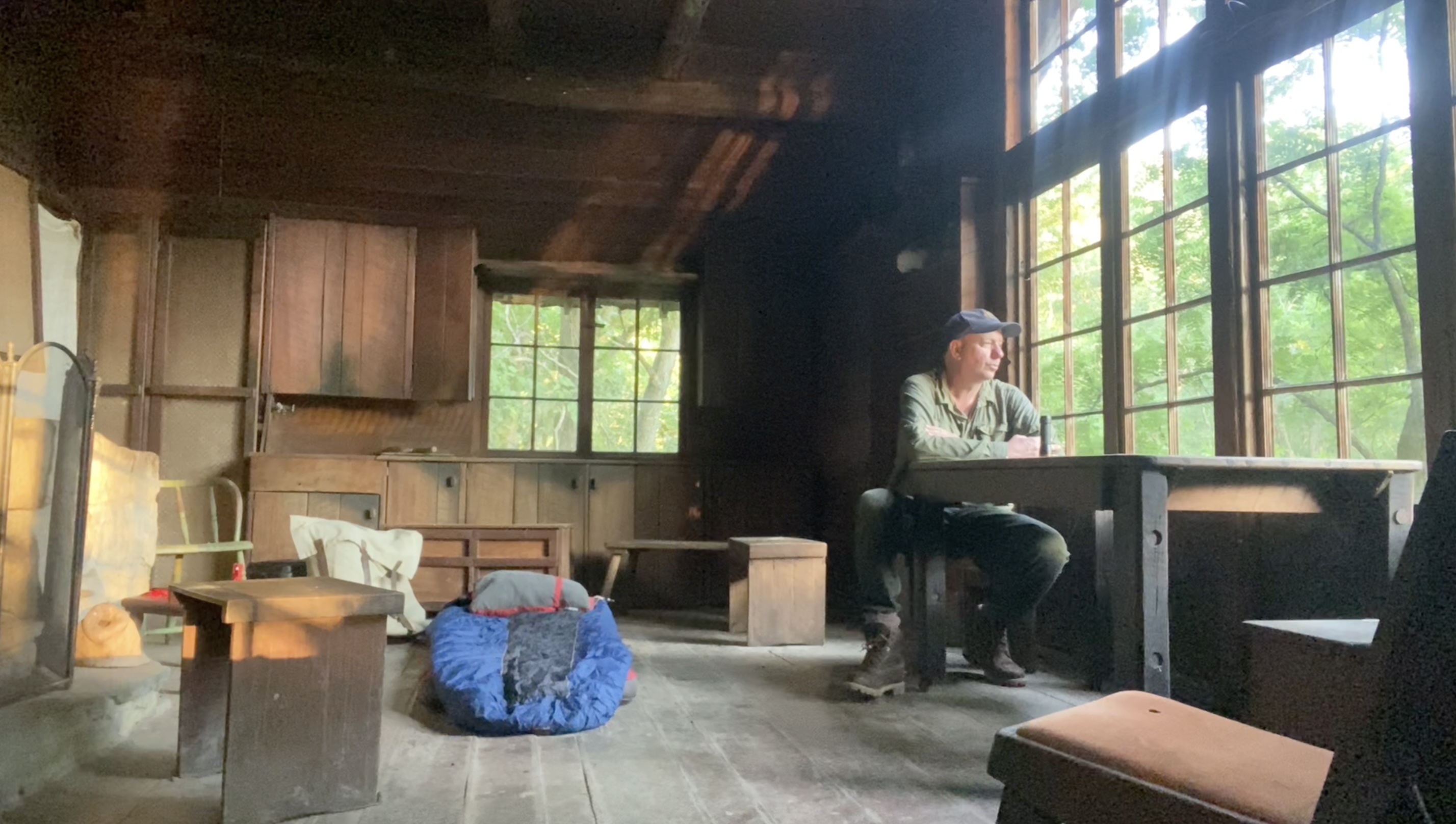
Neal Moore getting ready to bed down for the night inside Payne Hollow on the evening of July 22, 2025.

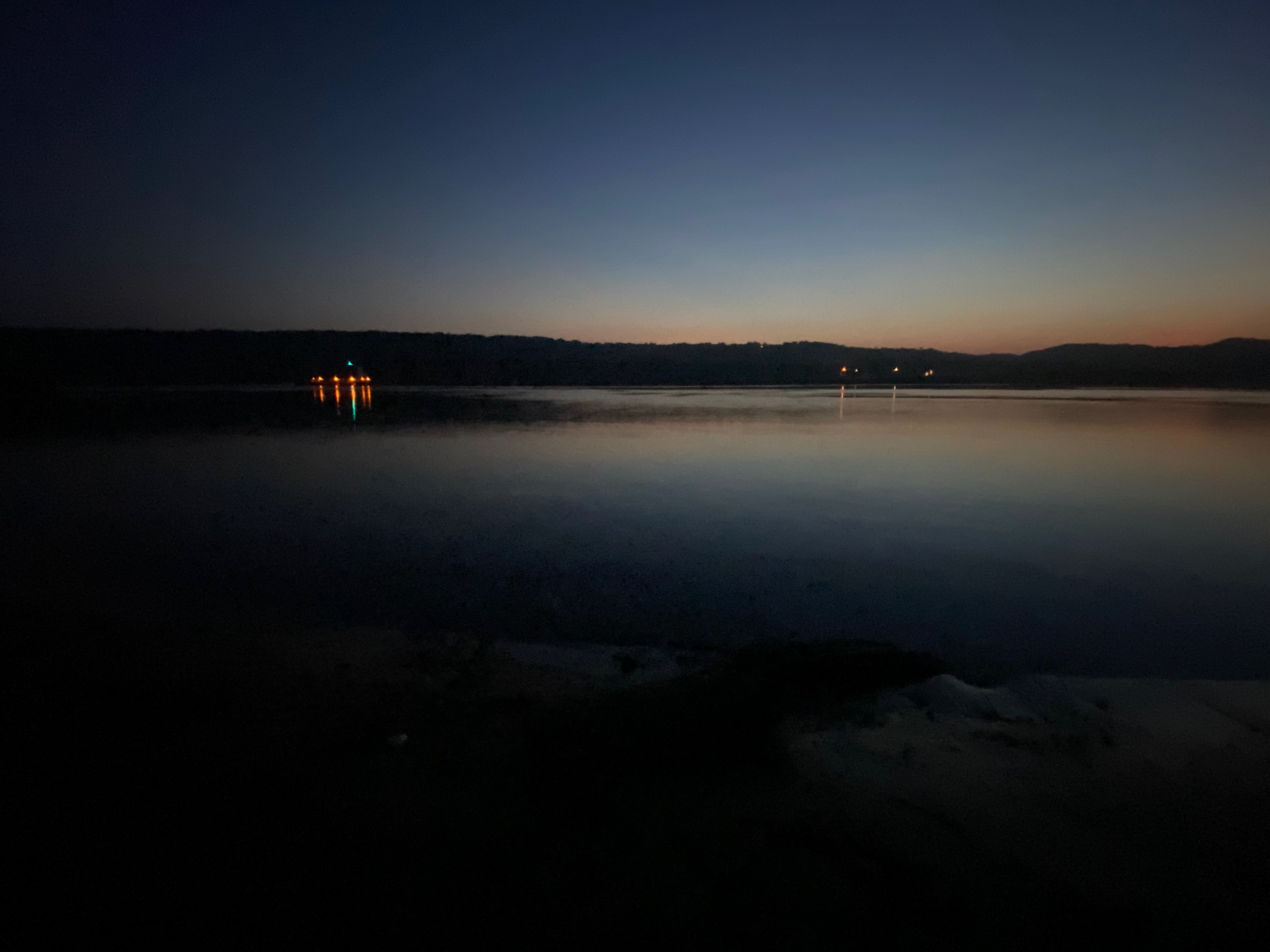
From my perch of a porch outside the side door of Payne Hollow, the steady flow of the Ohio could be viewed through the trees. As I sat and admired the wildness all about me on this recent exploration down the river, there was a moment, in concert with the sun’s final rays, when I could hear voices. When the trees rustled in a lack of a breeze and I felt the hair on the back of my neck stand up. It was the height of summer and sweltering hot but then it turned cool. I thought of the Wendell Barry-inspired pastoral ghost story opera “Payne Hollow” and the line of Harlan talking about the music that’s just out of hearing. I was sure it was a haunting. And with it the realization the Hubbards are very much still here. And then it passed, and I was at peace once again.

The sun had set proper and there was that golden strip of an afterglow. Just at near-dark there was the hum of an approaching tow pushing up the Ohio. The river acted as a muse for many of Harlan’s works, along with the home itself and surrounding landscape. I thought of Harlan in such a circumstance – with such an oncoming tow – that he might grab for his paint brushes and a found strip of wood or tin or available canvas and head down to chronicle the waterborne paddle-wheel tow of yesteryear. I rose from my seat and bounded down to the river to capture the passing modern-day vessel with my camera. With a smile and an understanding that he’d seen and chronicled countless such images.

A solitary tow pushes upriver past the shoreline of Payne Hollow on July 22, 2025. Photo by Neal Moore.

Back up on the hill, I rolled out my sleeping bag onto the floorboards of Payne Hollow, took a swig from a bottle of Kentucky bourbon for good luck, and closed my eyes. Morning dawned through the windows bright and cool and clear without further incident. I woke from a peaceful sleep, rubbed my eyes, and rolled up my sleeping bag. Packing up my river bags and heading out the door, I paused before locking up to poke my head back into the home and say, “Thanks for the stay, Harlan and Anna. It was delightful.”

***

“Anna and I were attracted by the very conditions which caused it to be abandoned. We are unique among its inhabitants, not farmers, nor fishermen nor shanty boaters in the accepted sense; yet closer to the earth than any of them, with true respect of the river and the soil, and for Payne Hollow. May it long remain as it is, not merely for our selfish enjoyment, but for the satisfaction it must give many people to know there is such a place. Few wild pockets are left along the river these days.” – Harlan Hubbard from Payne Hollow: Life on the Fringe of Society

Many thanks to Payne Hollow on the Ohio for the invite, a Kentucky non-profit with a goal to sustainably preserve, protect, and promote the legacy of Harlan and Anna Hubbard.