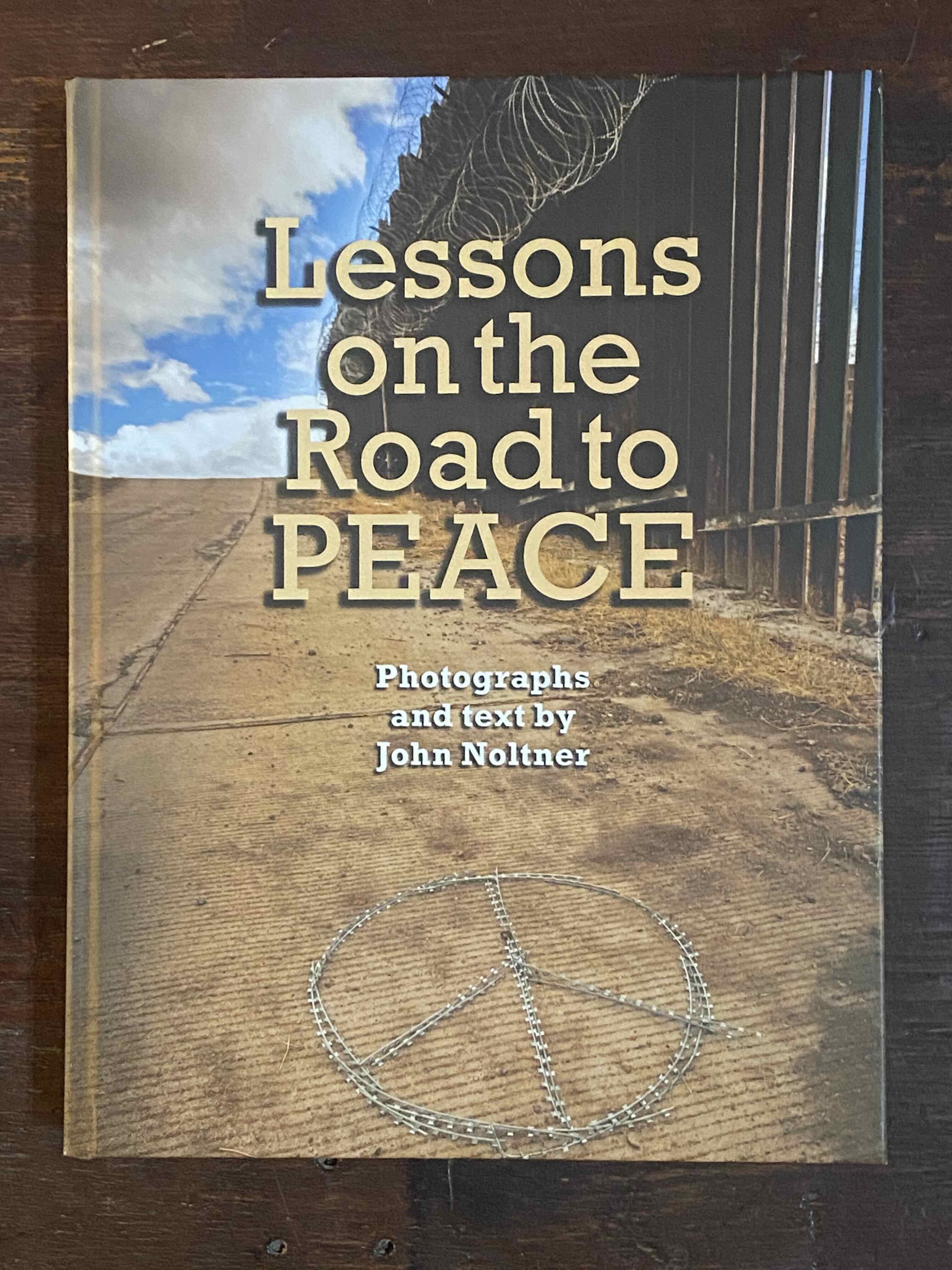
A huge congrats to John Noltner and his new book: Lessons on the Road to PEACE. I met John on the banks of the Tombigbee in Columbus, Mississippi midway along my canoe expedition across America. In John, I found a kindred spirit. He’s a storyteller, a photographer, and a seeker of the positive – in search of how we can and do come together as a nation.
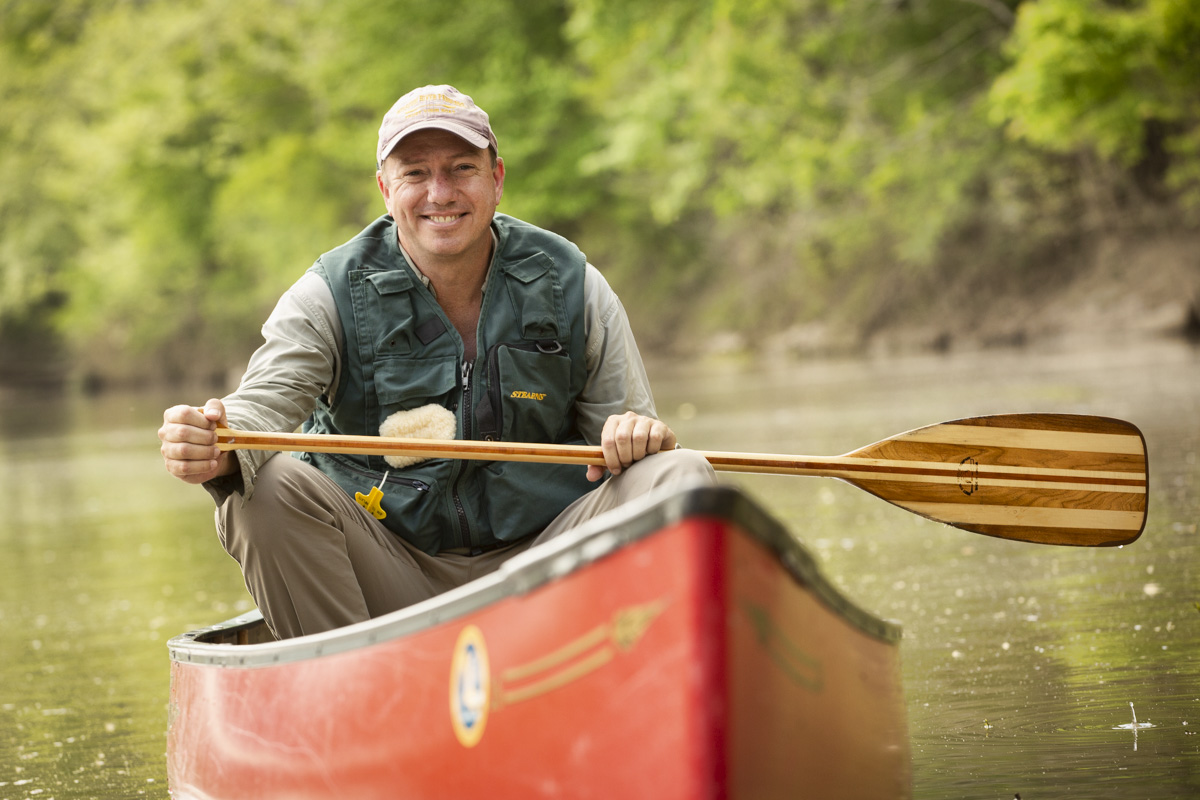
John was traversing the landscape (with his wife in an RV) and showcasing his then current book A Peace of My Mind. He interviewed me as part of his rambling feel-good series and asked if he could take a photograph. We made our way down to the Tombigbee, he positioned me just right in the light, I cracked a smile, and he snapped this photo to be included in his newest book.
John’s work has been showcased in National Geographic Traveler, Smithsonian, and on Good Morning America. It’s always fun to meet a fellow adventurer from which to learn and absorb positive energy. This book will help you find the courage to smile and rekindle a belief in humanity especially in trying times. I’m thankful to John and am pleased to call him a friend. Somewhere out there, right now, out on the open road, gritty and raw and real, John is collecting the stories of our better angels and spreading the hope of peace across this land.
It was a massive privilege to be a small part of Morgan Atkinson’s new documentary ‘This Is the Ohio,’ now appearing on PBS and Kentucky Educational Television. Congrats, Morgan!
“Once dubbed ‘the beautiful river,’ the Ohio River has since fallen on hard times, derided by some as the dirtiest river in America. Filmmaker Morgan Atkinson travels the 981-mile waterway from Pennsylvania to Illinois, discovering more hopeful perspectives that look at the river in new and provocative ways.”
Lone canoeist Neal Moore descended New York State’s Mohawk River, at the end of a journey that began 22 months and 7,456 miles ago, meeting people across 22 states and 22 rivers
His paddle has plied 21 bodies of water so far on his way across the continent. Downstream always means easier paddling, yet he knows that dangers abound—wedge up against a log or rock and the current will flip him and sink his earthly goods.
All the upstream slogs were worse, of course. His eyes would scan the river for the calm seams of flat water, and the points of land that subdued the stream and made the way less difficult. Lest he surrender hard-earned progress, he would dig and dig long past the burning of his shoulders in mid-morning and on into the long and stiflingly hot—or freezing and windblown—afternoon.
At Chautauqua, New York, I recently had the pleasure to sit down with veteran Access Chautauqua television host John Viehe to discuss South Africa, East Asia and my journey across America.
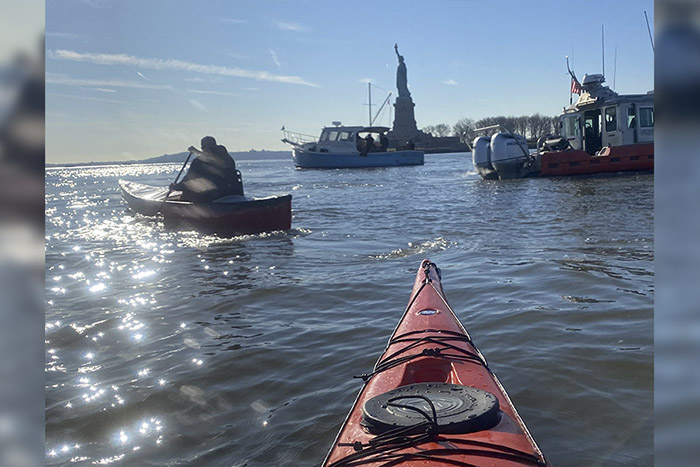
Neal Moore paddles toward the Statue of Liberty on Tuesday concluding a 22-month-long canoe trip that took him on 22 rivers and waterways from the Pacific coast in Oregon to New York Harbor. Birney Imes/Special to The Dispatch
Two years ago as he was beginning a canoe trip that would crisscross America, Neal Moore called a friend, a fellow paddler, who lives on the Hudson River just above New York City. He wanted to know the best time of year to arrive in New York by canoe.
The friend, Ben McGrath, a New Yorker staff writer, said he would consult with a neighbor, who was a more seasoned paddler, and get back with him.
At the time McGrath was completing a book on another long-haul canoeist — one who gave Neal the idea he could travel across the country by connecting rivers and who spent a night in Columbus doing such himself.
The neighbor and Ben agreed, December would be best, after the winds of November and before the snows of winter.
Armed with that information Neal continued the journey he had begun on the Columbia River in Astoria, Oregon, with the vague goal of saying hello to Lady Liberty in New York Harbor sometime in December 2021.
Along the way Neal — an expatriate who in his 30 years abroad was a Mormon missionary and an art dealer in Cape Town and an English teacher in Taipei — met Americans of every stripe.
They told him their stories; gave him rides to a store for provisions; provided warm meals and a place to sleep. Some even gave him the keys to their cars.
Occasionally his hosts would paddle with him, an afternoon, a day or several days. Neal invited these kindred spirits, these lovers of nature and flowing water, to join him in New York at the completion of his trip for a celebration.
They could, if they wished, paddle with him on his final lap around the Statue of Liberty.
“I chose to end at the Statue of Liberty because her hand is extended to every American,” Neal told a reporter in Pittsburgh. “We as Americans know if we fall we have the strength to get back up. I want to find what unites us. Because we all know what divides us.”
Neal’s welcoming personality and listening skills draw people out. He makes you feel as though you are part of his journey.
There must be scores of people like friends of Beth’s, who met Neal briefly while he was here, who now follow him on his blog (22rivers.com).
When Neal tied up at the dock near the Riverwalk in early April, he was 6,000 miles into his 7,500-mile journey. He said then he was on schedule to reach New York by December.
Neal’s arrival in Manhattan earlier this month was less than auspicious.
Passing under the George Washington Bridge on an ebbing tide, a strong wind turned his canoe around.
Unable to reposition his boat, he paddled the four miles to his destination backwards, which, as he said, was appropriate “because the whole (west-to-east) journey has been the wrong way.”
When waves splashed water into his boat, he put the Coast Guard on notice he might need help.
“They sent a New York Police Department boat that just went roaring right past me and never came back. It just threw one hell of a wake,” Neal told “Adventure Journal.”
On Tuesday morning at Pier 84 at West 44th Street, nine kayakers, outfitted in wetsuits and dry tops to insulate them from the 45-degree water of the Hudson River, prepared to launch.
Neal, who turned 50 just before reaching New York City, would be paddling the 16-foot red Old Town Royalex canoe he has used for the entire trip. He bought the boat on Facebook Marketplace in San Francisco while he was still in Taipei and had a friend pick it up for him.
Along the way, he’s asked benefactors and people he’s met to inscribe the white interior of his canoe with a Sharpie he carries for that purpose. He said those inscriptions, which now cover the canoe’s white interior, helped sustain him during his long and sometimes trying voyage.
Five of the nine kayakers who paddled with Neal had hosted and paddled with him when he passed through their towns.
Among their number was a registered nurse from Kansas City; a retired educator, who is now an environmental activist from Louisville; an educator from Pittsburgh and a Mississippi River guide from Clarksdale.
The morning was unseasonably warm with a slight breeze.
The paddlers would escort Neal down Manhattan’s lower west side before crossing over to the New Jersey shore, past Ellis Island and on to the Statue.
Two motorboats would accompany the group, one for the media and a rescue boat, one of which would take Neal back once he circled Liberty Island.
Ferry traffic increases in the afternoon and accordingly the waters in that stretch of the Hudson grow more turbulent, the guides for the trip said.
As the group approached the Statue around 1:30 p.m., Neal paddled his canoe out ahead of the flotilla.
Describing his mixed emotions as he approached the Statue, Neal said initially he was ecstatic. “The whole trip came back to me in rapid flashes.”
“And then I was crying,” he said.
“It’s been so much more than a physical trip,” he said. “For the biggest part of the trip, I thought it would go on forever.”
Later that evening about 35 people gathered for a reception at the Manhattan Kayak Club.
Ben McGrath, the “The New Yorker” staff writer who gave Neal scheduling advice, was one of several who spoke. Ben’s piece about Neal’s trip was published in the magazine’s Dec. 20 issue (“After 7,500 Miles, A Long-Haul Paddler Floats Into Town”).
Ben noted how Neal had brought together our geographically disparate group, most of whom did not know one another prior to this event.
We were from Mississippi, Oregon, Montana, Missouri, Pennsylvania, Indiana and New York.
“He connected us all and made us friends,” he said.
Birney Imes III is the immediate past publisher of The Dispatch.
Oil City’s Gale Boocks wanted to present a gift he received from a famed paddler to Neal Moore, who is paddling across the U.S. Moore made a stop here in the Oil region this past weekend. They met up and this is an account of this connection.
This past weekend a wanderer came through Franklin. A seeker really, a documenter, a man alone but among many; a former missionary on a different kind of mission, a paddler.
Neal Moore set out from Oregon on the Columbia River in a red 16-foot Old Town Penobscot Royalex canoe right around the time the Coronavirus was hitting the states. Being alone in a canoe was taking social distancing seriously, but that wasn’t his motivation. This world traveling ex-patriot author and super curious self-identified middle-aged man was going to explore his country of origin after having been away for so long.
“What I’m trying to do traveling across America is to listen and learn,” Moore said about why he is traveling in what would seem an erratic pattern of 22 rivers across the continental United States from Oregon to the Statue of Liberty where he hopes to land in the middle of December.
His stop in Franklin is 19 months into his journey. Along the way he has chronicled his encounters in dozens of handwritten journals, a blog on his website, and instagram account and countless stories that meander in and out of topic like the rivers he paddles.
In fact, he appears to crave meandering. From the swirls sent behind his paddle that mix and move with the current as they become one with the rhythm of the stream, to the mixture of bird calls intertwined with far off car horn reminders that civilization’s hustle and bustle hasn’t stopped during his journey.
“I think a lot,” Moore said about his average 25 miles a day paddling on the rivers. Each place he visits gives him even more to think about, more people to weave into the fabric of his memories, more conversations about life to ponder the similarities we share despite the differences we hold in our outstretched hand stopping ourselves from getting too close to one another. “Once we put the party politics aside we have so much in common,” he said about his many stops along the way meeting people of all walks of life and political ideologies. “I just try to listen, no judgement.”
When he landed on the shore of the Allegheny near where French Creek comes in this weekend it was the same day an article appeared in The Derrick and Hews-Herald about his stop down river in Emlenton a day or two earlier. Oil City’s Gale Boocks, an avid paddler himself back in the day, saw this article and knew he wanted to meet Moore. The next morning he went to where an old paddler would think to find Moore, but no one was there. He, on a hunch, tried the local B and B appropriately named Peddlers & Paddlers and lo’ and behold there was Moore sitting on the front porch talking with new friends.
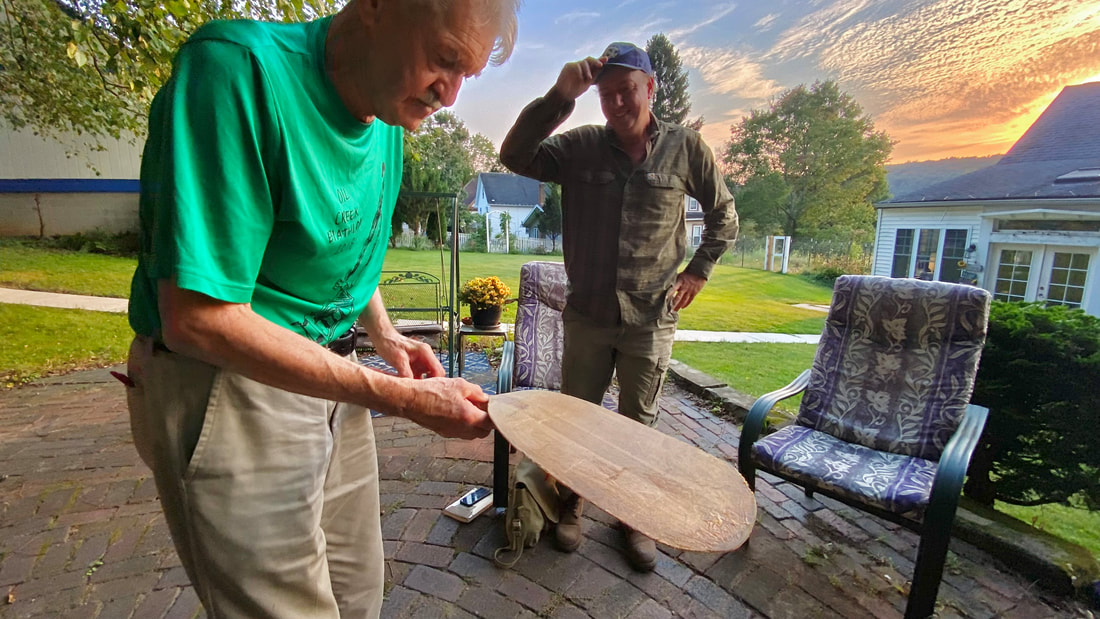
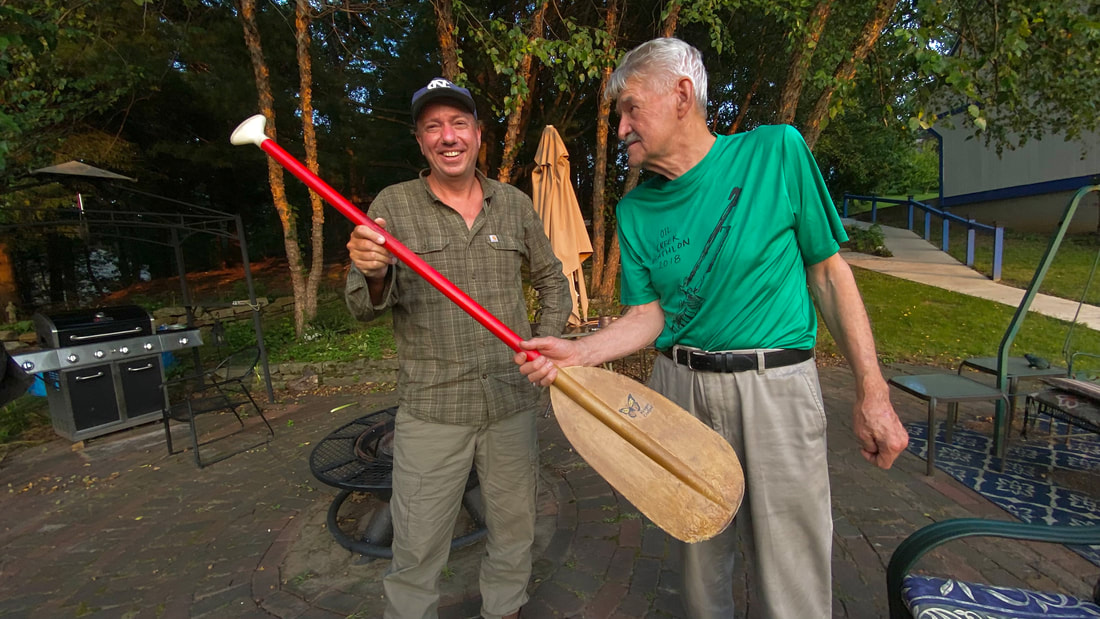
Boocks sat and joined the conversation and after chatting awhile it dawned on him that he had something he wanted to pass on to Moore. A paddle he used many times on many rivers that was a gift from a person that could be described as a forefather to the modern paddling world. Moore was very familiar with this legend. Verlen Kruger paddled over 100,000 miles in his lifetime, spoke many times about paddling all over the world and authored books on the subject. Moore said he had read Kruger’s books and admired him greatly. Boocks, a preacher, performed Kruger’s wedding vows.
Boocks invited Moore over to stay with he and his wife and sit out back to talk about life and the spirit that moves people to do what they do.
Neal Moore sits in Gale Boocks back yard this past weekend during his stop in Franklin and Oil City. Encounters like this one with Boocks and many others along the way are helping in the journey still to go. Boocks said the main reason he wanedt to meet Moore was to share his knowledge of the upper Allegheny. “It’s not hospitible in places,” Boocks said. “And know where those places are.”
And that’s what they did.
Boocks presented a treasured paddle he had received from Kruger to Moore as a gift. Moore said he never met Kruger. This was quite an honor for him to receive this and vowed to use the paddle as well as eventually find a younger paddler to pass it along to in order to further pay this gift forward.
Moore departed the next day adding Franklin and his encounters to the list of treasured memories and his scratched notes in his journal.
His goal is to get up north while its still milder temperatures knowing it is best to beat the famed western New York first snows of the year on his way to the Hudson. He is hoping to reach the end of his journey, the Statue of Liberty, by December 14. “I’m approaching her from the American side,” he said, adding that this country is so filled with those whose ancestors approached her from the other side, and that many still are. Adding again to the fabric of who each of us are as Americans.
Moore might realize the shortest distance between two points is a straight line, but straight lines are boring and zigzagging is more fun and allows more time for reflection and encounters. Making connections is exactly what this journey is all about for him. How we are connected by water, how we are connected by similarities and sometimes even differences, how we connect to strangers and friends alike. That is what hours alone with one’s thoughts can do, find those connections and add them to ones personal spirit that has grown from the experiences.
Moore embraces serendipitous moments, like meeting Boocks and adding him to his tribe. And he added several other Franklinites as well in his short time. Some, like Chamber director Jodi Baker Lewis also want to meet him again along the journey and join for a few miles of paddling and help him celebrate his arrival and end of this part of his journey.
Given his objective, his journey won’t end at Lady Liberty. He is on a journey to seek beyond his own tribe and try to better understand the tribe of humankind.
Photo courtesy of Jodi Baker Lewis who met Moore and now wants to paddle along with him during part of his journey sometime after Applefest is over. Connections, fabric, stories. Moore left the next day from Franklin and began posting more photos on his Instagram account.
Not his first try
This was Moore’s second attempt at this journey. The two time cancer survivor set out in 2018, but once in a century flooding brought that journey to an end. He said he is self funding this journey and tries to live minimally, often pitching his tent where allowed or a spot offered. “When you need help and help is offered, it becomes a part your life and your journey.” He said he’s learned over time that people want to help and he also like to help others. He and Boocks talked a great length about the spiritual strength of being in the service of others, a definite shared bond found beyond just the love of paddling on a river.
Understanding America’s heart and soul
Understanding who we are as a people with each stop along the way, Moore examines further the complexities and simplicities that makes Americans, Americans. Sitting on a patio in the back of Gale Boocks‘s house on a Sunday night, waiting for roasted corn and a couple of slabs of meat off the grill, Moore and Boocks shared an experience that can only happen when someone is accepting of a wayward stranger on a long journey. These encounters become beautiful to witness and experience. The many encounters we have in life we take for granted, family, friends, neighbors…. sometimes it takes a stranger to remind us of that we have so much more to learn about each other. And sometimes, how little we know about ourselves.
Moore is getting to know people and by doing so, he is understanding the culture of a place and how each place is different while being the same.
Moore and Boocks inspect the Kruger paddle that Kruger himself made. It is a kevlar paddle that Boocks said” if you were being attacked by a bear and you swung this paddle and hit him, the bear would stop and the paddle would still be able to be used.” When I asked Boocks why he wanted to give this paddle to someone he just met, he said “It just seemed like the thing to do when I found out he was a foller of Verlen.” Moore said he was humbled by the gift adding, “The power of this journey, the people I come in contact with and the nature around me. It builds. I’m in the best shape of my life at 49. I feel stronger everyday.” He said he has be fortunate to stay healthy and during the height of the pandemic last year he was very careful and as soon as he could get the vaccine he found his way off the river to get it.
Carrying people with him and how to follow his journey
Moore has been collecting signatures on the canoe. Some have faded or washed off in the journey, but many remain. All who signed are with him in his strength to go on. He has written also a quote from Richard Bock, the famed auther of Jonathan Livingston Seagull, “Bad things are not the worst thing that can happen to us, nothing is the worst thing that can happen to us.“
Moore tells a story like following a map of rivers with tangents and off-shoots. He has a penchant for describing adventurers of the highest caliber as “badass.” At 49 he is in the best shape of his life and his body and mind have allowed hime to stay focussed for thousands of miles of hard paddling. He is earning the badass title.Follow his journey on his website at https://22rivers.com/storytelling/ or on instagram at https://www.instagram.com/riverjournalist/?hl=en
A Peace Of My Mind: Building community and bridging divides through portraits and personal stories.
Neal Moore is paddling 7,500 miles across the United States. Photo by John Nolter, taken in Columbus, Mississippi.
Neal Moore is a journalist, an adventurer and an expatriate. He is in the midst of a two-year journey, paddling 7,500 miles across the United States. I met him in a coffee shop—by chance—in Columbus, Mississippi and we found time the next day to do an interview.
“So the big idea is to travel from sea to shining sea, connecting the waterways. I’m looking at 22 rivers. The idea is to touch 22 States and make my way across 7,500 miles from the Pacific Coast, to the Continental Divide, to the Gulf of Mexico, to the Great Lakes, to the very feet of the Statue of Liberty. It’s a two year journey.
I’m attempting to connect waterways, but also to connect the stories of everyday Americans, to listen to folks and try to understand what the commonality is, the thread between us that can spin positive and speak to our mutual experience.
I’ve been an expatriate on and off—mainly on—for 30 years. I’ve been living between Africa and East Asia for this time and this is a chance to come back to my own backyard, and to experience it up close and personal. This is a unique way to see the country.
The canoe is the first form of transport and these rivers and waterways are the first thoroughfares in this land and they absolutely connect. And so, to unfurl the map in your mind and then to try to plot out your course, it took a year just to plot the course.
When I look at rivers, when I look at water, I’ve always found that this is sort of a stabilizing substance. Our bodies are +/- 70% water. The surface of the earth is +/- 70% water. And I think there might be a correlation there. When I was younger, I went to school in Hawaii. Then when I transferred to the university of Utah, I would take off every winter quarter and go back to Capetown. And for the three months I was there—which is their summer—I would just be surfing in the water every single day.
I had all this stress. I had lost my brother as a boy. I had lost my mom. And when I came home, my dad had moved on. It was just me, and I found, when you submerge yourself, and even when you’re near a waterway, that stress washes off.
So, the idea was to paddle the year leading into national elections, and then the full year after, no matter how it would have turned out. What would we look like as a nation the year after national elections?
___
I identify as liberal. I sort of identify as very much as flawed, as well. So I understand that I don’t have all the answers. And the moment that I think that I do, that’s when everything sort of goes topsy-turvy and my personal life sort of gets messed up. And so for me, when you you do unfurl that map of America, and you look at my route, this route that I’ve selected, these 22 rivers and waterways, it’s by and large, all red. The country is very red in these rural locations that I’m finding myself paddling through and stopping off to, to meet folks.
So my thinking going into it is sort of like George Orwell and his masterpiece, Homage to Catalonia where he’s a journalist based in London. This was before his fame, of course, with Animal Farm, with 1984. Well before that, and he puts himself onto a boat and he disembarks in Barcelona and he attaches himself to the losing side of the Spanish Civil War and to an anti-fascist faction known as the POUM. At the end of chapter one, he finds himself on the front, taking a shot at another human being for the first time in his life.
What he says is, “understand that I am biased, but also understand that I am here.” And this is the age before the green screen. But what he’s saying is we have New York journalists, the big name ones, and we have London journalists, the big name ones who say that they’re there during the Spanish Civil War in Spain, and they’re not. They aren’t there and they’re still biased. But as he says, I’m biased, but I’m here.
And so my thinking, looking at the map in that vein and with that exclamation point is to see the country and to learn, and really try to take off the mask of these monikers that we sort of throw on to ourselves. The things that if we let them, can separate us, be it identity politics, be it race, be it religion.
What I’m looking for is that common thread, from coast to coast. What I’m really looking for is the common humanity, and I’ve seen it. I’ve seen it with individuals. I’ve seen it with families. I’ve seen it with communities. And when you see it, and when you’re able to document it, it just blows you away. It’s so profound.
When you add up all of these stories, everybody has a story. My thinking is by the time I get to the Statue of Liberty, and approaching her from a rarefied view, coming the wrong way, from the West Coast to the East Coast, I feel like I earned these towns, that I earned the chance for these stories. I want to earn that view. And to really properly understand it, I need to first understand who we are, and what we’re about and how far we’ve come.
___
I think the big surprise for me has been the wildness. A journey like this by and large, you’re pushing yourself out into the wild. And then in so doing, you get to embrace the wildness within. As Max finds out with Where the Wild Things Are, the monster is inside of us. And so to be able to understand that, embrace that and try to deal with that on a personal basis, in concert with nature. When you’re in your canoe, you’re down low in the water, and you see it, you experience nature from a wholly different vantage point.
Every day that I’m out there in nature, every single day, I find myself laughing. It’s this care-free laugh of, I really should be clocking in or clocking out somewhere with a proper job. And I’m not. I’m out here in nature and I’m free. I’m positively free. And there’s something beautiful about that.
I’m generally up an hour before first light. I’m deflating my air pad and rolling up my sleeping bag. I’m packing up inside the tent and taking the tent down. It takes about an hour to an hour and a half. And then I put all of my worldly belongings into my canoe. And I push off. And in that exact moment, it’s just pure perfection.
There’s something so beautiful about that moment where you step off from Terra Firma into the water. Whether I’m headed downstream with the current or whether I’m fighting like hell going upstream, you’re in the moment. I don’t travel with with earbuds in my ears, listening to books on tape or listening to music. Nature herself is my orchestra.
And when you’re paddling, you’re looking out for obstacles at all times. So you’re listening to the water. You’re watching out for boulders. You’re watching for hanging tree limbs.
Whether it be the pandemic or whether it be the headwinds and the tornadoes and the two derechos. There are hard times, but you understand that it’s temporary. You understand that around the bend, that we’re going to be okay.
In many cases on this journey, I’m risking my life. I’m putting myself completely out there. And there’s a strange thing that happens. There’s this strange phenomenon that takes place, when it’s touch and go, when you realize that you’re in a situation that can absolutely end your life, it’s when you feel like you really live. You have to focus. You cannot freak out and you have to see your way through.
And so whenever you have tribulation, you have to have to experience that. Be it the loss of loved ones, be it nature’s temporary fury. You have to soldier through. And by making your way through the hard times, on the flip side of that, when you make the safe harbor, when the sun comes out nice and bright and beautiful, then it’s all the sweeter. It’s all the sweeter because you’ve earned it.
___
I think our greatest strength is empathy. When you stop and you take away these labels that we like to identify ourselves by. When you strip all of that away, what we’re left with is something beautiful. And it’s something I think that we can all connect to. We can all relate to. And if we let ourselves, we can all love in a positive way. That is our common humanity. That is the natural desire to help, to have empathy for our brothers and sisters. And I think from coast to coast, what I’m finding doesn’t always work out that way, but when you’re looking for it, you see It. You see it.
And when you do see it, it strengthens your belief in mankind. And I think it makes you—the would be traveler in this life—a very happy person.”
Discussion questions:
-What is the boldest adventure you have ever embarked on?
-Have you ever placed yourself in harm’s way?
-When have you pushed your physical and psychological limits?
-Have you experienced water in a healing way?
-Do you agree with Neal that empathy is our greatest strength?
-When have you offered empathy? When have you received it?
-When have you had a clear sense of our common humanity?
-When have you experienced wilderness?
-What does Neal mean by the phrase “the wilderness within?”
-If you could set off on a journey, what would you hope to find?
Fourteen months ago in Astoria, Oregon, Neal Moore shoved off in his 16-foot Old Town canoe, bound for the Statue of Liberty, some two years and 7,500 miles ahead. The 49-year-old had come home after nearly 30 years abroad to rediscover America and share the stories of its people in a style of journalism all his own, “slow and low down from the view of a canoe.” …
Neal Moore uses detailed charts of the Mississippi River to plot stopping points and possible campsites while canoeing across the country. He is in the middle of a 22-month, 7,500 mile journey that will take him from Oregon to Ellis Island. Photo by Les Winkeler, THE SOUTHERN ILLINOISAN
GRAND TOWER — Neal Moore has packed a lot of adventure into his 49 years, beginning with a Mormon mission trip to South Africa as that country was emerging from apartheid. Moore has spent most of his adult life in Africa and Asia, but has longed to return to his American roots.
The California native is currently in the middle of a 7,500-mile trip in which he hopes to reconnect to his native country in an incredibly personal way. He is essentially retracing the steps of Meriwether Lewis and William Clark’s epic Voyage of Discovery.
He will travel 22 rivers over 22 months while making his way from the Columbia River in Oregon to Ellis Island in New York. Moore recently spent the night in Grand Tower where he provisioned himself, just in time, for colder weather.
An author and freelance journalist, Moore’s goal is to gain insight into the soul of America, to dissect what Lewis and Clark have wrought, there is another side to the trip that Moore had to take into consideration while planning. Twenty-two months in a canoe, making your way through some of the biggest, as well as most treacherous water in the United States takes a toll – mentally and physically.
The reality of paddling nearly 7,500 miles is one of the reasons Moore is doing the trip from west to east … he’ll spend a lot more time traveling downstream.
“I’ve been planning and planning this for quite some time,” Moore said. “I was looking at initially going from east-to-west, naturally to tell of the progression. I was given a contact of Norm Miller, he runs the Missouri Paddlers page. He paddled a canoe in 2004 from St. Louis, up the Missouri River and over the divide. Talking to him what he said was it’s not the physical part, the struggle.
“I looked at the map, I knew there’d be 200 miles from Cairo to St. Louis, to come up the Mississippi, then up the Missouri, but what he said was psychologically, for hundreds and hundreds of miles on the Missouri to paddle up, it’s wild up to Yankton, knowing you could walk faster … So, looking at the map I got excited thinking, ‘What if I could do the whole thing in reverse?’”
That’s not a small consideration when you begin a 7,500-mile journey will some back issues. To compensate he outfitted the canoe with a back rest and steeled his mind.
“You’re forced to be strong,” he said. “Your body becomes strong, but also, mentally, you have to see that goal. It goes back to being an Eagle Scout where I wanted to give up and dad said, ‘You can’t give up. You started something, you have to finish it.’”
He began a similar trip a couple years ago, but flooding forced him off the water.
“Two years ago, I was against a 20-year flood on the Columbia River,” Moore said. “It’s really heave ho, I really like the idea of the open canoe. You’re experiencing the same hardships they (Lewis and Clark) would have encountered as well. You’re opening yourself up to hell or high water quite literally.
“But, you’re also open to all of the good. You are going to meet people who aren’t so nice. You’re going to meet people who might wish you ill. You’re going to meet a lot of people who are there to support you and encourage you that you can learn from as well. That also goes hand-in-hand with their experience as well.”
That’s where the psychology kicks in. For 22 months, Moore will basically be isolated on the river, except for the people he meets along the way. There is no room for a support group in his [16-foot canoe].
During the course of the journey, he will spend most of the time with his own thoughts.
“You have to will yourself forward,” Moore said. “You fight and you fight. This is a part of life as well. You have to have a goal and you have to sort of struggle. And, part of the beauty is the struggle. There are days where you just whistle and you just laugh at the beauty, the beauty of this river. You also have the other days where you are fighting for your life.”
He said his early life featured frequent moves, forcing him to make new friends on a regular basis. That experience is coming in handy on the trip, although there are still some difficult times.
“The psychological part, I don’t like big crowds too much,” Moore said. “I really like the idea of being out there. At the same time, I’ve moved for the majority of my life. When I was a kid we lived in eight different houses in Los Angeles.
“Especially doing these stories, you have these intense kinds of friendships that are short, then you have to get back on the water. That, for me, I think is the hardest part. As my mom tried to teach me, by leaving you’re opening yourself up to the possibility of the realization of more friends and stories down the road.”
You can follow Moore’s progress and chart his new friendships at www.22rivers.com.
Along the Snake River at Nisqually John Landing, Wash.
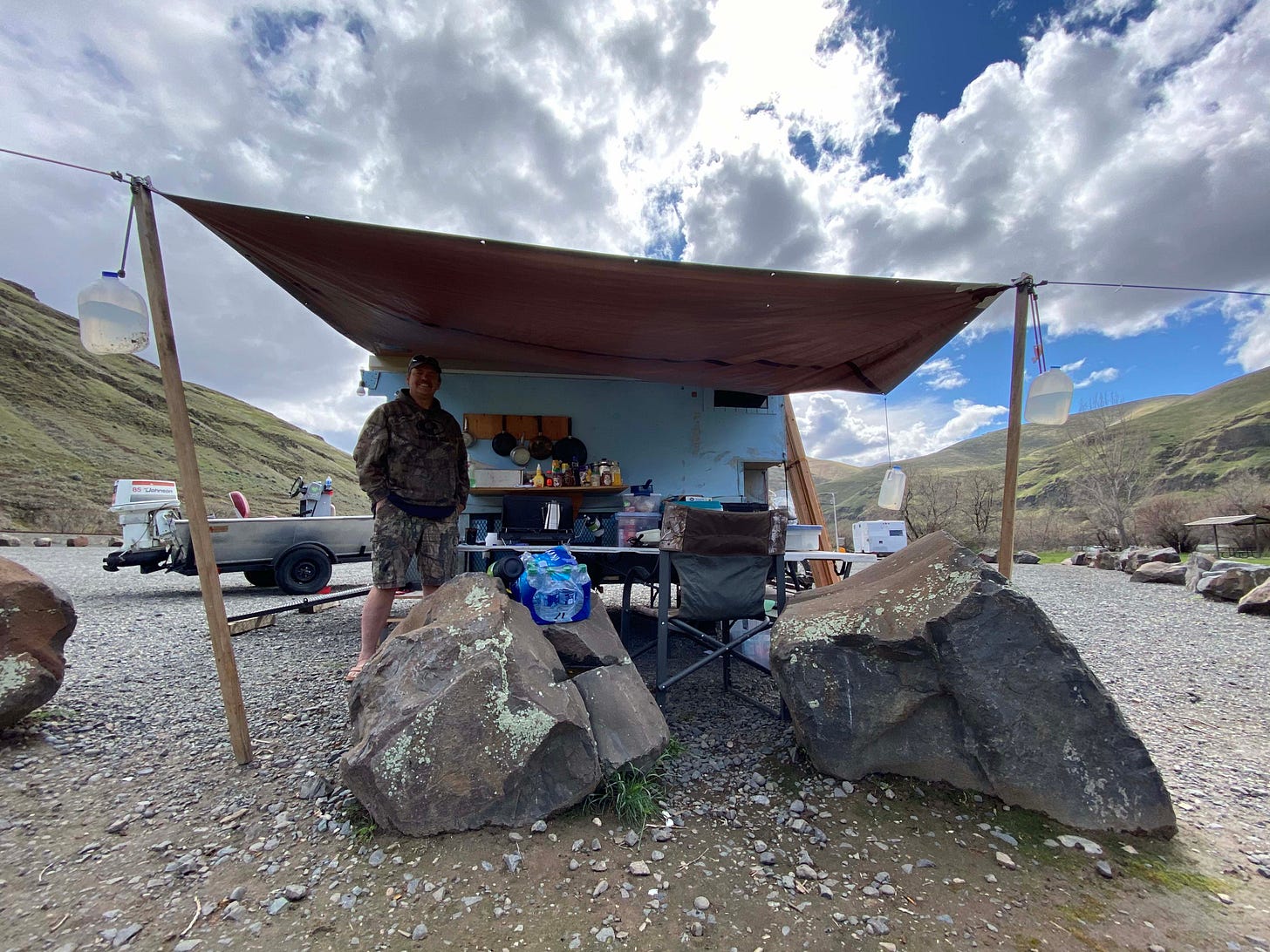
Brian Bensen stands astride his makeshift home with pride. Bensen was my neighbor at Nisqually John Landing, Wash. Photo by Neal Moore.
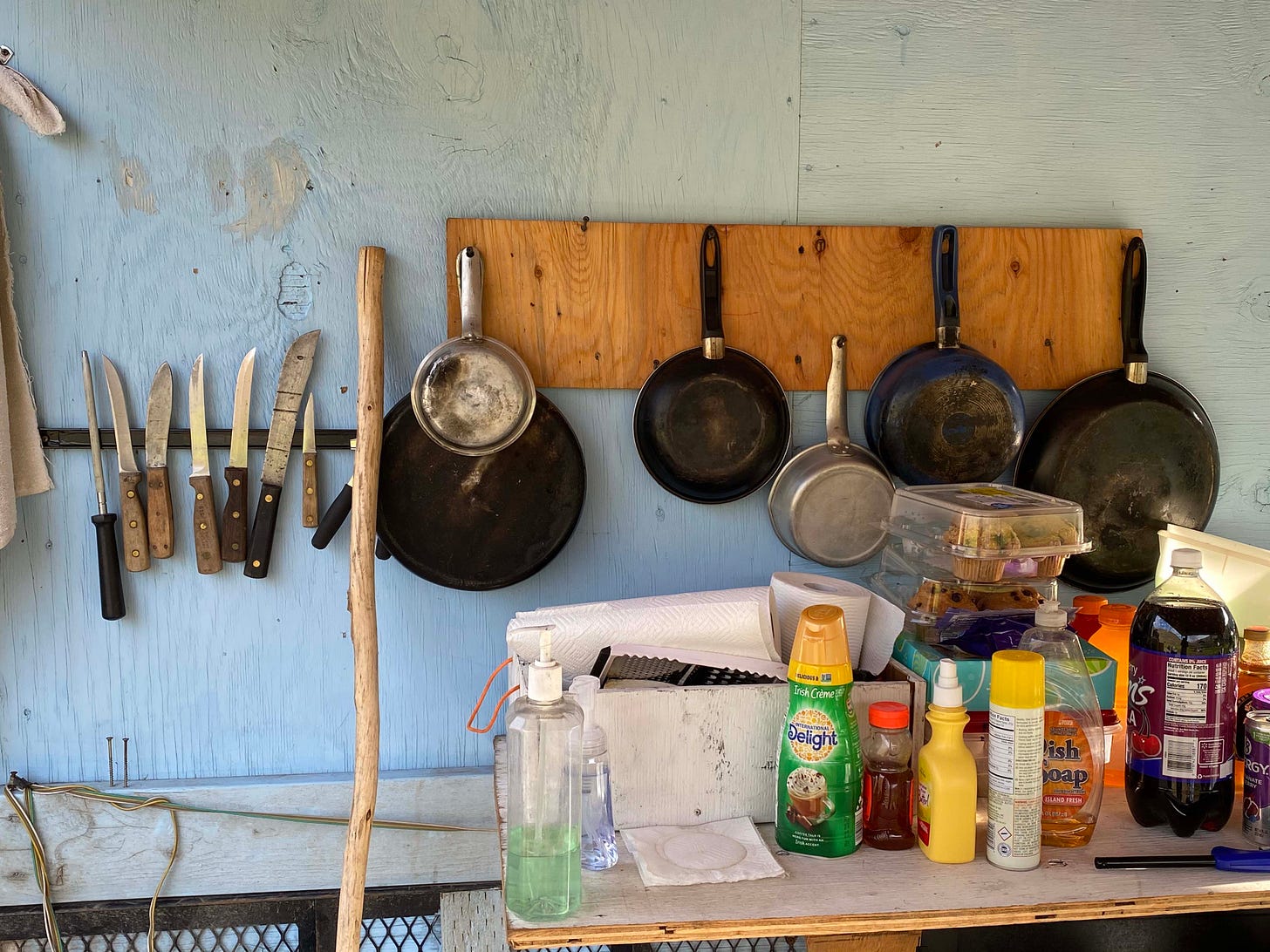
Brian Bensen is a minimalist, a fisherman, a hunter, and a survivor. He lives along the banks of this river, of multiple rivers, out of a 7’ x 12’ motorcycle toy-hauler he lovingly calls his house. Attached are a quartet of solar panels, a trio of car batteries, an AC/DC converter, a drop-down bed, an air conditioner, a TV and DVD player, pots and pans and knives and forks, a bottle of Purell hand sanitizer, a tarp, and a blanket hanging off of his higgledy-piggledy back shower featuring Marilyn Monroe. Bensen has spent the last three years shifting this home, along with a Kawasaki 650 off-road motorcycle that clamps down inside, an aluminum jet boat, and a GMC truck to pull them from camp to camp, Gypsy-style. “If you look, especially in the Northwest, in the twelve Western states,” he says, “there are campgrounds that are beautiful where you can spend 14 days, no money involved.” He laughed at the thought, at all the memories of Lolo Pass in the summers and this very spot on the Snake piled with snow come the winter. “And that’s about as long as I want to be in one place anyway.” Bensen is sixty-two and he’s been on the move for all of them. Civilization calls his elemental lifestyle homeless, but he calls it sweet freedom.
“I consider myself the king of campin’ because I’m off the grid,” he says. “I’ve been at it three years, perfected a lot of things. Literally, if I have to, I can survive. With nothin’. No help from nobody.” Although there are contradictions to being labeled a minimalist when you have a Kawasaki 650, he might be forgiven because he wants to trade it in for an electric scooter. But either way, he is still a minimalist. And that’s part and parcel of Spartan.
When folks less fortunate come around, Bensen is happy to share. “Just heat up the coffee if you want,” he told his neighbors, a homeless couple from the neighboring trailer at Nisqually John Landing here in Whitman County. “The heater is right there. The creamer and honey, it’s on the shelf.”
Detail of Bensen’s collapsible kitchen. Push comes to shove, Bensen’s going to provide for himself, and he’s going to give to others. “I figure if things get really, really bad – especially after what I seen at Walmart a couple weeks ago, I can always feed myself. Feed as many weary travelers as I can.” Photo by Neal Moore.
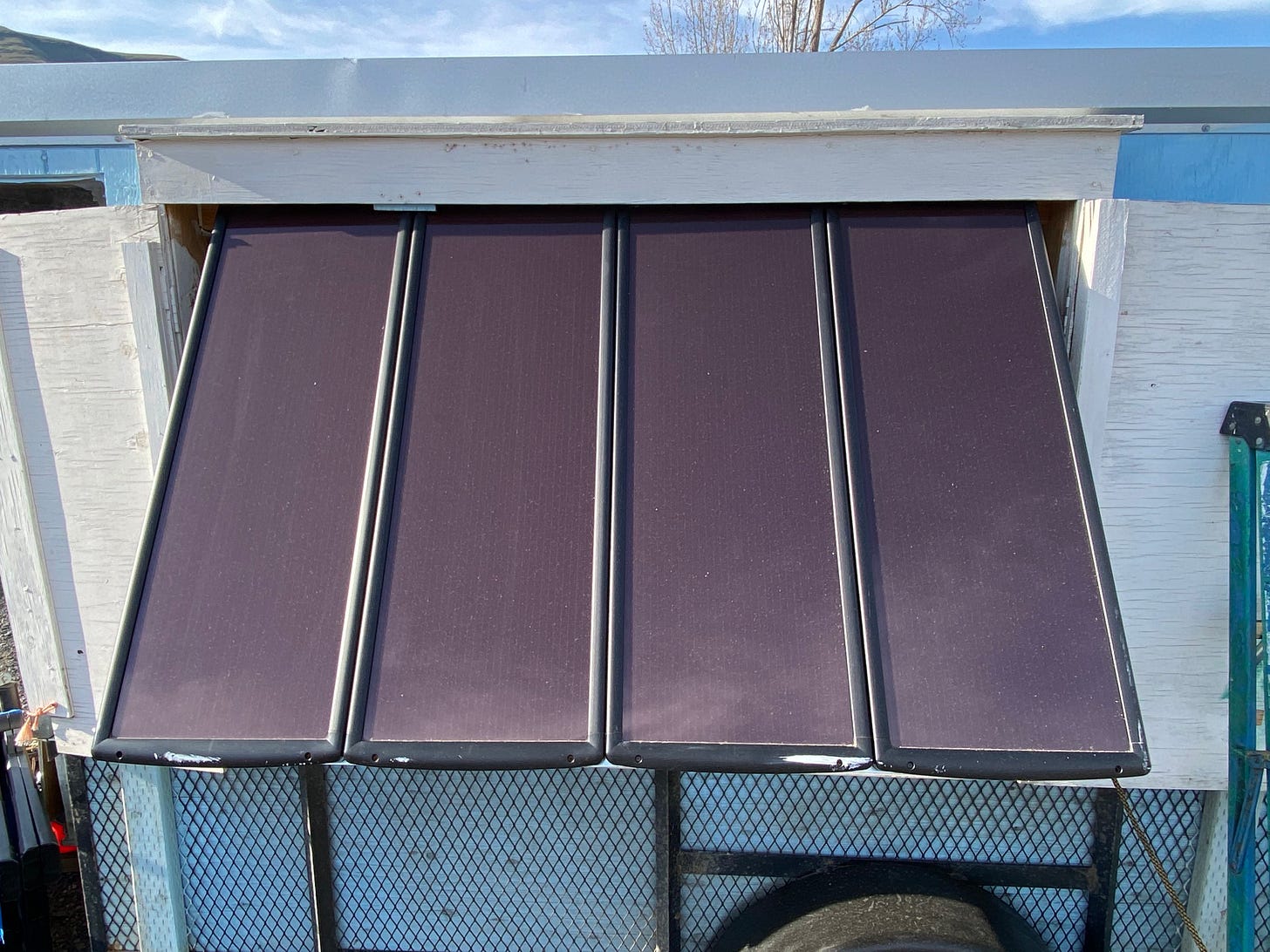
Detail of Bensen’s solar panels attached to the side of his toy-hauler-cum-home. Photo by Neal Moore.
The world around Bensen, around us all, finds itself in a gut punch of a downward spiral and we don’t yet know what bottom will look like. When asked what advice he might have for others, for people that will soon find themselves, not by choice, but by necessity, out of doors, he thought and then raised his head and his voice like a preacher. “My advice to you if you find yourself in that situation, first off, it’s one day at a time. Think of nothin’ but base survival. And then modify it. That’s what I did. I started out with one panel and one battery – so I could afford about two hundred bucks. And then once I got to know the system, I continued to learn, to graduate farther and farther.”
Bensen bought most of his hardware at Home Depot in the 75% off rack. The solar panels, each twenty-five watts, came from Harbor Freight. The solar system is capable of 14.4 volts. The whole setup with the control module and lights, because he’s a preferred member and he had a coupon, was $149. On top of the trailer are coils that go back and forth in plastic garden tubing which Bensen reckons can handle between eleven and thirteen gallons of water. It’s mounted on a 30-gauge galvanized steel sheeting roof. It gets hot in the summer. So hot, he had to add a cold-water line to mix it. “So, the whole setup you’re looking at – I probably don’t have 2 grand into it, including the power and the trailer – the whole nine yards.”
Brian Bensen shows a passerby the inside of his trailer at Nisqually John Landing, Wash. He calls breaking camp “riggin’ down”. He can rig this trailer down to move on to the next camp in forty minutes. Photo by Neal Moore.
It’s easy to glorify, but difficult to understand a truly Spartan lifestyle. The Spartans of ancient Greece lived with their armaments. They were warriors. They lived with physical emphasis. The emphasis was on combat. Bensen, who was born into the Home of Truth satanic cult in Moab, Utah, was raised up with the group’s, and later his family’s strict and simple ways. He is missing his left eye, and he told me his step-father, who he says he could never please, once yelled at him: “An eye for an eye? No! Somebody takes one eye, you gotta take both.” Bensen has been fighting for as long as he can remember, he’s been scrapping his way to happiness and freedom since he left home, his family and the commune at age thirteen. He admits to an “illustrious life,” including stints on the oil rigs, cowboying like a vaquero, raising his family as a single parent rough and on the road with a child in one arm and a “Will Work for Food” sign in the other, along with stretches in multiple county jails.
The road forward for Bensen and his menagerie of vehicles is fraught with Covid-19-related closures. His favorite camping spot, Heller Bar, surrounded by semi-arid mountain peaks and an entry point for power boats into Hells Canyon, recently denied him entry. Soon after we met, all free camps in Idaho closed their swinging gates. While I was here at Nisqually John Landing, state park rangers came by to cordon off the bathroom, and there are rumors of this camp, of all free camps in Washington following suit.
“I never go hungry because I’ve always got food around. Once the snow melts, and it gets warm, I get up into the mountains. If they block off the roads, I’ll take my Kawasaki – they can’t stop me. Man, there’s wild berries and wild lettuce. It’s a paradise. I eat a lot of fish because I am ‘the master of disaster spin-caster’.”
Bensen’s got itchy feet by nature, and you never know what’s coming next. When his wheels and his boat and his trailer are not in motion, his mind is. “I can literally go wherever I want, whenever I want, for however long I want,” he told me. “My goal for this winter is – I’m headin’ down to Yuma. And wanderin’ around the desert lookin’ for the Lost Dutchman’s Gold Mine. For somethin’ to do. To entertain myself.”










 22 Rivers