
BROWNSVILLE, MINN
A number of habitat islands are taking shape in the Upper Mississippi River just below Brownsville, Minnesota near the Minnesota-Iowa boarder – islands in the stream now being reclaimed for wildlife that were once prevalent before the Corps’ locks and dams were introduced back in the 1930s. The project is an effort by the U.S. Army Corps of Engineers, in conjunction with Fish and Wildlife, and Minnesota and Wisconsin Department of Natural Resources to “restore lost and diminished fish and wildlife habitat in the pool by restoring islands.”
According to Jesse Weymiller, a local tow-boat sub-contractor tasked with moving rock via barge to help construct the approximate 22 islands in the project, the work is moving along well – now in phase three of three phases.
 Jesse represents three generations of river-men who presently man their set of two tow boats and multiple barges – a local family run business who represent over 100 years of experience working the river between them.
“I started working when I was 15 – first working summers,” explained Jesse, now age 29. “I guess my future was pretty well set out before me.”
Jesse’s uncle, Tim Weymiller, who has worked dredging, towing, and construction on the river with his father from the age of 12 likes the idea of local workers included in the project. According to Tim, most jobs go to out of state contractors and sub-contractors, up from Mississippi and Louisiana, with locals making up about 20% of the current workforce. “But that’s really okay – because we also travel. We go where the work is. It just so happens we’re now working local.”
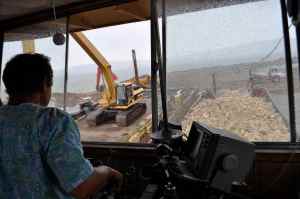 The islands are comprised of a layer of sand which is dredged from up stream in the river, a layer of rock, followed by the planting of native grasses and rows of willow trees to help buffer the island while attracting a number of waterfowl, turtles and fish.
I spoke with local resident and fisherman Jody Sonsalla who talked about the cost involved – stating it was a very good thing. “A number of years ago, the Mayor of Brownsville – Tim Sears – stood up and told the different people at the [town] meeting – ‘You know, $100,000 worth of rock in 1980 would have saved us $15m today’ – and it’s true – and you know, it’s one of those things that if we wait till tomorrow its just going to cost us more.”
While I canoed through the three-mile construction zone taking shape in the middle of the river, it was pleasing to see a return of the waterfowl that were once so prevalent in these parts. I noticed bald eagles, pelican, seagulls, as well as a great egret who stood watching the cranes, tugs, tow boats, and barges, busily re-creating a once-lost habitat.
 (11/28/07)
 Starting from the Brian Coyle Center of the University of Minnesota where Somali children of all ages worked on computers, talked music, and played basketball, we moved through the inner-city landmark of Cedar-Riverside Plazas, a low-income housing set of buildings – all colorful beyond belief – which have been reclaimed from a once drug/gang infested stronghold. “You used to not be able to enter that area,” explained Ms. Hakeem, who ran for City of Minneapolis Mayor back in 2005 under the Green Party banner. “But now you can walk around freely, even at 10pm at night. When the Somali refugees began to arrive, they naturally moved into the least expensive section of town – Cedar-Riverside.”
  Part of learning about pride in your community comes from actively pitching in to help it out. As we moved along the streets and under the bridges, Ayan and Mary introduced me to their latest community project – a mural of Minneapolis they are working on in conjunction with “Articulture”. Here, Executive Director Elizabeth Greenbaum explained that when it comes to at-risk kids mixed with art, “art is a wonderful equalizer, especially for students who don’t succeed in other subject matters. When you think about it and take it a step further, we’re talking about the basic understanding and the basic concepts to write – and that leads into reading and that leads into learning – so [the] arts are very much orientated to learning on all levels.”
 thought about the mural, now bordering one side of the building his shop inhabits. Without thinking, he simply said, “I think it’s a great idea. I’m very impressed with the groups of people who go there.” When asked how the old-school, predominately German and Swedish community is adapting to the large influx of Somali refugees, Jim thought before explaining, “While most people are okay with it, overall I think a lot of the seniors aren’t adapting.” Although he was quick to point out that after all, these same old timers had once been immigrants as well.
  Relay for Life is in association with the
  At the age of 36, one town cancer survivor, Kathie Smith, a mom of two young children, explained that it was Austin Price, a young boy who was diagnosed with cancer at age 4 1/2, who “paved the way for my kids to handle me being diagnosed with cancer.” “I graduated from high school together with [Austin’s mom] and Austin was in day care with my children. He taught my kids that just because you have cancer [it] doesn’t mean it’s fatal.” Somewhat of a living legend here in Aitkin, Austin, now age 6, has survived a year following eight months of hospitalization and treatment down at Children’s Hospital in Minneapolis. “He’s made it,” beamed Kathie, fighting back tears.
 When asked for advice for others who might be fighting for their very lives around the world, Austin, moving between examining the camera and sitting on his mother’s lap, rubbed his head before answering: “Be strong” – to be followed by the simple, hard fought admonition – “be brave.”
 “It was a surprise to get the award from the Minnesota Small Business Administration but also a bigger surprise to be invited to Washington D.C.,” explained Mr. Wells. Upon arrival to the White House with small business award winners from different states, Andy was seated in front as a ‘special guest’ – a guest whom President Obama would address in his speech on the “courage and determination and daring” of great leaders, stating: “It’s what led Andy Wells, a member of the Red Lake Ojibwa Tribe to invest $1300 back in 1989 to found Wels Technology, manufacturing industrial tools and fasteners, and creating jobs near reservations in Minnesota, where he lives.”
 Upon arrival at Wells Technology, which doubles as Wells Academy, it struck me as an interesting concept to put a classroom front and center in the headquarters of a main business office. “Every day is an open house,” explained Mr. Wells. “Every day we’ve got a busload of reservation kids or church groups or even car enthusiast clubs coming around. When the busses pull up you can see who the tough kids are – the ones who smoke a cigarette outside before coming in and hang their head in the classroom. But when we start to show them how our products help shoot flares out of military helicopters and other interesting things, they perk up – they start to ask questions – they start to understand why it is important to learn about math and science.”
 “There is book learning and there is other wisdom,” explained Mr. Wells, referring to the system of ‘elders’ within the Native American community. “The [positive] influences began in my life early – it was neighbors, my parents, my grandparents … A neighbor friend, named Charlie Barrett, who really had no formal education but was a very humble neighbor noticed me running ahead of the adult groups quite often and he said to me, ‘Why don’t you open the door for people when you’re up there.’ At the time I thought he meant the physical door but now when I look back, maybe he meant more. Maybe he was a wise fellow like many of the wise people I’ve met, and he could see that perhaps one day I would be able to open doors of opportunity for people – and now that’s one of my main missions in life – to continue doing things that help other people because so many have helped me.”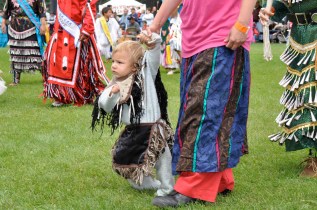
 Veterans, the youth, women, and elders are all honored at this traditional pow wow, now celebrating its 47th year, in multiple ways. Many of which are sacred and cannot be recorded by camera or sound. For example there are the songs of the drums. Each drum possesses within it a song which is special – a song within that only that drum can play.
 What makes this particular pow wow special is that it features approximately 300 dancers and concentrates on the old and the young. My take for a story was to attempt to document how the knowledge of the dance is passed down from the old to the young, from generation to generation.
 And funny enough, when I spoke with Andrew Wakonabo, a winning boy crowned “Mii-Gwitch Mahnomen Brave” from last year, he said the same thing, explaining, “I pretty much learned myself – watching other people dance.” The winning dancers are crowned “brave” and “princess” and their title is more complicated than simply wearing a crown and a banner. Leech Lake Band of Ojibwe Councilman Joe Gotchie explained that once they win, for the entire year they must “demonstrate responsibilities [so] that other youth look up to them.”
 There’s a bond between the old and the young within the Native American community that other cultures can learn from. The Ojibwe historically used complex pictures on sacred birch bark scrolls to communicate their knowledge.

 22 Rivers