Hood River News: A voyage by canoe across America

A7_Neal_Moore_t800Photo by Kirby Neumann-Rea

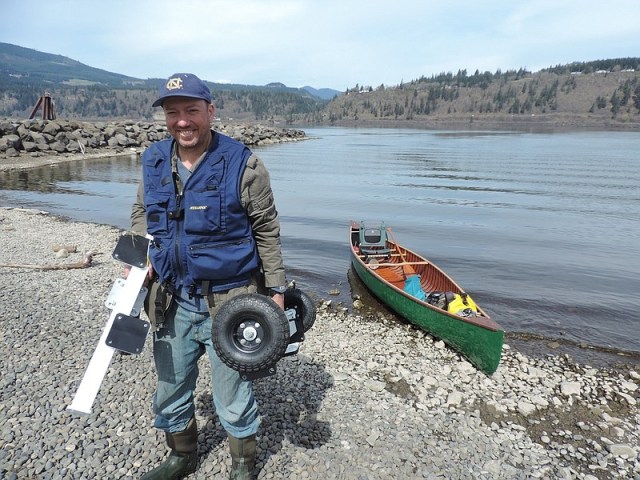
From the Pacific to the Atlantic coast, Neal Moore (pictured) will travel a total of 7,500 miles across America in the next two years, by both canoe and land, to document and connect stories of diversity.


Hood River News

Over the past eight years, former CNN [citizen] journalist Neal Moore has not traveled, but has lived in Africa and China to try and understand different cultures instead of just experiencing them.

Now, he’s on a mission to understand ours in America.

However, his voyage to understanding America is unique in a way that connects himself with the origins of this country.

In 2008, Moore had this idea that, “What if the greatest adventure was in your backyard?”

Not literally in “your backyard,” but instead the backyard of this country: rivers.

“Before we had roads, we had rivers,” said Moore. “To really understand where we come from, my journey relies on using the nation’s rivers with my choice of transportation being a canoe, as that’s how I feel is the best way is to learn about the origins of this country as I am putting myself in the shoes of those before us.”

In a two-year expedition, Moore’s solo journey by canoe stretches 7,500 miles across the country.

Born and raised in Los Angeles, Moore’s access to outdoor recreation growing up was a hard thing to come by.

But what helped him to venture out of the city was becoming a Boy Scout.

Moore, who is an Eagle Scout, had his first experience with canoeing at summer camp at the age of 12.

That experience, along with his passion for storytelling, helped lead him to the 7,500-mile voyage he currently is on.

The mission of Moore’s journey is to document and understand stories of diversity from Astoria to Queens, New York, to find the “common amongst us all,” said Moore.

Moore started his two-year voyage early last month in Astoria because of its “rich history of diversity,” said Moore.

Astoria is home to the first U.S. settlement west of the Rockies, and saw some of the nation’s earliest migration with Chinese immigrants.

And with Queens being one of the more diverse places in this country, Moore’s decision to highlight these two cities as a start and end will help him discover “the common between our nation,” he said.

“By taking my canoe through the rivers of this country and connecting the stories from Astoria to Queens, I’m trying to give face to a country that’s split into two,” said Moore.

However, it won’t be easy.

Moore’s expedition will take him across 22 different rivers and states, including the Columbia River, where he’s currently paddling.

“The Gorge is a different animal,” said Moore. “It’s like nothing I have experienced river-wise.”

Not only will canoeing across the country be a difficult task — Moore already feels he has developed arthritis from paddling his canoe 152 miles into this journey — but trying to understand a country and the people within it in a short period of time will show itself as a challenge.

Although that’s what makes this journey achievable for Moore.

“When you push yourself outside of your comfort zone, you must make new connections and it puts yourself in new situations that you wouldn’t be in otherwise,” said Moore. “That’s what makes you grow.”

Moore split his journey up into three parts: to the Great Divide, the Big Easy, and to Lady Liberty.

Moore hopes to complete the first 1,086 miles of his journey to the Great Divide in two to three months. To follow and learn more about Moore’s journey visit 22rivers.wordpress.com/about-the-voyage.

Wheels!

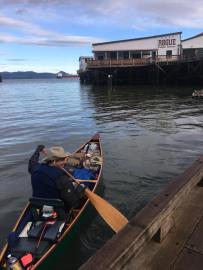
Friend David Brown at Precision Rail of Oregon helped me put together some wheels to connect rivers on my journey across America (see the yellow lines on my route to see where I’ll need to haul the canoe and gear). The wheels are loosely based on Steve Posselt’s design, a long distance kayaker who just paddled down the coast of Australia — who told me he’s portaged for over 1000 miles in his career. Amazing!

The Daily Astorian: Spinning a story

Freelance journalist sets off on 7,500 mile canoe odyssey

By Elleda Wilson

The Daily Astorian

Published on March 9, 2018 12:01AM

Screen Shot 2018-03-09 at 3.22.21 AM

Neal Moore, a freelance journalist called “a modern-day Huck Finn” by CNN, set off from Pier 39 in Astoria last Saturday to start his two-year 7,500 mile cross-country canoe expedition. But his mission is more than the journey — along the way he wants to “spin a story of the human face of the economic situation. And in Astoria, I’d love to start out with a good one.”

To that end, he wanted to interview Astorians “from the Nordic, Finnish and/or Chinese-American community who run a business. … The idea is to speak about the first settler inhabitants of the town (these three cultures), and see what they’re up to today.”

Regina Willke at the Astoria-Warrenton Area Chamber of Commerce helped him set up interviews, and he was off and running. He talked to Liisa Penner, Pam, Julie, and Lori Lum, Robbie, Roger, Ron, and Flora Law, Berit and Yorgen Madsen, Saara Matthews, and Sari Vedenoja. Floyd Holcom was Neal’s departure consultant, advising him on the tides and safest time to leave, and local writer Peter Marsh took the photo shown of the actual takeoff.

The Astoria interviews will be the first of his 100 stories across America, which will turn up on his blog at tinyurl.com/NealMoore in a few months. Photos are already up on his Instagram account at instagram.com/alittlewake, and you can also follow his travels at fb.me/alittlewake

“The town has been so very hospitable and friendly,” he recalled of our fair city. Apparently Astoria made as good an impression on Neal as its residents.

Launch from Astoria, Oregon

thumbnail-4A successful launch from the mouth of the Columbia River at Astoria, Oregon. A treacherous stretch of river awaits, along with the promise of adventure and stories and friends over the next two years. Cheers to Floyd Holcom, Tom Hilton, and Peter Marsh in Astoria for their hospitality, assistance with preparations, and camaraderie, along with all of the families I interviewed in Astoria for the very first story to be (stay tuned). Also thanks to my friends around the world for their support and belief in this project. The big idea — to paddle a canoe 7,500 miles across the United States — from the Pacific to the Continental Divide to the Gulf of Mexico to the Great Lakes, to the Atlantic at New York city — in search of the American dream.
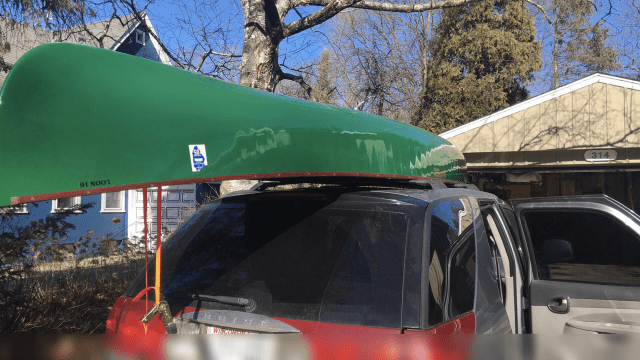
Photo courtesy Floyd Holcom; video courtesy Peter Marsh.

The Picasso of canoes?

To launch out onto a voyage of nature and heartland and Main Street and liberty, to embrace and fully explore the storied town and country and river landscapes of this land down low from the bow of a canoe, it felt only natural to consider my vessel to be as more than a mode of transport and lifeline, but as an allegory for freedom.

Which led me to the history of canoe making in the United States, and with it, the legacy of master wood-and-canvas canoe maker L.H. Beach of Merrimack, N.H., who in the 1950s first introduced a thin fiberglass hull reinforced with wooden ribs to the world. “THE FIBERGLASS CANOE THAT LOOKS LIKE A CANOE” was his slogan. A perfect blend of the old and the new.

00o0o_bTRA4RFzG1p_1200x900

From L.H. Beach to his son Lem, to grandsons Randy and Vernon, the authentic Merrimack design was passed along and remained true.  While Randy retained Merrimack for many years in name, his “black sheep” brother Vernon moved West and started up Navarro in his California garage, a canoe design based on Lem’s old molds.

Fast forward to the present, with WhiteGold and Kevlar and Tuf-Weave Flex as one’s (pricey) choice of material, with manufacturers like Northstar and Wenonah and even my very own Old Town running through my mind (according to Paddling.net there are “900 or more canoe models to choose from”), I decided to look back to where the revolutionary balance of old and new originally began.

With Merrimack eventually purchased by Sanborn Canoe Co. of Winona, Minnesota, and Navarro bought (via Craigslist) by a pioneering retiree couple in Rock Island, Illinois, the choice came down to price and availability.  And just the right model for this trip.

Loon on CarThanks to an exchange of emails with Bruce and Sue Peterson of the reincarnated Navarro Canoe Co., I soon settled upon the Loon, which can track in wind and wakes and waves, and also carry a generous “expedition” long-distance load.
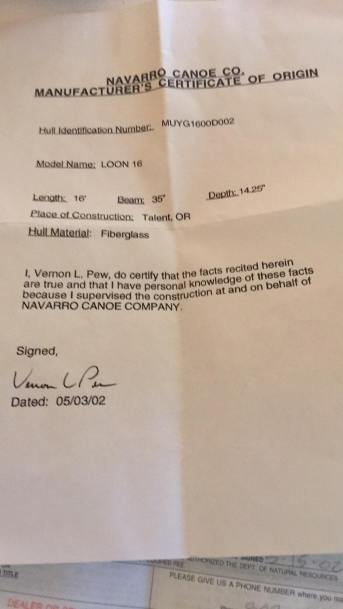
27398526_10155724263167655_1462546566_oIn the end, I took a lead from Sue and found my very own Navarro Loon on Craigslist up in Lake Bluff, just above Chicago. The nautically-minded gent who was selling had taken care of his craft with love and with oil and with grace, and as it dates from 2002, it comes with a Certificate of Origin, from Talent, Oregon, signed by Vernon Pew.

The canoe will be more than a partner in expedition. She will be my home base for the next couple of years, a focal point for the journey, and a canoe I’ll need to embrace with my life. I see it as a great honor to carry (and paddle) along a bona fide Merrimack/Navarro work of modern art from West back to East, to partner up and traverse and share via this blog the watery byways of this great land in style and with a tip of the cap to history.  In so doing, hopefully living up to L.H. Beach’s good name.


20 random things

I was tagged by @hettela to share 20 things about myself, so here goes:

On a hike across northern Ethiopia in 2014 with a donkey named Afro (well, his real name is Gopher — in Tigrinya that means “Wild Hair”)

1) I attended a Rudolf Steiner school as a kid so I’m big on the arts but don’t believe in grades or tests.
2) My family moved every 2 years around LA and I promised myself when I got big I’d stay in one spot.
3) Instead of revolving communities I now revolve continents.
4) I was asked to join my friends in the “gifted class” in Jr High, if only I’d take an IQ test, and I flatly refused, asking my teacher who she thought she was to measure my intelligence.
5) The most interesting person I’ve ever lived next to was the comedian Richard Pryor at the time he set himself alight.
6) I am drawn to eclectic characters with stories to share.
7) I hit my head in the bathtub as a little kid and have had a speech impediment ever since.
8) Which has inadvertently helped develop my writing.
9) On the night I finally got represented, by Writers House, I confided with the barmaid that this was the greatest day of my life, to which she replied, this is my worst. Life is relative.
10) I lost my brother Tom when I was thirteen and he was sixteen. Not a day goes by when I don’t pause and smile and remember him.
11) For a long time Hemingway’s The Sun Also Rises was my bible but now I like good traveller stories.
12) I’m currently reading Danziger’s Travels: Beyond Forbidden Frontiers.
13) On the open road is my favorite place to be.
14) I think I spend too much time dwelling on the past.
15) I just finished a memoir about my exploits as a teenager in the townships of South Africa.
16) A jumbo jet I once travelled on lost 2 of 4 engines over Africa.
17) The first question people ask about paddling the Mississippi is: Tell me about the time when you almost died.
18) I’m in awe of friends and family who settle down and start a family.
19) I think the ideal life is that of Huckleberry Finn, and I love the fact we have no idea what happened to Tom Blankenship.
20) I live for travel and continually dream about the next adventure to be.

Mission Statement: Sea to Shining Sea

My name is Neal Moore. I’m a storyteller and a paddler, and I’d like to invite you on an expedition of epic proportions.  We’re going to be taking this canoe up the Columbia River from here at the confluence of the Columbia River on the Pacific Ocean, right across America — 7,500 river and portage miles to New York City.

It’s going to take 2 years — we’ll be traversing 22 rivers and waterways, touching 22 states and stopping off in 100 story-stop towns. Although the best stories are going to be the stumble-upons – the characters we meet up with along the way. The characters that hold the power to transform how we look at the nation, how we see ourselves and our place in the world.

The expedition, it’s large in scope and it comes at a time when we’re struggling, when we’re searching, for our identity as Americans, for a path forward.  The aim here — it’s not to be divisive but to be inclusive. To showcase and highlight and celebrate how our identity, ethnicity, and freedom play out across this entire land.

Also, to showcase that discovery.  For you, for a worldwide audience, for really anybody whose interested in what makes the American experiment tick.

Of how we can wear our heart on our shirtsleeves — of how we can try.  Small communities, big metropolises, indigenous Americans, African Americans, Latinos, Asians, gays and straights, and the transgender community to boot.

Those who identify with all of the above, with none of the above, that hold the secret for what works for them, for their families, for their communities.

They’re not going to say it — they’re going to show it.  And if we stop and pay attention, and observe, and feel, we can find the answers, we will see and we will know what has always made this country great.

Inclusiveness, and hopes and dreams and falling down and scraping our shins and getting back up and drying our tears — and putting our best foot forward.  With the hope, with the certainty, that the future can most certainly be bright.

It’s a grandiose idea, that taking a canoe across the country, that thread by thread, that piece by piece, when we link it all up together — from here at the Pacific Ocean to the Continental Divide to the Gulf of Mexico to the Great Lakes to the very feet of the Statue of Liberty — we will know, we will feel, and we will understand, the story of America.

CNN.COM: A modern-day Huck Finn

ATLANTA, GEORGIA (CNN.COM) —

iReporter Neal Moore left the northern source of the Mississippi River in July and ended his trip in New Orleans in December, traversing the Mighty Mississippi the whole way by canoe. His mission was not only to document his canoe journey but also report on and participate in positive and uplifting stories of American communities along the way. To view CNN.com’s “Down the Mississippi” retrospective CLICK HERE.

Brad Pitt’s Green Building Boom

LOWER NINTH WARD, NEW ORLEANS

NOLA

Considered one of the most famous neighborhoods in America, New Orleans’ Lower Ninth Ward is presently undergoing a transformation from the poster child of post-Katrina devastation into the epitome of green, sustainable living. I met with key players on the ground to discuss how this is taking shape and how the environment is playing an active roll in the psyche of the Lower Ninth Ward’s returning populace.

Interviewed in this piece:

Tom Darden, Executive Director, Make It Right NOLA; Robert Green Sr., Resident, Lower Ninth Ward; Darryl Malek-Wiley, Regional Representative and Environmental Justice Organizer, Sierra Club; James Perry, President, Louisiana Housing Alliance and Mayoral Candidate for the City of New Orleans; Dr. Douglas J. Meffert, Center for Bioenvironmental Research at Tulane University; Professor Mark S. Davis, Senior Research Fellow and Director of the Institute on Water Resources, Law and Policy, Tulane University.


A Prison Without Walls

ANGOLA, LOUISIANA

I had no idea there was no perimeter wall at Angola as I canoed along the natural barrier that surrounds three sides of Louisiana State Penitentiary – the Mississippi River. The sun had broken thru the morning mist as I made my way upstream from my camp the previous night on Shreves Bar Island, about one and a half miles downstream. The short upstream trip was work but at long last I reached the prison’s ferry landing. I had read online that this was a ferry for prison guards only, and as such, I had hoped to catch a ride into the prison. The ferry was not operating and I was later told that due to high water, they were using a “crew boat” for foot passengers only, but that this only took place during a shift change.

I was preparing to make the trek up to Angola on foot when I met my first convict “trusty”, Charles Martin. Mr. Martin had driven up in a truck while I was pulling my canoe out of the water and had busied himself working on the ferry structure moored into the banks of the river. When asked how far it was to the gate of the prison, Mr. Martin turned towards the road from where he had just come and replied, “What gate?”

Angola has transformed itself from what Collier’s Magazine once called “the most dangerous prison in America” into what observers are now calling the safest. According to Warden Burl Cain, this about face has taken place with two words: “morality” and “communication”.

The communication in the prison, afforded by Warden Burl Cain, gives the men a sense of freedom, a sense of hope. It is a psychological barrier that has been taken down – and the men are truly appreciative. From my interview with the warden, I was led to a meeting with the radio station, newspaper, and television station, before being brought to the prison’s hospice, into a room where Richard Vinet was on vigil, awaiting his death. Mr. Vinet, age 54, whose liver is failing, has been at Angola since 1984 and is officially now “on vigil” which means he was not expected to last the next 24 hours. As I spoke with Mr. Vinet about his love for the radio station and the chance he had had to request his favorite songs, a USA Today photographer snapped photos. When asked what it was that he wanted most to say, Mr. Vinet pointed towards his nurse, as well as one of Angola’s vice-wardens, Cathy Fontenot, stating, “I want to thank these two women here.” According to Ms. Fontenot, “No inmate here dies alone, a stroke of compassion which tends to lead the prisoners here in hospice to the realization of the gravity of their past actions.” When asked for specifics, Ms. Fontenot quoted a late prisoner who had spent time here in hospice as saying, “I realized the last person I was with when they died was my victim,” going on to say, “I’m truly sorry.”

Warden Burl Cain takes a similar approach when it comes to the men on death row, a people he refers to as “his children”, taking the trouble to hold their hand as they are executed by lethal injection. In so doing, Mr. Cain, who will have worked with these inmates on getting as right as possible with their maker, is able to “communicate” in a wholly different fashion. There is nothing fake or pretentious about Warden Cain. The man commands respect thru his presence alone – when he enters a building. Among multiple people I spoke with, both outside and inside Angola, the idea of Burl Cain as a good and honest guy was unanimous.

Approximately 86% of the 5,000 inmates at Angola are never going home – a sentence of “life” that in the State of Louisiana actually means it. The strategy of Mr. Cain is simply to let these men he has custody over have the chance to better their lives, to communicate, to be men.

As the sun began to set, I asked to be taken out to the prison’s old cemetery, a place where 1/3 of all those who die here will be buried, having no family or friends to take their remains away. I found a bronze marker set up for the “Unknown Buried Here” with the dedication: “Remember not my name nor my sins nor guilt nor shame; only that I was a man.”

In the end it was two inmates who pushed me and my canoe back out into the Mighty Mississippi. The sun had gone down, and the Mississippi was shiny black, reflecting the lights of the crew boat. I was not afraid. I knew exactly where my island lay, having approached the night before under similar circumstances. There comes a time on this river when you become one with your craft, where the danger of a seriously dangerous river is outweighed by a sense of calm, of a cocoon that envelopes you and lets you know you’re going to be alright. It could very well be due to the fact that I was only a visitor, but I felt this same safety – this same calm feeling the entire day at Angola – my very first day in a maximum security prison. My canoe with my gear in it had been loaded on a truck, and together we heaved it out and into the water. It was a strange feeling to step in and glide away. The convicts whose names I had forgotten to ask waved and wished me Godspeed. The sliver of a moon had broken thru the clouds for a moment and as the current took me, I waved back, feeling a certain camaraderie with the prisoners and their warden, but thankful to be free.

THE FARM

Thanks for making this story possible:

Vice-warden Cathy Fontenot.

My guide for the day was Major Joli Darbonne.

Interviewed for this story on video at the “Ranch House” – Warden Burl Cain.

KLSP (Louisiana State Penitentiary) — a 100-watt radio station that operates at 91.7 on the FM dial from inside the prison to approximately 6,000 potential listeners including inmates and penitentiary staff. The station is operated by inmates and carries some satellite programming. Inside the walls of Angola, KLSP is called the “Incarceration Station” and “The Station that Kicks Behind the Bricks.” Interviewed for this story is KLSP disk jockey Keith Alexander. Mr. Alexander is 44 years old and has been incarcerated at Angola for 21 1/2 years.

LSP TV Station 21 is a one-room television station that serves Angola State Penitentiary. Interviewed for this story: Matthew Morgan, sports editor; and Shawn Vaughn, editor.

The Angolites interviewed for this story are: Lane Nelson, managing editor, age 55, incarcerated at Angola for 28 1/2 years of a life sentence for murder; Kerry Myers, editor, age 53, incarcerated at Angola for 19 years of a life sentence for murder; and Klye Hebert, age 44, incarcerated at Angola for 9 years of a life sentence for attempted murder.

In the hallway of Maximum Security Cell Block D are: Marlo Green and Devon Morris.

Interviewed at Angola’s Hospice: Richard Vinet, age 54, incarcerated at Angola for 25 years.