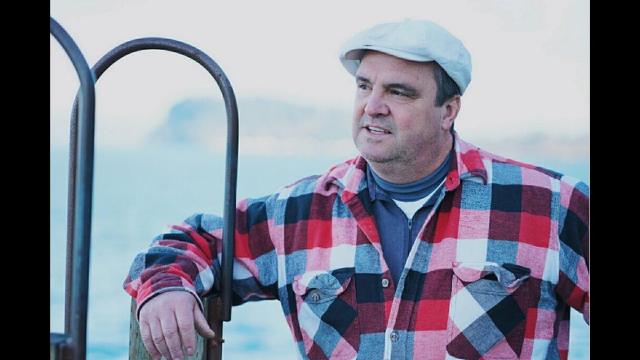
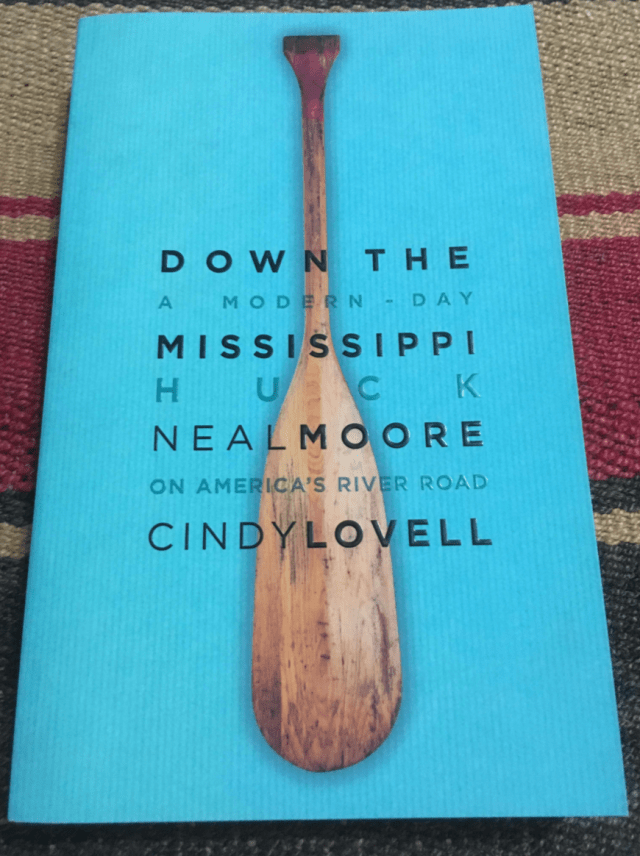
Neal Moore is the author of Down the Mississippi, an account of a solo canoe voyage from the Mississippi’s headwaters at Lake Itasca in Minnesota to New Orleans, and, most recently, Homelands: A Memoir, about his time as a naïve, 19-year-old Mormon missionary in South Africa as it was throwing off white-minority rule. A nomad, public speaker and itinerant scribbler, Neal’s reporting has taken him from night-market meetings with Chinese cyber-dissidents to mountaintop encounters with approaching super typhoons. His dispatches from North America, Africa and the Far East have appeared in The New Yorker, Der Spiegel and on CNN International. His “sea to shining sea” journey of illumination was covered by news outlets around the world, including The New York Times, The Times of London and Adventure Magazine of New Zealand.
The Hood River Valley has a history of ‘others’. The Finns of the late 19th century, the Japanese of the early to mid 20th century, and now those who identify as Hispanic and Latino. I recently spoke with a number of town leaders and bright light activists. Mainly women, both young and old, who are standing up in a unified voice of defiance. Here is a sampling of what they had to say.
Interviewed for this piece (in order of appearance):
Adriana, 23 – Adriana is “a Mexican that happens to be undocumented in the place that is really hard to be undocumented.” A student and activist, Adriana works nights as a waitress/bartender. “We’re on the verge of a revolution here,” Adriana told me. “Either jump on or get off.”
Paul Blackburn, 52 – Paul is the Mayor of Hood River, one of the few (if not only) Spanish-speaking mayors in the State of Oregon. Paul has formed the Latino Advisory Council and would like to see more Latinos on the city council and as mayor one day. He told me that “as the federal tenor and tone go the wrong way, it’s really motivated us to rally around our neighbors and friends and to work together for inclusivity in our city.”
Maria Elena Casmo, 44 – Maria Elena is a health policy analyst who immigrated with her husband Carlos, a civil engineer, from Chile. After five years in America, her status was changed from ‘non-immigrant’ to ‘immigrant’. She gained permanent residence in 2002. Regarding the current anti-immigration atmosphere in America, Maria Elena told me that people of color like herself, “Woke up. [That] they are not going to tolerate this type of speech.”
Montserrat Garrido, 16 – Montserrat, daughter of Maria Elena, is a Junior at Hood River High School who would like to become a journalist. She recently found her voice as a student activist at Hood River’s “MLK Day” rally. Montserrat has travelled back to DC for the Women’s March and for the Anti-Gun March with the students from Parkland, Florida.
Vicky Stifter – Pastor of Riverside Community Church – United Church of Christ. Vicky’s background is in the law. She has spent years on the Texas border working with immigration issues. A member of the community of Hood River for many years, Vicky tells me that if need be, her church has voted unanimously to shelter those in need as a sanctuary church.
Gladys Rivera, 28 – Gladys was born in Hood River in 1989. At the age of four, her mother (at the time six-months pregnant) was deported back to Mexico. She tells me that her mother took her by the hand and hopped back over the fence into America the very same day. While growing up, Gladys told me that she felt confused about her identity, that she “was never Mexican enough and never white enough.” Today, Gladys is an outspoken community member with Latinos en Acción (Latinos in Action) and the Latino Advisory Committee, amongst other groups. She is a mother of three.
Graciela Gomez, 47 – Gracelia arrived in America from Mexico at the age of 14. She wanted to attend school as a child, but her father told her that they were here to work. Graciela has cleaned houses, worked in fruit packing houses, and has picked cherries, pears, and apples. For the past 33 years, she has petitioned the government for a green card, which she received this past year. But she says it doesn’t mean anything when others in the community have yet to receive theirs. “If we don’t say something we are going to keep living in the dark,” Graciela told me. “And it’s time to bring a little light.”
Matt English – Matt is the Hood River County Sheriff. He tells me, “In our area, at least a third of the community is Latino, and so many of those people have some cultural differences that we need to work together to understand. And there has been a real push within this organization to build trust so that the Latino community is trusting of us.”
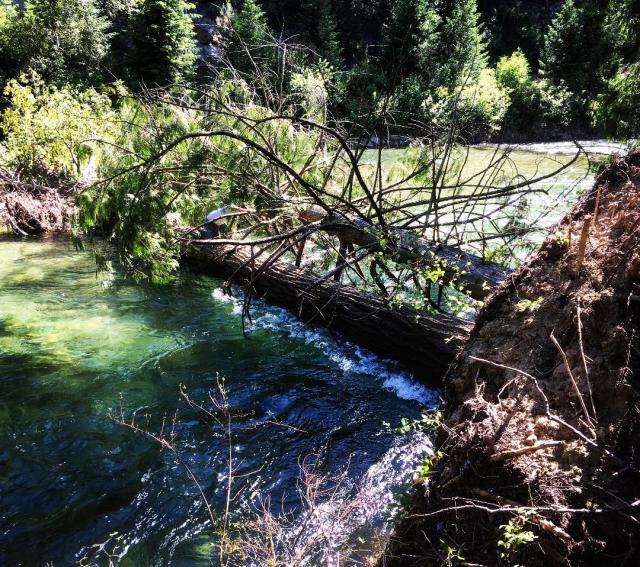
A bend in the river. And a logjam stretching the breadth of the St Regis River just behind spelled trouble. I was moving fast and paddled for the embankment to crash into it, to slow down. I hit it just before the huge cottonwood swallowed me up, tipped into the drink, and grabbed the roots and vines to pull myself to safety — as the canoe and all my gear disappeared under the obstruction. I was wet and cold and in shock.
Fireman Chuck Anderson recovers my Bear Vault full of expedition food from a duo of fallen trees spanning the breadth of the St Regis River above the town of St Regis, Montana on Tuesday, June 12, 2018.
I scrambled for the highway and as I was walking back off the off ramp to get help from a fly fisherman I’d seen nearby, a big Dodge Ram pickup came hauling the wrong way up the off ramp directly at me.
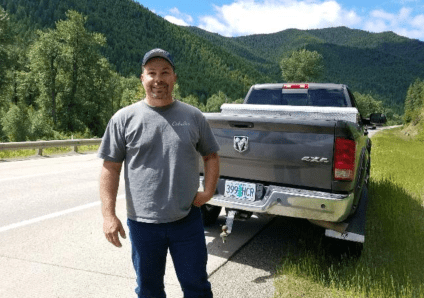
Passerby Darin Boyd and his Dodge Ram pickup were on the scene before hypothermia could set in. Along I-90 near where my canoe came to a rest in the adjacent St. Regis River, Monday, June 11, 2018.
It’d been ten minutes and passerby Darin Boyd had seen the green canoe and paddles trucking upside down just downstream and was immediately looking for the canoeist to assist. Before hypothermia could set in I was in his truck with the heat full blast.
We scouted the river and thanks to Darin’s hunting skills and binoculars he spotted the canoe stuck on a rock in swift current across the river and down a steep embankment. We got to the town of St Regis, Montana, and by the time we found the sheriff deputy, he was already looking for me. Another passerby had reported the upturned canoe and Deputy Ryan Funke had already been up and down the river a few times. We returned to the scene and the volunteer firefighter brigade soon arrived.
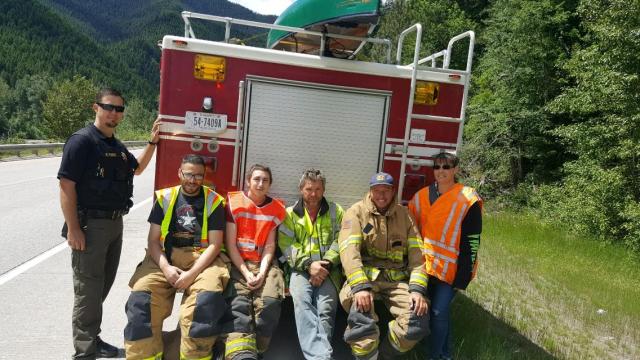
I changed out of my wet clothes for a fireman suit and with a wench and two sets of rope we lowered fireman Chuck Anderson down to the canoe. We recovered half my gear and the canoe itself, as seen soon after up top this fire truck.
From left to right: Deputy Sheriff Ryan Funke of the Mineral County Sheriff’s Office, Firefighter Zack Lott, Firefighter Mark Boyett, Firefighter Chuck Anderson, Neal Moore, and Firefighter Kat Kittridge of the St Regis, Montana Fire Department. Along I-90 near where my canoe came to a rest in the adjacent St. Regis River, Monday, June 11, 2018.
Montana folks look out for each other and this day I was lucky and fortunate enough to be on the receiving end of this kindness and expertise. A big shout out to Darin Boyd, Ryan Funke and the the Mineral County Sheriff’s Office, along with Kat Kittridge, Chuck Anderson, Zack Lott, and Mark Boyett of the St Regis, Montana Fire Department. And also to Kat’s brother John who heard the town siren and answered the call.
A recovered map showing the section of Montana were this expedition nearly came to and end. If you look just underneath the top rock you’ll see the town of St. Regis where the St. Regis River meets the Clark Fork.
Shaken, but safe and sound, I’m safely on to Missoula, Montana, where I’m currently re-gearing up with help from friends both near and far. Stopping to catch my breath, settle my nerves, and continue forward on to the Divide and the next leg of the journey — down the Missouri and Mississippi rivers to The Big Easy, New Orleans.
Note: The all-volunteer St. Regis, Montana Fire Department assist travellers like me all the time. Mineral County stretches from Lookout Pass on the Idaho-Montana border to mile marker 76 along I-90 east of Alberton, Montana — a healthy swatch of jurisdiction. With limited federal funding, these fine folks do rely on donations. If you’d like to support what they do, you can send a donation to: St. Regis Fire Dept., PO Box 9, St. Regis, MT 59866.
I’m currently into Spokane, Washington and headed to Coeur d’Alene, Idaho. You’ve gotta walk a lot of this section of the Spokane River (both in and out of the water) due to dams, falls, logjams and rapids. But man is it beautiful country!
World photo/Don Seabrook Neal Moore gets help from Carol Busjahn, Wenatchee, unloading his nine-year-old canoe at Lincoln Rock State Park on Monday. He was headed to Daroga State Park to spend the night on his journey. This canoe replaces one that was busted up while recently paddling through the Gorge. Busjahn’s family hosted Moore at their house over the weekend.
WENATCHEE — Neal Moore has had many adventures living overseas on and off for about 25 years, but an idea came to him in 2009.
“I had this epiphany,” he recalled. “What if the greatest adventure of my life was in my own backyard, so to speak?”
So he paddled down the Mississippi River, ultimately producing 50 stories of how people were coming together and making it through the recession.
Now, the Los Angeles native is back in his canoe – this time, with an even bigger journey in mind. His trip as planned will span 22 waterways, 22 states and 7,500 miles.
The goal is to connect 100 stories from 100 cities and towns to tell the story of America.
From his start in Oregon, Moore arrived in Wenatchee on Friday. He had never been here before.
“You’ve got the wine country, you’ve got this arid landscape with this intensely beautiful river cutting through,” he said in an interview Saturday. “(Friday) I spent the whole day walking downtown, trying to get a feel for the place. I’m not sure exactly what’s going to happen with the story — or if there will be a story — but the people that I’m meeting are just incredible. People who are transplants but have been here for 20 years.”
He left Wenatchee on Monday and will travel to Idaho and Montana next.
Neal Moore paddles near Turtle Rock on the Columbia River as he heads to Daroga State Park for the night. World photo/Don Seabrook
Moore was out of the United States for the last six years, but he saw that everyone was paying attention to Washington, D.C., especially after the November 2016 presidential election.
“But then the second question mark that I’ve observed has been, what about the rest of America?” he said. “That’s where this journey comes into play. The idea is to come from the Pacific Coast to the Continental Divide to the Gulf of Mexico to the Great Lakes to the Statue of Liberty. … My thinking is to sort of highlight who we are as Americans – what we look like, how we tick, how the American experiment ticks — and to show the very best of us.”
Some cities are part of Moore’s plan, but he’s also discovering places for stories as he travels. He’s gotten some recommendations on people to talk to from organizations like museums and chambers of commerce.
He said he doesn’t want to create a script or put a spin on a story, but rather to listen and document what he learns.
“It’s not about man against nature,” he said. “It’s not about X number of days to come across the country in record fashion. It’s more about the communities and the people. The highlight, for me, is not to turn the camera on myself so much, but to turn the camera on the communities and be able to highlight their stories.”
Moore mostly camps but sometimes stays with friends of friends.
He said he chose to canoe rather than drive to honor the country’s first peoples and first thoroughfares. It also allows him to take his time with the project, he added.
“With the paddling, combined with the journalism, you feel like you’ve earned these towns,” he said. “You’re paddling, sometimes for days and days, and the story ideas are swirling around in your mind. Then you step into a town, and you’re so excited to be there, and now you’re trying to pull off a story of international consequence. It’s a challenge on top of the physical challenge.”
In addition to writing, Moore takes still photographs and videos. His ultimate plan is to turn the stories into a book.
He expects to complete his journey by December 2019.
Here on the Columbia I’m keeping my eyes and my heart open to everything nature and natural. The river itself in all of its glory, the currents and sky and the cliffs. My days are spent observing the whirl of an eagle, the thump of a badger, the jump of a fish — the life underneath and around and above as I paddle upriver.
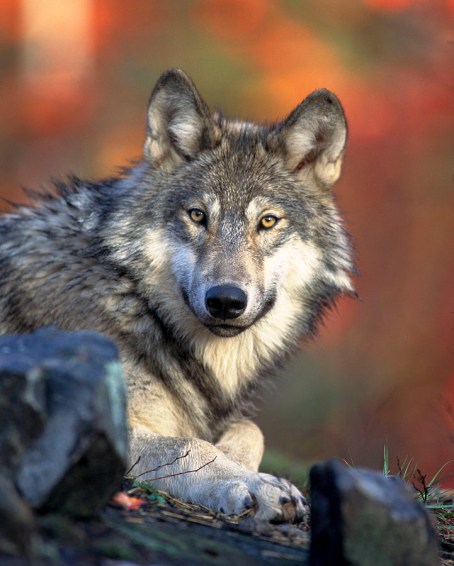
Just past the town of Wanapum I was aiming to make camp on a beautiful stretch of island when I startled a deer amongst the sage, sand and prickly pear cactus – the second I’d seen the very same day. I paddled myself on and shortly thereafter just under the dense and jungle-like trees and laid out on top of a patch of tall grass was a broad snout and large nose pad and a small set of ears pointed straight up. The beast was substantial — larger than the coyotes I was raised around in the foothills of Southern California. I believe it was a Gray Wolf (Canis lupus) – the very first I’ve ever encountered in the wild. It sat up and stared, watching me intently. It never did flinch and the moment was amazing. We locked eyes as I paddled slowly past and I knew that this island belonged to him.
I made camp on a nearby sandbar and late into the night came the Call of the Wild. A solitary wolf singing up to the vault of heaven and night sky. It’s moments like this that I wish I could share with you. But the fact is I never did reach for my camera or attempt to capture audio. It would have spoiled the moment. What excites me more than anything is the promise of more wildlife to come. As I begin to enter genuine backcountry into north-east Washington, Idaho and Montana. As I begin to feel wild myself.
Along the COLUMBIA RIVER GORGE, OREGON and WASHINGTON
I knew that traversing this nation’s first waterways in a canoe would be a challenge, along with the hope of a tribute to the first people who for millennia have called America home.
The word tribute is a great word because it’s a river word. Rivers that flow into larger rivers are called tributaries. Where they meet is the confluence. And their source point is the headwaters.
And if you scratch the surface by taking a canoe out and onto the water, and take a good long look all about you, and listen, and most importantly, feel, you’ll find the undercurrent, the rhyme and reason of the journey.
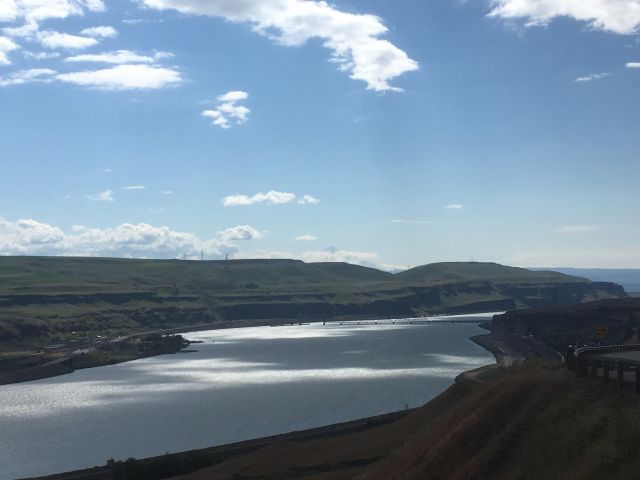
The Columbia River today with a replaced Celilo Indian Village seen on the left, and the Oregon Trunk Rail Bridge further downstream. Photo by Neal Moore.
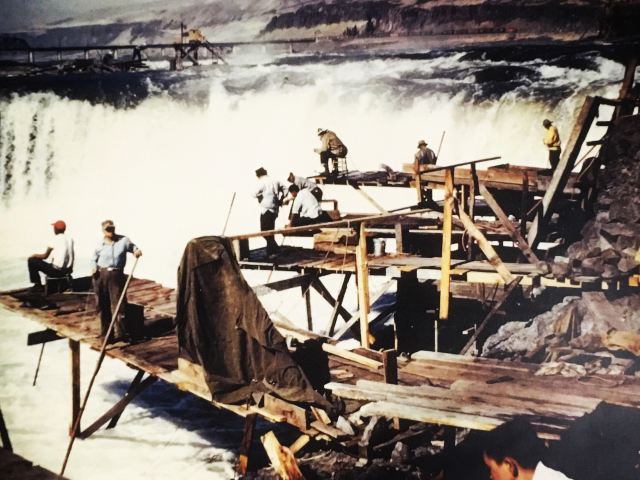
There’s a stretch of the Columbia River Gorge where people still speak about the village that once was, before it was washed away by the construction of The Dalles Dam in 1957. The place was called Celilo Falls, where a cascade of high-current whitewater gave way to platform scaffolds and fishermen and the giant chinook salmon that swam up through the rapids and jumped over the falls.
If Astoria, Oregon, at the mouth of the Columbia River, is celebrated as the first U.S. settlement west of the Rockies (founded in 1811), it is important to note that Celilo Falls stretches back quite a spell further. For 15,000 years, Celilo was a gathering place for the Native American people, the oldest continuously inhabited community on the North American continent, and a mecca for traders who came for the salmon from far and wide.
“I remember the sound of that river and of those falls,” Wilbur Slockish, Jr. told me. Slockish, who was raised on these waters, is the chief of the Klickitat people, a Native American tribe of the Pacific Northwest. “I used to make money by packing one or two fish – the fish were bigger in those days. And I packed them up for the fishermen so that they could fish and I would struggle up there. And that’s where I got my strength, for that was my exercise.”
Original previously unpublished photograph of Celilo Falls in the 1950s by Chet Coats showing the falls that are now submerged by the damed up river. Although inaccessible, it is said that the falls still flow. Courtesy the Coats family.
And Slockish was not alone. During my time on this portion of the Gorge, I visited several of the 31 native fishing in-lieu sites. I toured and met with different tribes who make up the Columbia River Indians — the Warm Springs, Yakama, Umatilla, and Nez Perce.
Down in Cascade Locks, I met with young Nez Perce natives who were busy getting ready with their boats and their nets for their ceremonial fishing. The first fish of the year, the spring salmon, are collected by the tribes for their ceremonial needs. Extra salmon are brought home to fill the freezers for the years ahead. Only once the quotas are met, will the tribes consider fishing commercially. Although this year’s spring salmon is late, these Columbia River fishermen were hopeful.
Bud Herrera, 54, casts one of six poles out into the Columbia below at Rufus Native In-Lieu Fishing Site below the John Day Dam. Photo by Neal Moore.
Bud Herrera, 54, of the Columbia River Inter-Tribal Fish Commission, fishes below the John Day Dam on the Columbia River. Bud, a Umatilla, tells me this could be one of the lowest seasons on record since 1939 for the spring chinook salmon. Bud fishes by scaffold and by line, and while this year’s catch is low, he likewise remains confident.
Bud’s cousin, Cort Herrera, 54, a Umatilla, spoke to me about how family and fishing go hand in hand. “It just goes together. You know, we catch the fish together and have good times here – make memories together on the riverbank. Just have fun, you know. That’s what it’s all about – to teach the younger generation, so they can do it when we’re not here. Just like we learned from our family relations.”
While I was documenting the Herrera family, Bud’s nephew helped his 9-year-old nephew land a spring chinook salmon. The kid’s face said it all. His gap-toothed smile was priceless.
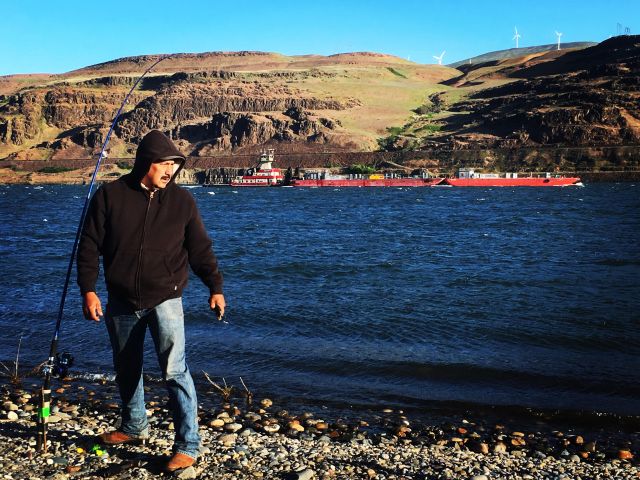
Cort Herrera, 54, checks his lines as the Willamette C tug pushes barges of juvenile salmon downriver, assisting their natural progression around the dams. Photo by Neal Moore.
The reason for the 31 in-lieu sites goes back to the Treaty of 1855, which Wilbur Slockish Jr.’s grandfather was a signatory of. When asked to remind us what the treaty promised the local native tribes, Slockish explained: “We were to retain our lands, certain lands, and to retain our fishing rights and our hunting rights. We were to retain all of our other food gathering activities. Places that we fished at. And we gave land to the federal government in exchange for that. We were promised adequate healthcare and they were supposed to build a hospital.”
Today, with the construction of the dams and the washing out of the villages, living conditions for the Warm Springs, Nez Perce, Umatilla, and Yakama Native American tribes at the original in-lieu dedicated settlement sites along the Columbia River Gorge remain unsafe and unsanitary. As residents await the federal government’s decades-old promise of “adequate permanent housing” to replace their once-thriving communities washed away by the construction of the dams.
“A lot of people here,” said Slockish, “they seemed all to think that the government and the courts gave us hunting rights and fishing rights — not realizing who gave what to whom.”
There is a connection to this land and river that the native people understand. That they live and breathe and practice and teach. “That is what is important and I try to protect it,” said Slockish. “Because these are the gifts that our creator gave to us. We protect them and take care of them and in turn they will take care of us. Because we don’t own them — the future owns them … So that’s why we value them. Our bodies are made from this land and everything will return to the land – the law of the land – go back to it. So why would you harm it?
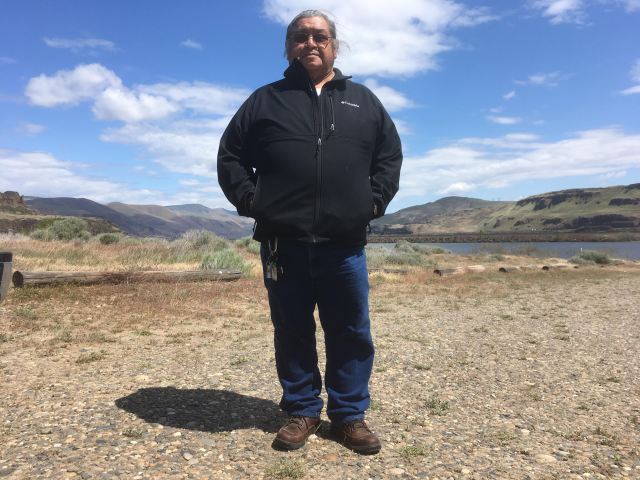
Wilbur Slockish, Jr., chief of the Klickitat people, at Horsethief Lake State Park, just downriver from where he fished at Celilo as a youth. Photo by Neal Moore.
“You know when people from the east came this way, they saw all of this land up by the Tri-Cities and down the Gorge and thought it was idle – Idle land, look at this. We can irrigate it. Think of the profits we can realize from it — but they didn’t think, they didn’t realize that it was our supermarket. There was deer, elk, rabbits, grouse, other birds that we ate. Medicine, roots, all within that idle land and that’s why they thought of the dams. That was in the 1920s. People from the east are always doing that — comin’ out here and altering — they altered the landscape. And our foods aren’t the same anymore. Our roots are coming earlier, our salmon are coming later. We should have already had freezers full.”
Cy Jim, 51, who identifies as a Warm Springer, fishes on the Washington side of the river just below the John Day Dam, one of four U.S. Army Corp of Engineers dams of the Columbia River Gorge. For him, it’s more than just subsistence. It’s a way of life.
“Fishin’ just keeps us goin’,” Jim said. “This river keeps us goin’. It’s something we’ll never give up. As long as there’s fish here, we’ll never give it up. We’ll always do it.”
But Jim wasn’t always able to fish. His father, like Slockish’s father, turned away from fishing the Columbia following the washing away of Celilo in 1957. It was too painful, and besides that, there was frequent animosity towards native fishermen over competition for fishing rights that followed.
“I’ve been shot at, I’ve had rocks thrown at me,” Slockish said. “I’ve had boulders rolled down the hill at me, and I’ve been cursed, all over my own food.”
And then there was the “Salmon Scam” of the late 1980s. “We were blamed for 43,000 missing fish when it was aluminum plants that poured fluoride at John Day Dam. See that dam right there? There’s a big gravel bed there – there used to be 50, 60, 70, 80, 90 pound salmon spawning in that area – and with those gravel pits they built the dam and killed it and they poured fluorides in there and the salmon, they lost their sense so they just spawned in a different area, they adapted, but we got blamed for it and I went to prison for three years for it.”
Slockish laughs at the memory of his incarceration at El Reno, a medium-security United States Federal Correctional Institution for male inmates in Oklahoma. “I always called it my government sponsored vacation.
Back in Astoria, Oregon, I befriended Columbia River Gillnetter, Cook Inlet Drifter, FisherPoet and Folklorist TOM HILTON, who shared with me this poem:
All that’s left is legend,
Names etched in a
granite Wall
Black and white photos
Folk Lores For sale
In the maritime museum
store
Boats of wood
Hands of Steel
Hearts of gold
All races
Colors
Creeds
A man was valued
By his word
Firm handshake
His deeds
White aproned Super-
models
Grinning from ear to ear
Days measured by
seasons
Not years
Tattered edges
Faded Yellow Brown
Ripped
Torn
Memories of the glory
days
When gillnetting was
born
Dilapidated docks
Rotten pilings
Broken tops beneath
our tidal view
Skeleton bones
Partially Submerged
Floating Homes
Lonely Net racks
Empty Bluestone tanks
Broken windows
Moldy musty dusty
dank
Wooden corks,
Lead lines,
Linen nets
Stripped clean of all
their glory
No more Mug up,
Coffee Time
Just Empty Chairs
waiting for stories
Court is no longer in
session
Yesterday’s myths
See thru faded
Transparent
Not bitter
Jaded
Today’s Mono-filament
Tangle Nets
Jesus Box
Deadliest catch drama
Overstated
Overrated
Prima Donnas
If those pilings could
talk
What tales would they
weave? Would they be
fortuitous of sport
fisherman’s greed?
Countless stories
Work is our Joy
Fortunes made
Love
Families
Togetherness
Life
Salmon
Laughter
Heartbreak
Lost
Of Butterflies
And Bowpickers
Double-enders
Power scows
Cash buyers
And Tenders
Four bits a pound
Clifton
Brookefield
Altoona
Alderbrooke
Uppertown
Uniontown
Celilo
Where did they all go?
Salmon Culture
A menagerie of people
A colorful past
Romanticized
Plagiarized
Eulogized
By people like me
Fishing is more than
Tradition
Governor
It’s a Religious
Ceremony
Ebbing current
Tides shift
Surge of change
Pulling our nets
Taking us under
These words bury my
pain
Black and white photos
Names etched on a
granite wall
Let’s not forget them
The true legends of fall!
This mighty river
What It was back then
Full of Salmon Sturgeon
Seiners, Trollers,
Gillnetters
Cannery women
Stomper
Astoria’s Fighting
Fishermen
The Story is over…
All the Legends have
died
Our Eyes welled with
wet
Politicians lied
Last of my tears shed
Cried
So if pilings could talk
Ask one how it was
back then…
It will probably tell you
Those days are gone
forever
Kid
With the stroke of a pen…
Photo by Mitch Eckhardt
Copyright Tom Hilton and FisherPoets Anthology. Illusions of Separateness. “Uniontown Supreme Court: If The Pilings Could Talk” was written to pay respect for the men who fished and the women who worked the Columbia River. Audio recording and video of the old cannery at Clifton, Oregon by Neal Moore.
I had the pleasure to meet up with Bud Herrera of the Columbia River Inter-Tribal Fish Commission. Bud is an Umatilla, a fisherman and entrepreneur who lives near the Rufus Landing Recreation Area where I recently made camp. We traded goods (he told me with a laugh, just like 150 years ago).
He gave me a beaded salmon necklace so that other Native Americans I meet along my journey will know that I’m a friend, dried salmon for energy, which he called “gold”, and his own personal copy of Shadow Tribe: The Making of Columbia River Indian Identity by Andrew H. Fisher. I gave what I could: organic coffee, a honeycrisp apple, and the promise of a signed copy of my previous expedition memoir, Down the Mississippi.
I am excited to come back to Rufus to document Bud’s story and those of his tribal elders. The Umatilla are a Native American tribe that traditionally inhabited the Columbia Plateau along the Umatilla and Columbia rivers, a civilization dating back millennia. Bud told me that salmon is gold and that we as a world are all connected by water. Heartfelt words from a humble and wise new friend.
JOURNALIST Neal Moore at the Hood River marina with his Navarra canoe, shortly after his arrival in Hood River. Moore hit the Columbia River again April 9 and two days later it cracked during portage around The Dalles Dam. Moore found a new, stronger (and lighter by six pounds) canoe through a private seller in White Salmon and expected to continue his journey by Thursday.
Chance encounters can sometimes be life changing in grandiose or miniscule ways. You may not realize at the moment of the encounter, but years later, you may look back and say, “Hey, if I hadn’t responded to Kirby’s call and connected with Neal Moore, we may have missed the opportunity of having our youth featured in a story in the New Yorker, a documentary on CNN or a book detailing a canoe voyage across America.” The journey of 7,500 miles from sea to shining sea is described as a “voyage of discovery into the depths of America’s soul.” Moore’s desire is to tell the stories of the diverse communities he encounters along the way in an effort to “understand and celebrate individuals, families and communities rising above themselves.” What was to be a brief stop in Hood River turned into a week of discovery for Moore and the community.
I have always believed that building relationships is key to living life fully. I don’t believe in fate, but I do believe that if you are open to interacting and potentially forming a relationship with those you meet, your life will be enriched. Much can be learned about yourself, about those you meet and the way they perceive the surrounding environment.
Back to Kirby’s phone call. It came at a somewhat inopportune time. I was in the emergency room with my youngest granddaughter waiting for the doctor to come in and do an examination. She had exhibited some painful symptoms that morning at school which suggested appendicitis. Aya is a wisp of a second grader, who seldom complains about physical discomfort. She reminds me of a willow sapling, tall and slender, physically strong, swaying in the breeze, family roots and love grounding her. Seldom do tears well up from monkey bar blisters or brother’s inadvertent kicks or pokes. Insensitive remarks or inequitable treatment are another matter, turning on a fire hose of tears. All turned out well. No appendicitis or nasty flu bug detected. Rest and relaxation were the words from the wise doctor and we followed the orders precisely.
I visited with Kirby briefly, hearing tidbits about a man he hoped I would speak with, a man who had paddled upstream from Astoria on a journey of discovery. These tiny morsels of information intrigued me, and I said “Sure, have him give me a call.”
*
That afternoon Neal Moore gave me a call and I learned a little bit more of his journey. It would be 7,500 miles across American, from “sea to shining sea.” He would chronicle his journey and document through film, newspaper article and book the stories of small towns and big cities along the way. These were stories of hope and inspiration that underscored the spirit of our country and its remarkable diversity. I was all in at this point, and agreed to meet at the library the next morning, spending a day introducing him to the people and places that would showcase our community.
As I pulled up in front of the library, I could see a soggy young man standing on the steps in the pouring rain. My bad. The library didn’t open for another hour. We sought refuge in my home in Odell. Over several cups of coffee and a plate of chocolate chip cookies, we began a lengthy conversation about Hood River and the people who make this such a beautiful place to live.
Neal said he had enough stories to research that would take him through the weekend, but he hoped I could connect him with a place to stay and store his life possessions now packed in his canoe on the marina. I first offered my home, but thought better of it when I realized that the people he would need to talk to lived down the valley and transportation by canoe is limited in that respect. We pondered this transportation dilemma and agreed to meet later in the day after I went to my blood donation appointment. I was optimistic that I could find someone willing to house him for the next few days.
*
As I waited in line for my Rapid Pass review at the Red Cross station, I began texting folks living in town, and who are connected to activism, the theme Moore chose to highlight. Let me tell you, a lot of networking gets done at a blood drive. Like-minded people seem to extend their hands and hearts as well as their arms to give life to others. After a few “out of town” replies to my texts, who before my astonished eyes would appear, but an angel in fashionista clothing, Barbara Young. We chat. “Sounds interesting,” she says. “We have an RV in the driveway he could use. It would be better than the pouring rain camping on the rivers edge.” Relief. A warm place to stay and one of the connecting hubs of activism in our community. After a brief call to her husband Gary, Barb learns that they have plans the next three days.
I move behind the “veil of secrecy,” a curtain used by the Red Cross staff to review my health history. Suddenly I hear Barb’s sweet voice calling. “Hey Maija. I am waiting here with Paul Blackburn and he says he has a room.”
I am ushered to my donor bed and the needle is inserted, blood filling the bag rapidly. At the precise moment I finish, Paul plunks down on an adjacent gurney. I fill him in on a few details and the connections begin to fall into place. The Blackburn/Dillon household is full of activism and connections for our intrepid paddler.
*
The following days are a whirlwind of conversations with Gorge Ecumenical Ministries, Latinos in Accion, The Next Door, Somos Uno … From there, he is on to the individual activists’ stories, Vicky, Gracy, Adriana, Montserrat, and Cristina. Moore has to extend his time in Hood River another three days to make all these connections. He has just scratched the surface.
Moore’s story begins in a community where helping hands, hearts and arms are extended willingly and compassionately. It is the story of many generations who have met discrimination and adversity head on, inspiring a new generation of movers and shakers.
My story is the story behind the story; of the list of friends and acquaintances who began making the connections for Moore to meet our youth, our dreamers, our student activists. These students passionately believe that all lives matter, that our schools should be safe, that people of every age, gender, ethnicity, and faith should be respected. Their belief has been transformed into action, raising their voices, mobilizing their peers, proposing solutions to the problems plaguing our society.
I like the story behind the story that Neal Moore will tell. It is the story of our community at its finest moment, day in and day out.







 22 Rivers