
By Neal Moore
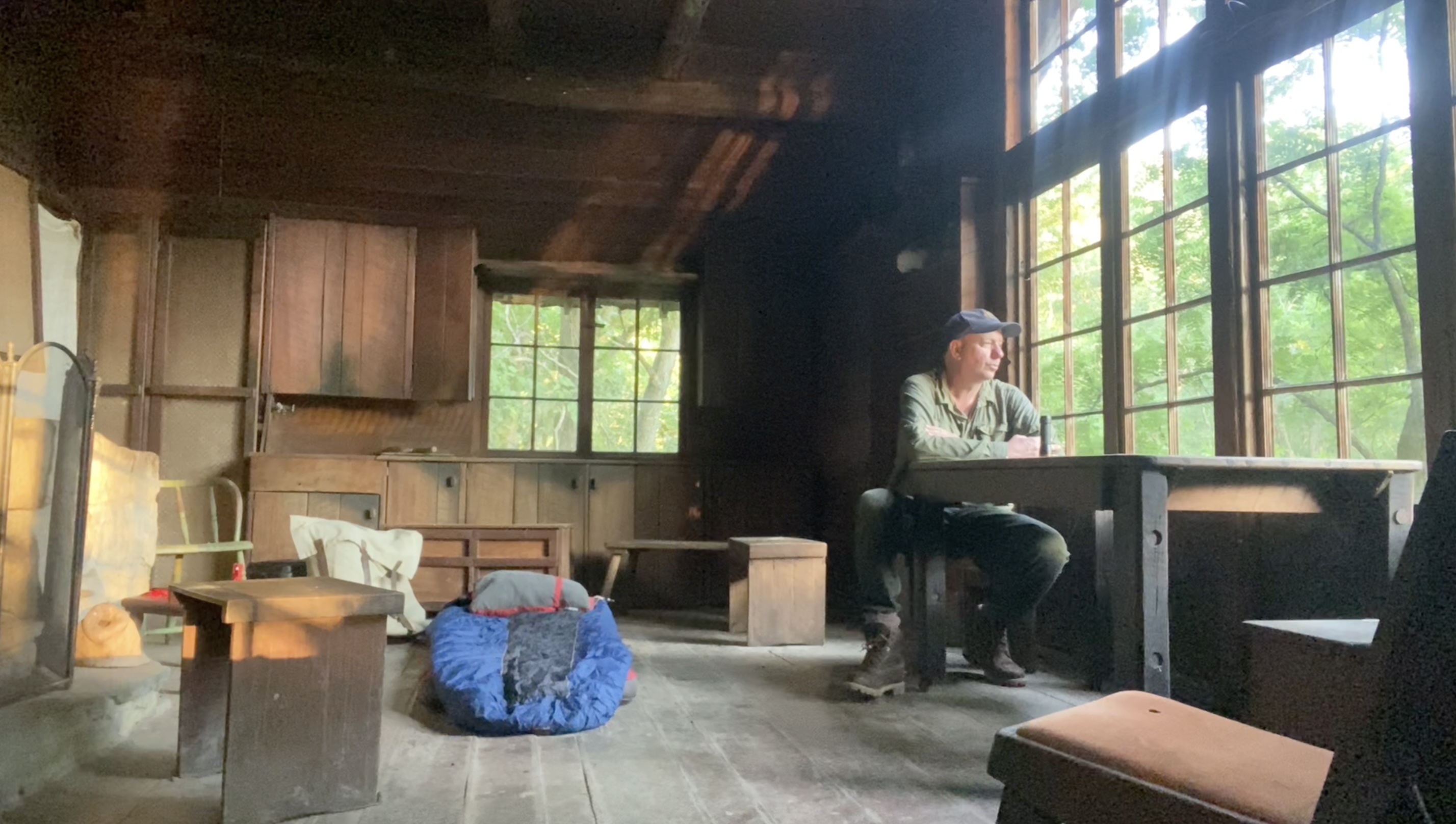
On a recent two-week canoe expedition down a portion of the Ohio River, I had the pleasure to visit and bed down at Harlan and Anna Hubbard’s beloved Payne Hollow near Milton, Kentucky. The Hubbards lived here from 1951 to 1986, subsisting off the land with no electricity and only cistern water. Harlan was a painter and writer and Anna was a librarian and musician. Together, they lived in harmony with the landscape for 35 years. Harlan designed and built Payne Hollow out of wood and stone, along with a detached studio.
“This is the day we begin a new venture, facing now the true direction.” – Haran Hubbard
It wasn’t my first visit to the property. Back in 2021, while paddling up the length of the Ohio River on my cross-continent sojourn, I’d often slog it out from first light until sundown – and beyond. On June 16, 2021, I was pushing for the boat docks at Madison, Indiana just up and around the bend, but came up short. The curtain of night fell, there was a frenzy of tow and barge traffic in the river up ahead, and as I looked to my side, the perfect stealth camp spot materialized.
A spit of land jutted out into the river just so along the Kentucky shoreline. It was flat and inviting, and I happily paddled to the riverside. Pulling my canoe and gear out of the water, I set up my tent, and took a seat along the riverscape, taking in the majesty of the stars and the firmament. It was a special place in my mind – I could feel it – so I marked the spot on my Google maps with a heart. I didn’t then know I was camping on the shore of Payne Hollow.

I’d soon become intimate with the art, life, and story of Harlan and Anna, along with a need to save their seven-turned-sixty-acre oasis connected to the river. By 2022, the property had fallen into a state of neglect. The owner had health issues and was not able to visit as regularly as was needed. There were reports that racoons had invaded the home and that it could soon be destroyed. I’d befriended a group of Louisville, Kentucky academics and artists, along with a separate group of Madison, Indiana concerned citizens who wanted to see Payne Hollow saved. I helped to bring the two groups together, to organize a meeting at the home of Bob Canada of Madison, Indiana, a retired dentist who had befriended Harlan and hosted him until the end of his life. My hope was that the two groups could put their collective experience, expertise, and influence together to purchase and save it. Which is exactly what happened.
From my perch of a porch outside the side door of Payne Hollow, the steady flow of the Ohio could be viewed through the trees. As I sat and admired the wildness all about me on this recent exploration down the river, there was a moment, in concert with the sun’s final rays, when I could hear voices. When the trees rustled in a lack of a breeze and I felt the hair on the back of my neck stand up. It was the height of summer and sweltering hot but then it turned cool. I thought of the Wendell Barry-inspired pastoral ghost story opera “Payne Hollow” and the line of Harlan talking about the music that’s just out of hearing. I was sure it was a haunting. And with it the realization the Hubbards are very much still here. And then it passed, and I was at peace once again.
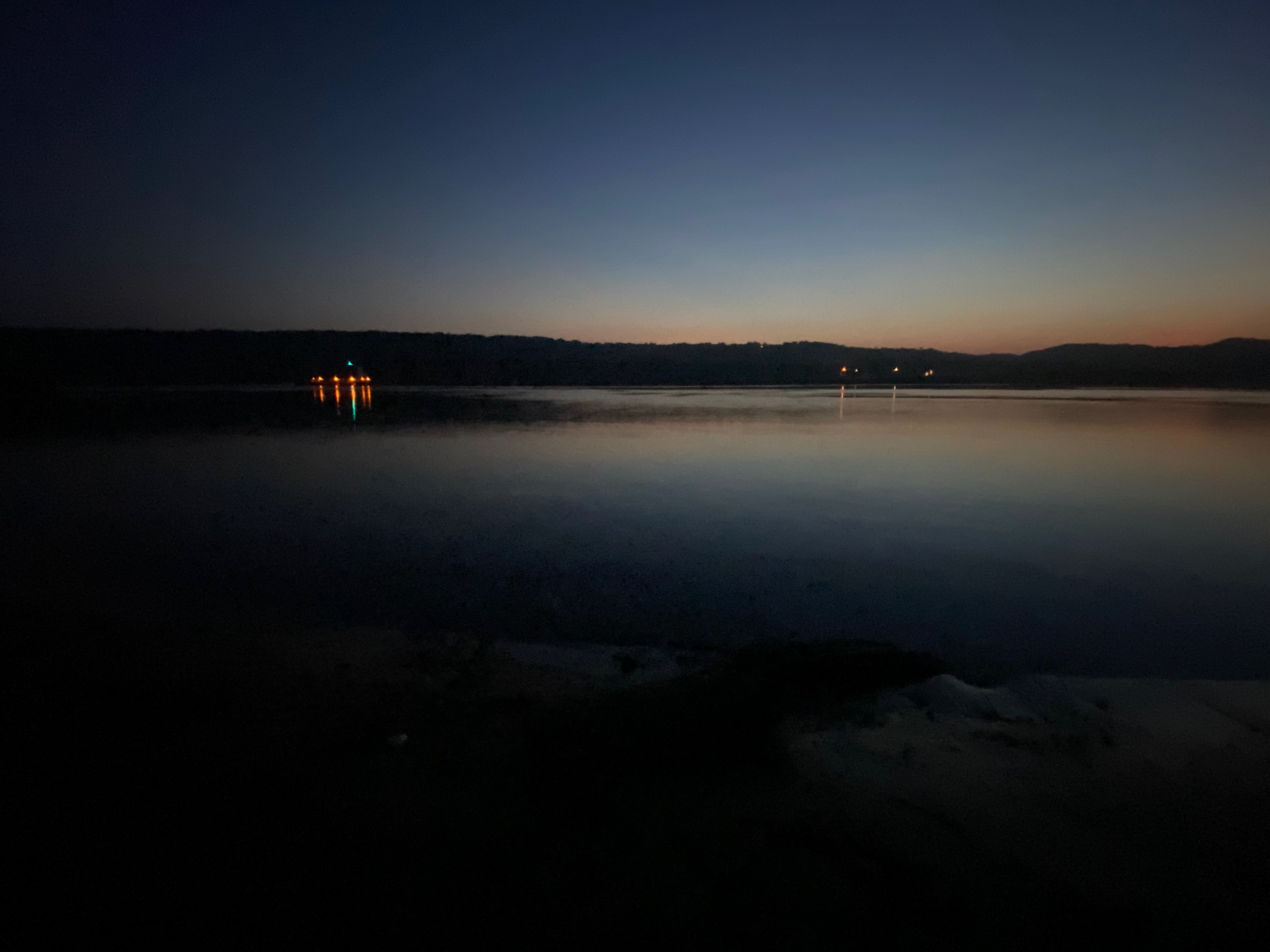
The sun had set proper and there was that golden strip of an afterglow. Just at near-dark there was the hum of an approaching tow pushing up the Ohio. The river acted as a muse for many of Harlan’s works, along with the home itself and surrounding landscape. I thought of Harlan in such a circumstance – with such an oncoming tow – that he might grab for his paint brushes and a found strip of wood or tin or available canvas and head down to chronicle the waterborne paddle-wheel tow of yesteryear. I rose from my seat and bounded down to the river to capture the passing modern-day vessel with my camera. With a smile and an understanding that he’d seen and chronicled countless such images.
Back up on the hill, I rolled out my sleeping bag onto the floorboards of Payne Hollow, took a swig from a bottle of Kentucky bourbon for good luck, and closed my eyes. Morning dawned through the windows bright and cool and clear without further incident. I woke from a peaceful sleep, rubbed my eyes, and rolled up my sleeping bag. Packing up my river bags and heading out the door, I paused before locking up to poke my head back into the home and say, “Thanks for the stay, Harlan and Anna. It was delightful.”
***
“Anna and I were attracted by the very conditions which caused it to be abandoned. We are unique among its inhabitants, not farmers, nor fishermen nor shanty boaters in the accepted sense; yet closer to the earth than any of them, with true respect of the river and the soil, and for Payne Hollow. May it long remain as it is, not merely for our selfish enjoyment, but for the satisfaction it must give many people to know there is such a place. Few wild pockets are left along the river these days.” – Harlan Hubbard from Payne Hollow: Life on the Fringe of Society
Many thanks to Payne Hollow on the Ohio for the invite, a Kentucky non-profit with a goal to sustainably preserve, protect, and promote the legacy of Harlan and Anna Hubbard.



 Garon, Fredrick, Brooklyn, and Veronica, four KIPP Charter School Middle School kids from downtown Helena, Arkansas smile as they walk the levee from their school to Mr. Ruskey’s Helena-based workshop. This is their second class at Quapaw Canoes, and even though their friends are catching the bus for home, these kids walk with a stride in their step.
 Mr. Ruskey does not speak in sound bytes. He speaks from his soul and he speaks with conviction. When asked how art, education, and the Mississippi River come together, Mr. Ruskey explained, “They come together with each paddle stroke you take. If you watch the way a paddle cuts thru the water – it creates a double spiral on either side of it – and if you look at the shape of a classic canoe, it’s almost the same shape you see created in the water as you’re stroking the paddle. And that’s the wonderful thing about the Mississippi River and any moving water – but on the Mississippi you see it more than any other body of water I’ve ever experienced. You see expressions of patterns, of life patterns – the very basic patterns that govern our life – you see them expressed, constantly being expressed and then re-created over and over again. And so it’s actually there on the face of the water that you see all those things come together. One of our mottos here is
  that the River brings us together, and in that sense it literally does bring together education and canoes and art – they all come together as you’re paddling the canoe.”
 When Jay and Beth VanWinkle saw that their favorite actor, fellow Mississippian Morgan Freeman, was coming out with a new movie titled “The Bucket List”, Beth turned to Jay and said, “I’ve got to see that.” One year previous, Beth VanWinkle had been diagnosed with Alzheimer’s Disease, and has been, as she puts it, “grasping for everything I could get [out of life – before it’s too late].”
 The film inspired Beth and Jay to write down a short list of ideas they wanted to accomplish before Beth permanently goes into, what she describes as her “cave” – a place where she will be in her very own world.
 In this report, we witness Beth leading the first annual Oxford Memory Walk as well as the story of Beth’s realization of her third and final wish – to ride a horse – a story which she will now be able to replay again and again, as her memory continues to fade.
 The cemetery is important because it was the first African-American graveyard of the region, founded in the 1870’s by the “Sons of Zion”, who were former slaves. The property was in use until the 1970’s but quickly slid into disrepair shortly thereafter. In the 1980’s and 1990’s there were rumors of the gravestones being used as “chop shop” jack props for car thieves and as a result – this was a location that the general public would dare not venture.
 Local activist Ken Hall of Volunteer Mid-South has been working with local volunteers to correct that for the past nine years.Currently, approximately eighty percent of the property is still covered by overgrown brush, weeds, and thorn bushes – but Mr. Hall is optimistic that one day this will change.
 American youth. Armed with machetes, mowers, and clippers, they go in search of the gravestones of the Sons of Zion by re-claiming the land for the future generations of those buried here.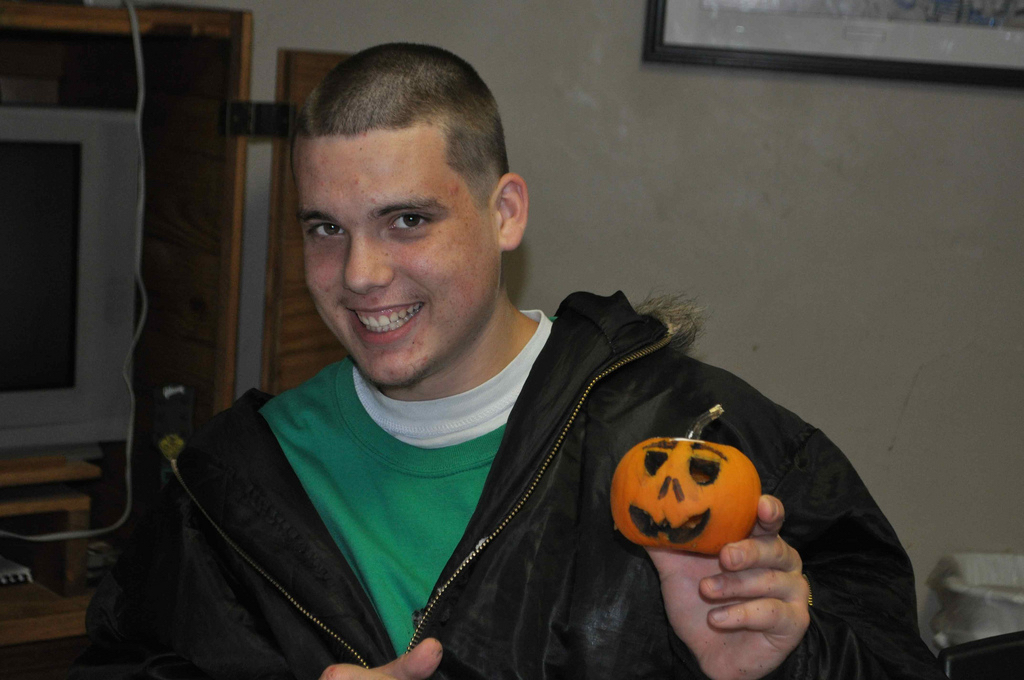
 22 Rivers