Overview by Managing Editor: Sherry Cook Stanforth & Literary Editor: Richard Hague
The contributions of poetry, prose, visual art, and photography in this collection form a creative tribute (using one meaning of the word) to one of the largest river systems in North America. The Ohio River Basin’s scenic and historic tributaries—rivers, streams, creeks, and rills—are flowing through nearly 204,000 square miles of territory, impacting more than 25 million people living in areas of Pennsylvania, Ohio, Kentucky, West Virginia, Indiana, Illinois, Tennessee, New York, Virginia, Maryland, Georgia, Mississippi, Alabama, and North Carolina. Nearly five million people drink water from the Ohio River itself, and millions more depend on the commerce, recreation, and transportation provided by its connected watersheds. The lovely living gift of the ohi:yó sustains us, body and soul.
And yet this precious lifeline, this vast and beautiful ecosystem, is being sickened by pollution, rewritten in the specialized, expressive language of dioxins, furans, PCBs, mercury, VOCs, phthalates, POPs, phenols, polycyclic aromatic hydrocarbons, HAB dead zones, E. coli contamination, on and on and on. In 2023, the American Rivers conservation group listed the Ohio River as the second most endangered waterway in the country. This diagnosis came well ahead of the February 3, 2024, Norfolk Southern train derailment in East Palestine, Ohio, that dumped at least five different toxic chemicals into a cradle holding people, flora and fauna, forests, fields, farms, parklands, yards—and of course, ever-moving water sources. And so Tributaria sings an elegy for irrevocable damage to the living world, even as it celebrates its sacred beauty.
Former US Poet Laureate Joy Harjo witnesses for us all the practice of intentional connection, of learning to claim (and reclaim) what exists beyond our immediate senses: “When I began to listen to poetry, it’s when I began to listen to the stones, and I began to hear what the clouds had to say, and I began to listen to others.” May these words and images invite that accountable, curious tuning. Tributaria offers only a glimpse into the complex heart of Ohio River country’s flowing waters, riparian margins, diverse life forms, geological features, and industrial properties. The living energy of nature and culture cannot be contained by simple designs and functions. Our stories of water will move throughout time, while we remain bound to the unfolding plots and diverse settings that shape our essential well-being within all of creation.
Many thanks to Sherry Cook Stanforth and Dos Madres Press for the invite, an Ohio Not For Profit dedicated to the belief that the small press is essential to the vitality of contemporary literature.
On a recent two-week canoe expedition down a portion of the Ohio River, I had the pleasure to visit and bed down at Harlan and Anna Hubbard’s beloved Payne Hollow near Milton, Kentucky. The Hubbards lived here from 1951 to 1986, subsisting off the land with no electricity and only cistern water. Harlan was a painter and writer and Anna was a librarian and musician. Together, they lived in harmony with the landscape for 35 years. Harlan designed and built Payne Hollow out of wood and stone, along with a detached studio.
“This is the day we begin a new venture, facing now the true direction.” – Haran Hubbard
It wasn’t my first visit to the property. Back in 2021, while paddling up the length of the Ohio River on my cross-continent sojourn, I’d often slog it out from first light until sundown – and beyond. On June 16, 2021, I was pushing for the boat docks at Madison, Indiana just up and around the bend, but came up short. The curtain of night fell, there was a frenzy of tow and barge traffic in the river up ahead, and as I looked to my side, the perfect stealth camp spot materialized.
A spit of land jutted out into the river just so along the Kentucky shoreline. It was flat and inviting, and I happily paddled to the riverside. Pulling my canoe and gear out of the water, I set up my tent, and took a seat along the riverscape, taking in the majesty of the stars and the firmament. It was a special place in my mind – I could feel it – so I marked the spot on my Google maps with a heart. I didn’t then know I was camping on the shore of Payne Hollow.
Payne Hollow by Harlan Hubbard, 1986, Oil on board. On display at the Behringer-Crawford Museum via the Caddell Collection. Photo by Neal Moore.
I’d soon become intimate with the art, life, and story of Harlan and Anna, along with a need to save their seven-turned-sixty-acre oasis connected to the river. By 2022, the property had fallen into a state of neglect. The owner had health issues and was not able to visit as regularly as was needed. There were reports that racoons had invaded the home and that it could soon be destroyed. I’d befriended a group of Louisville, Kentucky academics and artists, along with a separate group of Madison, Indiana concerned citizens who wanted to see Payne Hollow saved. I helped to bring the two groups together, to organize a meeting at the home of Bob Canada of Madison, Indiana, a retired dentist who had befriended Harlan and hosted him until the end of his life. My hope was that the two groups could put their collective experience, expertise, and influence together to purchase and save it. Which is exactly what happened.
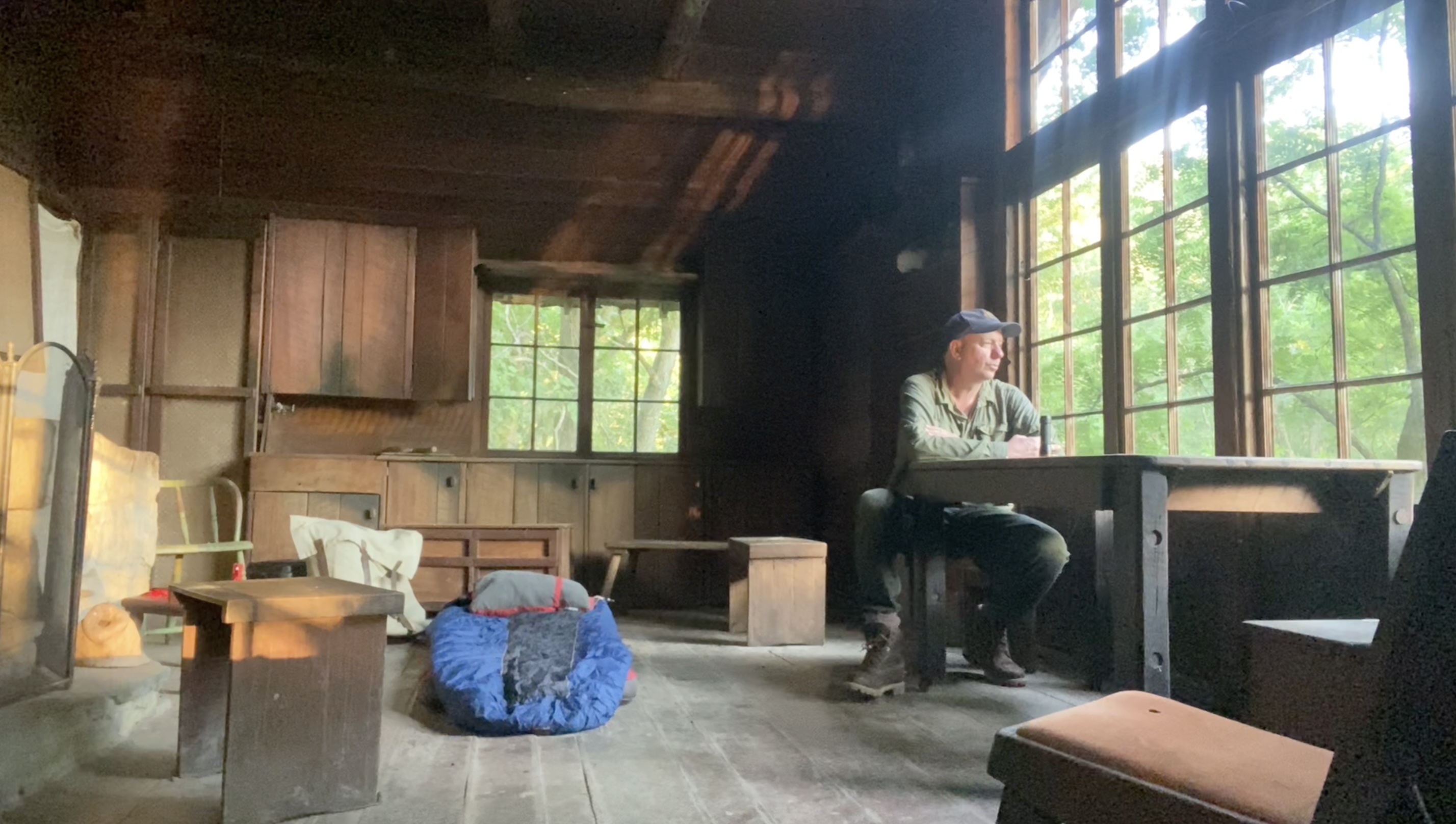
Neal Moore getting ready to bed down for the night inside Payne Hollow on the evening of July 22, 2025.
From my perch of a porch outside the side door of Payne Hollow, the steady flow of the Ohio could be viewed through the trees. As I sat and admired the wildness all about me on this recent exploration down the river, there was a moment, in concert with the sun’s final rays, when I could hear voices. When the trees rustled in a lack of a breeze and I felt the hair on the back of my neck stand up. It was the height of summer and sweltering hot but then it turned cool. I thought of the Wendell Barry-inspired pastoral ghost story opera “Payne Hollow” and the line of Harlan talking about the music that’s just out of hearing. I was sure it was a haunting. And with it the realization the Hubbards are very much still here. And then it passed, and I was at peace once again.
The sun had set proper and there was that golden strip of an afterglow. Just at near-dark there was the hum of an approaching tow pushing up the Ohio. The river acted as a muse for many of Harlan’s works, along with the home itself and surrounding landscape. I thought of Harlan in such a circumstance – with such an oncoming tow – that he might grab for his paint brushes and a found strip of wood or tin or available canvas and head down to chronicle the waterborne paddle-wheel tow of yesteryear. I rose from my seat and bounded down to the river to capture the passing modern-day vessel with my camera. With a smile and an understanding that he’d seen and chronicled countless such images.
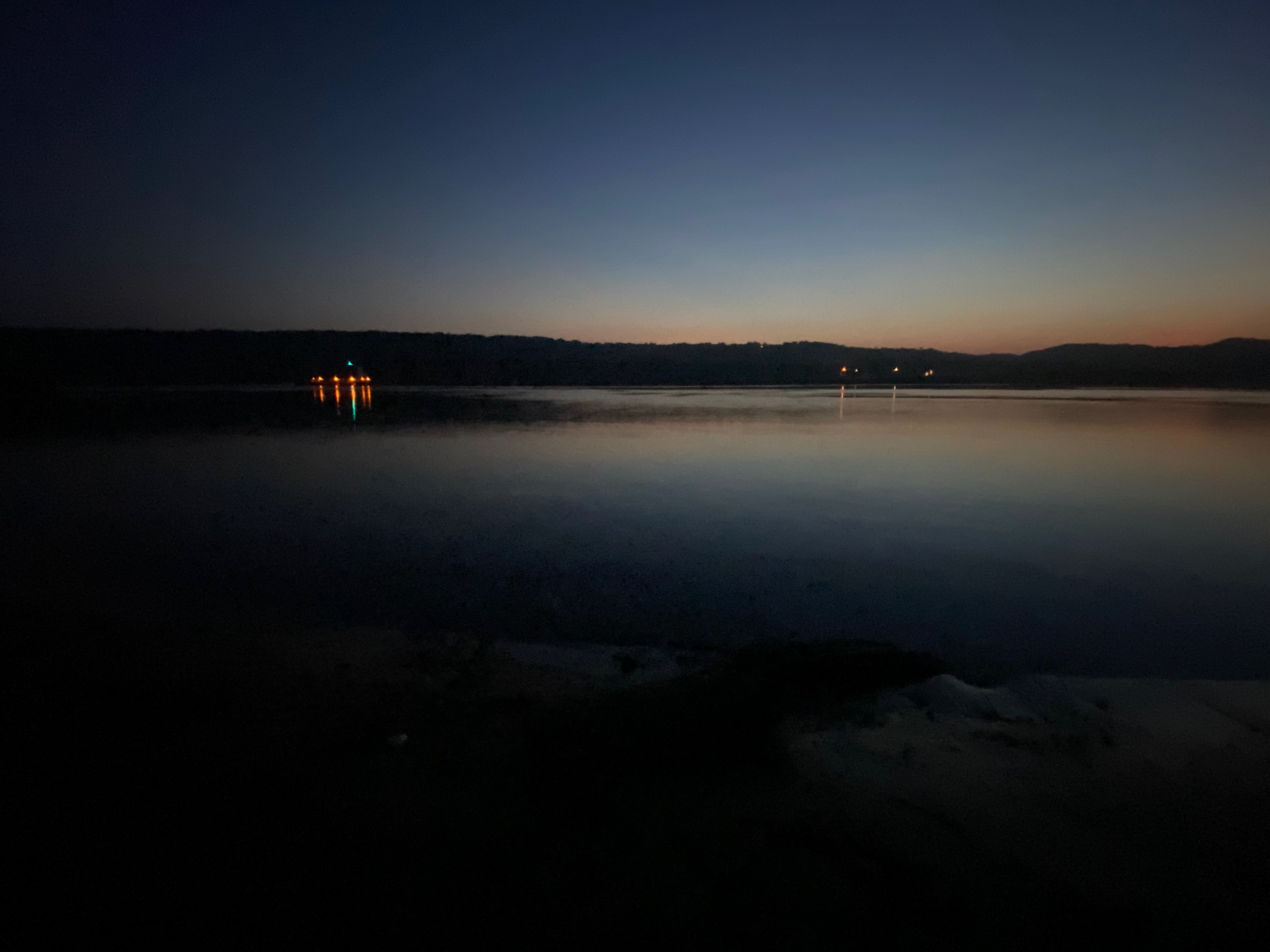
A solitary tow pushes upriver past the shoreline of Payne Hollow on July 22, 2025. Photo by Neal Moore.
Back up on the hill, I rolled out my sleeping bag onto the floorboards of Payne Hollow, took a swig from a bottle of Kentucky bourbon for good luck, and closed my eyes. Morning dawned through the windows bright and cool and clear without further incident. I woke from a peaceful sleep, rubbed my eyes, and rolled up my sleeping bag. Packing up my river bags and heading out the door, I paused before locking up to poke my head back into the home and say, “Thanks for the stay, Harlan and Anna. It was delightful.”
***
“Anna and I were attracted by the very conditions which caused it to be abandoned. We are unique among its inhabitants, not farmers, nor fishermen nor shanty boaters in the accepted sense; yet closer to the earth than any of them, with true respect of the river and the soil, and for Payne Hollow. May it long remain as it is, not merely for our selfish enjoyment, but for the satisfaction it must give many people to know there is such a place. Few wild pockets are left along the river these days.” – Harlan Hubbard from Payne Hollow: Life on the Fringe of Society
Many thanks to Payne Hollow on the Ohio for the invite, a Kentucky non-profit with a goal to sustainably preserve, protect, and promote the legacy of Harlan and Anna Hubbard.
“The Belly of North America, Sea to Shining Sea”, 30 x 38, watercolor, John Ruskey
Now we Paddle for the People, for all Creation ~ by John Ruskey

I am the river
but I am lonely
where are the people?
where is creation?

1

A young man set off in a red canoe to find out,
to paddle for the people — and all creation
in this great nation, from sea to shining sea
stroke to the east, stroke to the west

leaving the waters of the big whales
following inland watery trails
he started up the big river Woody Guthrie sang about
“Oh, it’s always we’ve rambled, this river you & I

All along your green valleys I will work until I die”
I see wind surfers and ocean-going freighters
but where are the salmon?  And those who followed the fish?
The First Nation peoples traded up and down the coast and the big rivers of the west

in their dugout canoes carved from western red cedar
and the Mississippian people carved theirs from cinnamon cypress
and did the same up and down the meandering muddy waters
of the great heart of this continent,

connecting big bony mountain ranges on either side,
and the salty sweet Gulf of Mexico in her belly
The people of the North Woods stripped giant birches of their skin
and crafted the sleekest, fastest, and finest vessels ever

European sailors entering the St. Lawrence Seaway
were amazed at how nimble the birch bark canoes scooted over the water
and now in a red canoe named Shannon, derived from that same tradition
a young man starts chopping his paddle left and right

back & forth, north & south, east & west
stroke to the one you love the best, stroking
with unrefined, but dedicated determination
and rhythm, and swirls, up and down the same rivers

and now we paddle for the people, now we paddle for creation
Neal Moore ended his 22-month solo canoe journey across America yesterday at the head of a small flotilla of friends he’d made along the way. The well wishers came from all over the country to share this moment with Moore, who led the way to the Statue of Liberty in the red Old Town canoe he’d spent nearly two years paddling and portaging from the Pacific to New York City.
Friends cam from Astoria, Oregon, where he started paddling 675 days before, from Clarksdale and Columbus, Mississippi and Louisville, Kentucky. A media boat followed the paddlers, carrying more well-wishers, as well as reporters from the New York Times, the New Yorker and Professional Mariner magazine. …
It was always going to be a schlep. While the odyssey’s contorted route – from west [the Pacific coast] to south [the Gulf of Mexico] to north [the Great Lakes] to east [Lady Liberty] – was selected to follow the seasons, to have the chance to be continuous, to make it so, there would inevitably be places where one would need to heave-ho. And the Erie Canal was invariably going to be one of those places.
I got word back in July of this year that the Erie Canal was going to shut down navigation early, on October the 13th. And so, I made the calculation – a barter with myself, and with this voyage – to paddle half of the 350-mile Erie Canal and to portage half.
A balance in all things.
So I had the pleasure to paddle between Buffalo and Syracuse, 170 miles. For the remaining 170 miles, from Syracuse to Waterford, New York – where the Mohawk meets the Hudson – I’d portage along the old Tow Path and the Bicycle Trail.
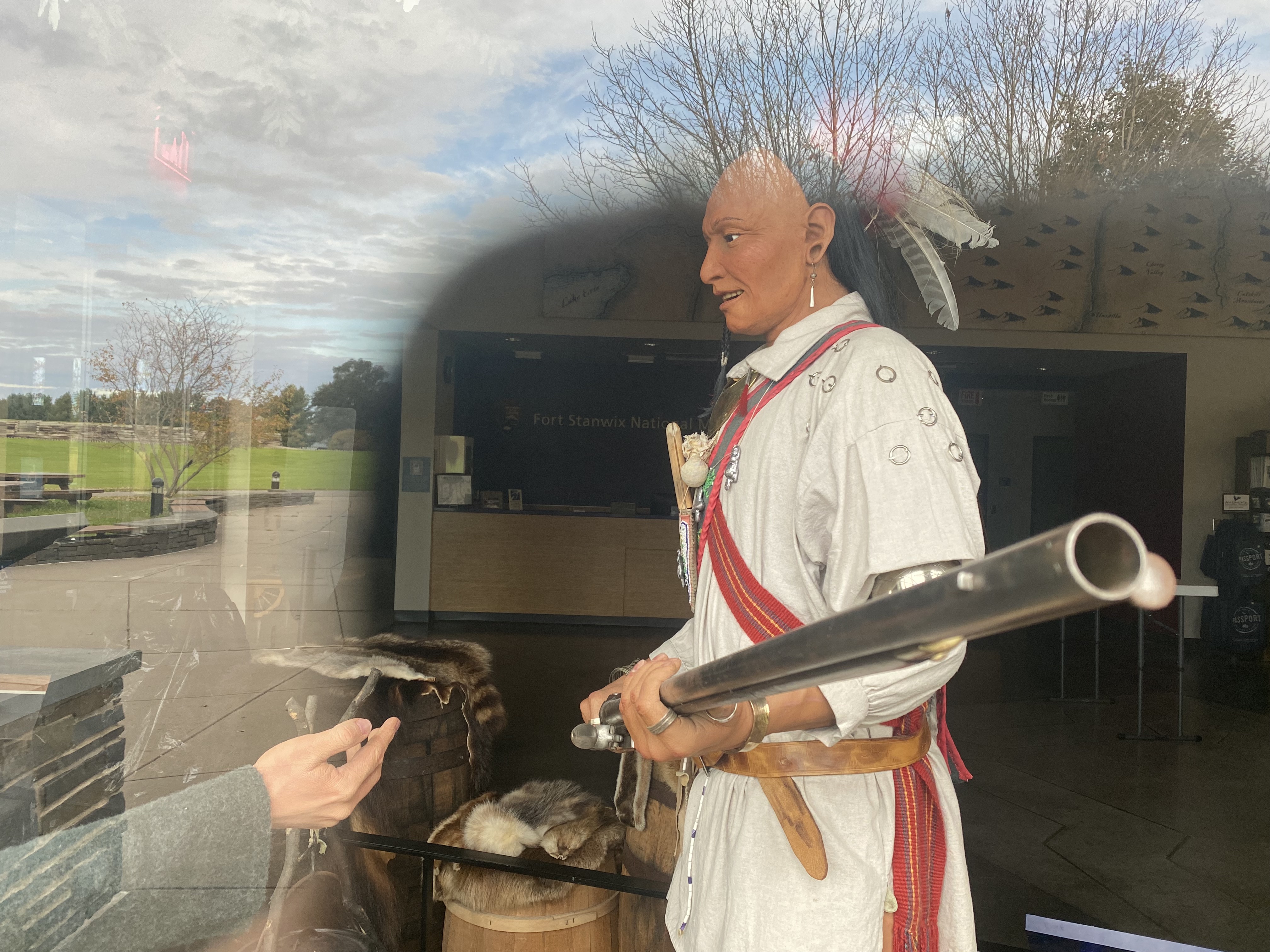
Detail of an Oneida portage and paddlers, Fort Stanwix National Monument, Rome, New York. Photo by Neal Moore.
Which I thought was appropriate, being the spot where mules and horses once hauled barges of goods back and forth before and just after the advent of the nation’s first railroad, which ran and rattled along this very corridor.
Forty-three miles into the march, when I got to Rome, New York, the spot on the map where the first shovel full of earth was dug for the canal on July 4, 1817, the place is known as “The Oneida Carrying Place”.
“The name of this portage trail between two river systems is the ‘Oneida Carrying Place.’ It served as a major east-west route linking the Atlantic to the Great Lakes when waterways were the lifeblood of trade.” Display at Fort Stanwix National Monument, Rome, New York. Photo by Neal Moore.
One can trace the history of this ancient path back in time.
For centuries Indigenous Americans, traders, soldiers, and travelers have crossed over this very path. It is here that goods and ideas were exchanged.
Beauty along the trail. First light at Little Falls, New York. Photo by Neal Moore.
As it turns out, the boats of the Oneida and the European fur traders who came after were flat bottomed, making it easier to lift, to drag and to roll underneath with logs.
In time, with my expedition wheels fastened firmly underneath my canoe and gear, I made the confluence of the Mohawk and the Hudson River. I here pitched my tent, to take in the beauty, to make peace with the final river to be, and to say fare thee well to my old friend, the Mohawk. And with her, my tenure along the Erie Canal.
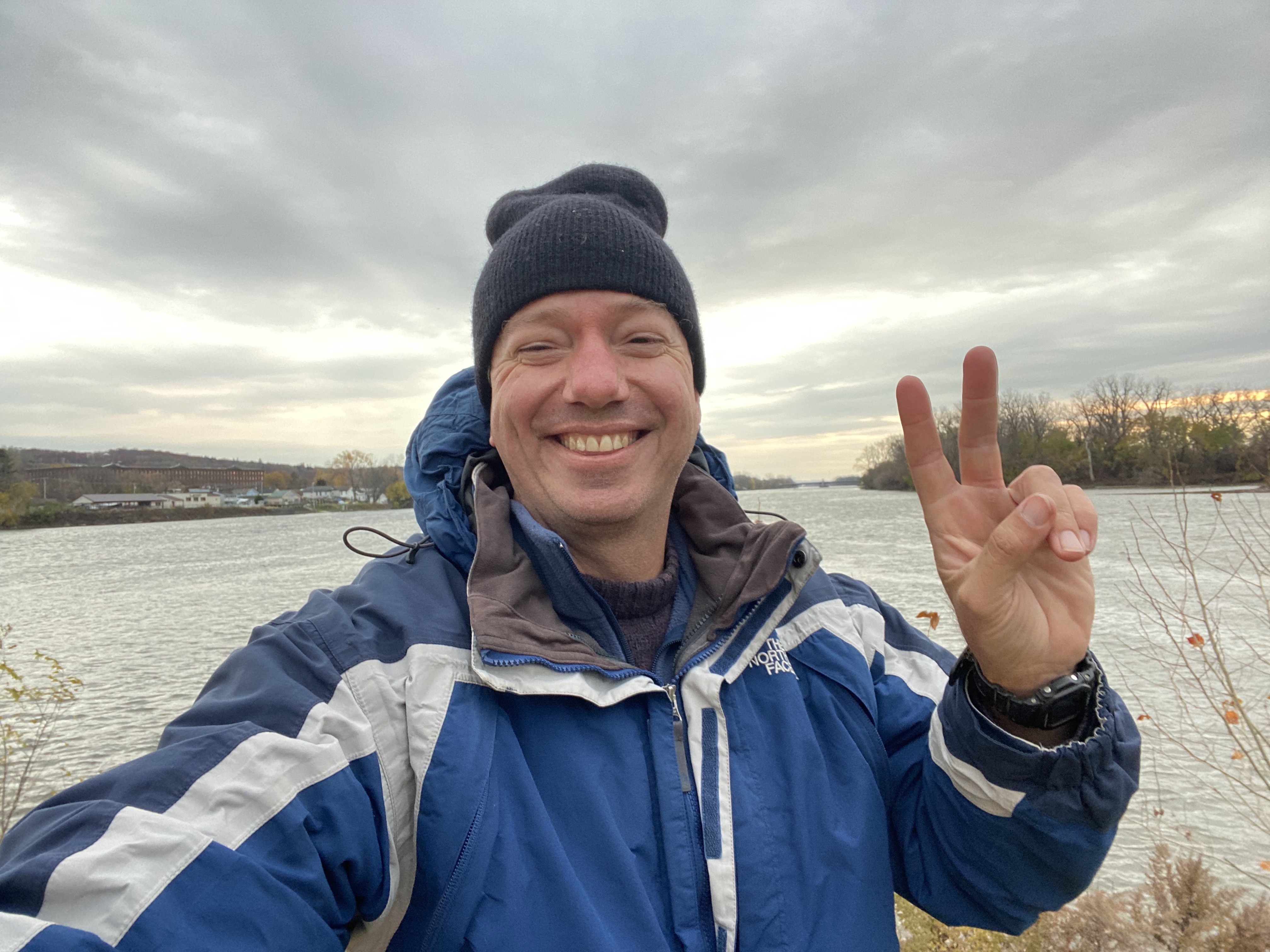
Arrival to the end of the Erie Canal at the confluence of the Mohawk and Hudson rivers. Selfie by Neal Moore.
View from along the Ohio River, headed toward Pittsburgh, entering the Willow Island Locks & Dam. Courtesy Neal Moore
This week’s episode of Inside Appalachia is all about how we interact with water and our rivers. We’ll hear from people who make their living on the water — like Marvin L. Wooten, a longtime river boat captain. He started working in the riverboat industry in 1979. “I got two job offers the same day, and I took this job,” Wooten said. “My dad always said the river will always be there. So that’s what I’ve chosen to make my living at.”
And we’ll meet Neal Moore, who’s been canoeing for 17 months, on a journey that will cover 7,500 miles coast to coast. Moore hopes to wrap up his 22-month-long trip this December at the Statue of Liberty in New York. Recently, he made his way into Appalachia. “For many days, I’m in the canoe from from first light until last light,” Moore told Inside Appalachia producer Roxy Todd on a recent stop along the Kanawha River in Charleston, West Virginia.
“I sort of have to find my landlubber legs when I step onto a dock like this at times. But for the most part, I actually feel pretty strong,” Moore said.
One year on the water and I find myself in New Orleans, the end of the second leg of my “22 Rivers Expedition” across these United States. It’s been a wild year for one and all, and for me, there’s been no exception. Weeks into my cross country paddle the Covid-19 pandemic hit. After discussing with trusted friends and colleagues, I determined that with the canoe as my only home, sheltering in place meant continuing the journey. New Orleans represents 4,400 river and portage miles behind me, leaving another 3,100 to go next year to make NYC. Cheers for everybody’s encouragement, friendship, and support. It absolutely means the world.
A man canoeing the nation’s rivers from the Pacific to the Atlantic wants to share a story about how interconnected both they and the Americans living and working on them are.
Caption for photo: Neal Moore is traveling 22 rivers over the course of two years on his trip from the West Coast to the East Coast. Along the way he is gathering stories about what unites people together despite deep divisions, including those of American politics. Last week, as the nation went to the polls for the presidential election, he was halfway through his 7,500-mile journey. (Photo by Patrick Tenny)
Neal Moore, 48, expects to be midway through his 7,500-mile journey this week when he reaches Memphis, Tenn. He saved money from a year and a half of teaching English in Taiwan to afford his two-year journey, which he purposely planned for the year before and the year after the election for the American president.
Moore was raised in Los Angeles, Calif., but he has lived much of his adult life overseas. He spent time as a missionary in South Africa, as an aid worker and, among other adventures, trekked across northern Ethiopia with a donkey named Gopher. Eleven years ago, he canoed down the Mississippi River, and it left an impression on him. Now he is expanding upon that voyage by solo canoeing 22 rivers in what he said is believed to be the longest continuous solo canoe trip ever undertaken from coast to coast across the United States.
“The idea is to come back to my home country and see it up close and personal and coast to coast, to see old friends and meet new friends along the way,” Moore said.
Moore left the West Coast, paddling up the Columbia River and past Portland, Ore., on February 9. He is in a red, 16-foot Old Town Penobscot canoe. He hopes to canoe around Ellis Island in New York Harbor to complete his journey by the end of 2021.
Moore picked the year before and after the election as a time to travel in part because of the deep political divisions in the country. At a time others are focusing on differences, he said he hopes to shed light on what brings people together, instead.
“It’s the ties that bind us together,” Moore said. “It’s looking at what we have in common.”
Part of the journey travels the same rivers explorers Meriwether Lewis and William Clark traveled on their Corps of Discovery expedition, although Moore notes he is doing so in reverse, in part to avoid the onerous task of paddling up the Missouri River.
“The big idea as I’m on, along and in these rivers is to be able to try to document stories and talk to people from all walks of life, different ethnicities, different immigrant tales, the idea being when you string all these rivers, when you string all of these stories together, you’ll have the story of America.”
Moore is recording the stories of many of the people he meets on the trip and compiling them into a book. People may follow his journey and donate at 22rivers.com as well as purchase books on past adventures, which help fund future ones. He is also documenting his trip on Instagram at @riverjournalist.
Moore’s route so far took him from the Columbia River to the Snake River. He then portaged 200 miles due north to Lake Pend Oreille in northern Idaho, where he caught the mouth of the Clark Fork River and went up past Missoula to the town of Garrison in western Montana. From there he portaged 60 miles over the Continental Divide to Helena and the Missouri River. He came down the Missouri to the Mississippi, pausing to paddle upriver 116 miles to Hannibal, Mo., hometown of Mark Twain. He paddled to the confluence of the Ohio River, then took another detour, paddling 50 miles upstream to Paducah, KY.
“I was just really keen to get a taste of the Ohio River and also to see the mouth of the Tennessee since I’ll be on the Ohio and the Tennessee next year,” Moore said.
Moore then paddled back down the Ohio to the Mississippi and is traveling downstream. When he reaches the Gulf of Mexico, he will then skirt it 150 miles to Mobile, Ala., before taking the Mobile and Tombigbee rivers, the Tennessee-Tombigbee Waterway and the Tennessee River, eventually catching the New River near Knoxville, Tenn., and then the Cumberland River. From there, he said, he will take the Dix River and then the Kentucky River through Frankfort before dumping out into the Ohio River just downriver from Cincinnati, Ohio.
Moore will then paddle up the Ohio River to Pittsburgh, Pa. He plans to take a side tour on the Kanawha River to see West Virginia because he has never been there.
“What I’m really excited about are parts of the country I haven’t been to before,” Moore said.
He will return to Pittsburgh and then catch the Allegheny to upstate New York, and at Chautauqua Lake will portage on a road named Old Portage Road about 10 miles. He plans to skirt the edge of Lake Erie to just above Buffalo. From there the Erie Canal will turn into the Mohawk, which dumps into the Hudson River around Albany, N.Y.
“Then I’ll ride the Hudson right on down to New York City,” he said. “The end game will be the Statue of Liberty. You can’t land there, but you can paddle around there.”
Moore said unlike 11 years ago, he is equipped with a marine radio, which should help with communicating with towing vessels and other boats. He promises to do all he can to stay out of the way of passing tows and doesn’t normally canoe at night, spending most nights in his tent, usually on a nearby island or sand bar.
Although he is on a very different trip than that taken by others up and down the country’s rivers, Moore said once again there is something that connects him to many of the others who choose to spend their time on them.
“Coming from Los Angeles and then based in a place like Taipei, it just really feels liberating,” he said. “It feels great to be out in the wild, whether it’s the extreme highlands or lowlands of Ethiopia or whether it’s in and along these major rivers, which by and large are extremely rural. It’s an exciting feeling to be out there surrounded by nature.”
Greetings from Memphis where I find myself mid-way across America from the West Coast to Lady Liberty in NYC. Cheers to one and all for your encouragement, friendship, and support. It means the world.







 22 Rivers