
CAIRO, ILLINOIS
The positive voices of Cairo, Illinois are drowning out the exteriors of a now legendary, crumbling Main Street. When one takes the time to step behind this facade, there are a group of local leaders who are putting their best foot forward, hopeful of a future that has no other option but to be bright.
 My muse for this story was singer/songwriter Stace England, who dedicated an entire album to the living legacy of Cairo, titled Greetings from Cairo, Illinois. After shooting a rather haunting rendition of “The North Starts in Cairo, Illinois”, Mr. England explained, “When [blacks] were traveling by bus from the South they were separated by a curtain from the white riders … They could take that curtain down in Cairo, because the North started here. So you can imagine people who had lived with segregation their entire lives getting into the land of opportunity [which would have been] a very dramatic thing.”
Yet the land of opportunity, or as Mr. Twain put it, “the promised land,” was not exactly full of promise for all citizens.
My first day in town, Preston Ewing, the City Treasurer and unofficial town historian, explained that before I could attempt to capture a glimpse of Cairo’s future, I’d “most certainly need to understand the past.” Mr. Ewing understands the past of this city as few others do, having served as the president of the local NAACP in the late 1960’s, a time in which Cairo gained national attention as a flashpoint of activity during the height of the Civil Rights Movement.
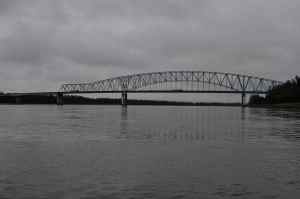 Cairo, Illinois is geographically important due to its location as the very first city of the North, located at the confluence of the Mississippi and Ohio Rivers along the Mason- Dixie Line, a place locals refer to as “the epicenter of the country.” As such, Cairo was referred to as “the promised land” by runaway slaves, headed north. “If you made it to Cairo and crossed the Ohio River, then you could consider yourself to be on somewhat free territory,” explained Bishop Paul Jones, who serves as Alexander County’s Circuit Clerk at the local Courthouse.
Bishop Jones is the first African American to hold the title of Alexander County Circuit Clerk, while Mayor Judson Childs is the first African American to hold the title of Mayor in the City of Cairo. An achievement for the African American community, on a local level, considering the town has been around for the past 150 years.
In the past, there have been two, rather well publicized communities in the town of Cairo – white and black. And yet, as Reverend Ronnie Woods, affectionately known by the town as “Coach”, (a title in reference to his twenty plus years as Cairo High School football coach) is quick to point out, these once separate communities are now coming together.
 Take a look around, as Mayor Childs would say, “with your eyes and your ears” and one will find that folks here have moved past their racial differences. In only a few short days in town, I was able to witness this firsthand, from the positive energy of the teachers of the Jr. and Sr. High School, to a “20/20 Vision” program embraced by local entrepreneurs and city officials alike, to a number of patrons at the town’s local hangout, the Nu Diner, who confided that Cairo is, symbolically hand in hand, simply moving forward.
Music & Lyrics used with permission by Stace England. Copyright Pearlie Mae Music 2005. All Rights Reserved.
 The “site” is one of the largest Habitat for Humanity projects in Habitat St. Louis’ history, encompassing twenty-four new homes for this year, adding up to ninety-one total for the Jeff-Vander-Lou neighborhood alone.
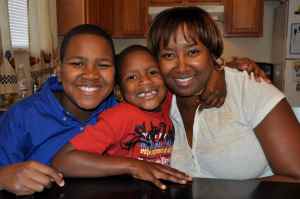 Alexander, age 12, and Ledra, age 7, the two young sons of home-builder Alfton Denise Jackson, are excited about the family’s new prospects. Their reasons are first for safety, and second because they will now each have their own bedrooms. “We used to live next to a man who would beat on his wife,” explained Alexander. “But now we’re moving to a safer place.”
 Asked if he was at times scared of his present location in life, Alexander reported, “Yes. There was a shooting,” going on to explain there are gunshots nearby that ring out at night.
 Looking around the Jeff-Vander-Lou neighborhood, it is exciting to see a community quite literally on the rise, rolling up their shirtsleeves in an effort to reclaim a past pride, a past history that folks around here point to with symbolic reverence. There are the odd dilapidated structures of days gone by, before the factory jobs moved out of town. There are a large number of vacant lots, and amidst the vacancies there is a whole new community that is quickly taking shape, rising up from the dust.
 And yet while folks are hopeful, the fact is that the recent history of Jeff-Vander-Lou is not exactly rosy, as seen most readily in the multiple stop signs strapped with stuffed teddy bears, of stuffed dolls of various shapes and sizes, pinpointing the intersections where children from the neighborhood have at some point in time lost their lives.
 2006 Habitat homebuyer Wendy McPherson, who is now volunteering as a “mentor” to Alfton Denise Jackson, amongst others, explained the phenomenon of what is happening here best by bringing the word ‘community’ down to its brass tax. Explains Wendy, “It says a lot about ‘community’ because it teaches your neighbors to come together as one and not just be next door – but to get involved … It helps others to become more aware of their surroundings and to draw together as a community and work together. It makes a difference when you know your neighbors and you look out for your neighbors and everyone comes together.”

 Pam Ritchie, Executive Director of the Opportunity Center and the former chair of Prairie du Chien’s Main Street Revitalization Project refers to her work as “community cultivation.” As she explains, “There are a lot of stories [from] many, many years ago about what Prairie du Chien looked like on a Friday night and it was lined with farmers in overalls and families on the streets – talking, gathering together, doing their shopping for the week – spending their money locally and supporting these businesses which in turn supported them.”
 sustainable food practices to the bright young learners at Prairie du Chien’s B.A. Kennedy Elementary School.
 and with that they were able to hire an executive director and create a membership of both downtown businesses and community members.”
 sustainable community [is] a community that … feeds itself, if you will, that keeps its energy churning and building here rather than going elsewhere.”
 Flash River Safari was featured on CNN International’s weekly citizen journalism show “iReport for CNN” this past weekend. To view the segment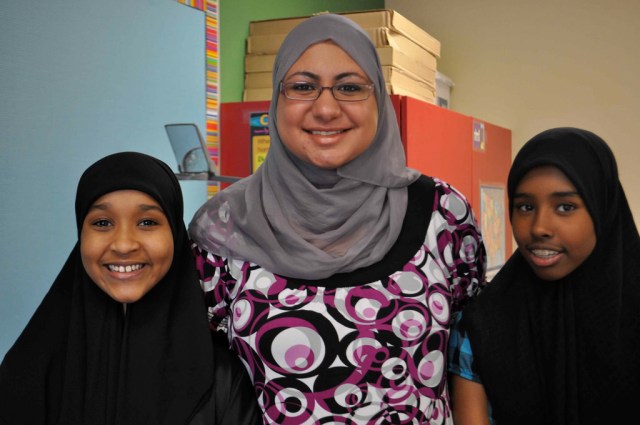
 “They heard rumors of a famine creeping across southern Somalia, [and] they wanted to visit the region themselves and see if there was any truth to the stories,” explained Kathy Eldon, Dan’s mother. “[He] was in Kenya for the summer, before returning to UCLA that autumn to continue his studies, [and] was utterly stunned by what he saw – hundreds of dead and dying women, children, and old people; thousands displaced in a desperate search for food. Although barely able to view the horrors unfolding before him, he shot them with his camera and they were among the first to be seen by a global audience. Moved by the response to his images, Dan returned again and again to Somalia, recording the aid that flowed into the country- and its decline into chaos. He never returned to UCLA.”
 “I learned that when you’re a journalist, you get to save people’s lives,” explained Ruqiya. “Not physically, but emotionally – because there’s people
 President Abdirahman Mohamed Mohamud‘s question to the girls and their class was if they had plans to come back to Somalia. The girls told me that they smiled broadly when asked this question, answering together, in unison: “Yes, we do want to go back to Somalia … We want to make a difference.”
 Jesse represents three generations of river-men who presently man their set of two tow boats and multiple barges – a local family run business who represent over 100 years of experience working the river between them.
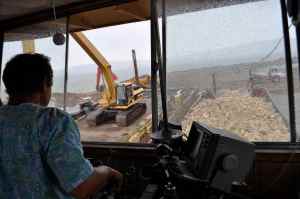 The islands are comprised of a layer of sand which is dredged from up stream in the river, a layer of rock, followed by the planting of native grasses and rows of willow trees to help buffer the island while attracting a number of waterfowl, turtles and fish.
 (11/28/07)
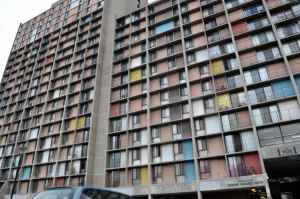 Starting from the Brian Coyle Center of the University of Minnesota where Somali children of all ages worked on computers, talked music, and played basketball, we moved through the inner-city landmark of Cedar-Riverside Plazas, a low-income housing set of buildings – all colorful beyond belief – which have been reclaimed from a once drug/gang infested stronghold. “You used to not be able to enter that area,” explained Ms. Hakeem, who ran for City of Minneapolis Mayor back in 2005 under the Green Party banner. “But now you can walk around freely, even at 10pm at night. When the Somali refugees began to arrive, they naturally moved into the least expensive section of town – Cedar-Riverside.”
  Part of learning about pride in your community comes from actively pitching in to help it out. As we moved along the streets and under the bridges, Ayan and Mary introduced me to their latest community project – a mural of Minneapolis they are working on in conjunction with “Articulture”. Here, Executive Director Elizabeth Greenbaum explained that when it comes to at-risk kids mixed with art, “art is a wonderful equalizer, especially for students who don’t succeed in other subject matters. When you think about it and take it a step further, we’re talking about the basic understanding and the basic concepts to write – and that leads into reading and that leads into learning – so [the] arts are very much orientated to learning on all levels.”
